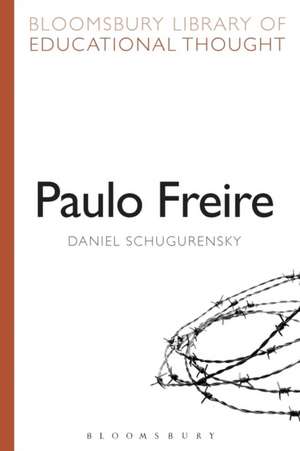
Paulo Freire: Bloomsbury Library of Educational Thought
Autor Daniel Schugurensky Professor Richard Baileyen Limba Engleză Paperback – 23 oct 2014
Daniel Schugurensky's text offers a coherent and accessible account of Freire's educational thought, looking at its contribution to educational theory and practice and exploring the legacy of Freire for contemporary education and the relevance of his thought for today's students.
Din seria Bloomsbury Library of Educational Thought
- 16%
 Preț: 270.57 lei
 - 16%
 Preț: 272.05 lei
 - 17%
 Preț: 257.73 lei
 - 16%
 Preț: 276.68 lei
 - 16%
 Preț: 270.09 lei
 - 16%
 Preț: 271.57 lei
 - 15%
 Preț: 274.13 lei
 - 23%
 Preț: 272.31 lei
 - 16%
 Preț: 278.18 lei
 - 16%
 Preț: 276.68 lei
 - 16%
 Preț: 278.68 lei
 - 16%
 Preț: 270.57 lei
 - 23%
 Preț: 270.57 lei
 - 23%
 Preț: 270.57 lei
 - 24%
 Preț: 259.81 lei
 -
 Preț: 324.25 lei
 - 25%
 Preț: 258.55 lei
 - 24%
 Preț: 258.99 lei
 - 24%
 Preț: 258.81 lei
Preț: 272.05 lei
Preț vechi: 353.69 lei
-23%
Puncte Express: 408
Carte tipărită la comandă
Livrare economică 18 noiembrie-02 decembrie
Livrare prin curier în România Termenul estimat este afișat lângă disponibilitate.
Transport gratuit de la 400.00 lei Plată online sau ramburs, în funcție de opțiunile comenzii.
Retur gratuit în 14 zile Comandă securizată și suport în română.
Specificații
ISBN-13: 9781472518859
ISBN-10: 1472518853
Pagini: 272
Dimensiuni: 154 x 232 x 16 mm
Greutate: 0.41 kg
Editura: Bloomsbury Publishing
Colecția Bloomsbury Academic
Seria Bloomsbury Library of Educational Thought
Locul publicării:London, United Kingdom
ISBN-10: 1472518853
Pagini: 272
Dimensiuni: 154 x 232 x 16 mm
Greutate: 0.41 kg
Editura: Bloomsbury Publishing
Colecția Bloomsbury Academic
Seria Bloomsbury Library of Educational Thought
Locul publicării:London, United Kingdom
V-ar putea interesa
-
 Preț: 263.75 lei
 -
 Preț: 304.34 lei
 -
 On EducationBertrand RussellPreț: 170.56 lei
 -
 Preț: 447.70 lei
 -
 St AugustineRyan N. S. Topping-17%Preț: 257.73 lei311.73 lei
 -
 Education Policy Research: Design and Practice at a Time of Rapid ReformProfessor Helen M. Gunter-16%Preț: 278.18 lei329.64 lei
 -
 Jerome BrunerDavid R. Olson-16%Preț: 270.57 lei320.96 lei
 -
 St Thomas AquinasVivian Boland OP-16%Preț: 278.68 lei329.91 lei
 -
 Robert OwenProfessor Robert A. Davis-24%Preț: 258.99 lei342.80 lei
 -
 The salmon of knowledgeNick OwenPreț: 153.50 lei
 -
 Making Schools DifferentKitty Te RielePreț: 446.20 lei
Cuprins
Series Editor's Preface
Acknowledgements
Introduction
1. Intellectual Biography
2. Critical Exposition of Freire's Work
3. The Reception and Influence Freire's Work
4. The Relevance of Freire Today
Bibliography
Index
Acknowledgements
Introduction
1. Intellectual Biography
2. Critical Exposition of Freire's Work
3. The Reception and Influence Freire's Work
4. The Relevance of Freire Today
Bibliography
Index
Recenzii
An outstanding textbook and resource on the scope of Freire's life, work and reach.
These two books continue, in a healthy and thought provoking manner, Freire's legacy of critical scholarship. They address questions of ongoing significance for educationists in the 21st century. They demonstrate the close link between theory and practice in Freirean pedagogy. They offer hope for the future while remaining sensitive to the political realities of the present. Close attention to these two volumes will prove rewarding for anyone who has a serious interest in Freire's work.
This review of Freire's work and its international reception is one of the most accurate one can hope to come across. It is extremely impressive with regard to its breath of coverage and is very detailed. This should be a vademaecum for anyone concentrating on Freire's large oeuvre. It derives from an expert hand, the hand of a person who is well steeped in Latin American and critical pedagogical politics and who has studied Freire's works and that of other writers thoroughly. Bravo, Daniel! It will be a major source of reference.
This book, in line with the author's curious and attentive attitude, provides an excellent panorama of the life and work of Paulo Freire. Daniel Schugurensky accomplishes the difficult task of balancing a general view of Freire with precious details about his biography, intellectual journey and reception around the world. It is a kind of an updated state of the art on the subject, and, in this sense, it will stand out among the books on Freire as a primary reference.
Daniel Schugurensky has written the most comprehensive book on Freire's work in the English-speaking world. With a penchant for detail, analysis and comparison, Schugurensky's book will be an extraordinary resource in courses of social foundations of education, curriculum and instruction and the politics of education. Unlike other books on the subject, here the voice and experience of Freire comes loud and clear. Yet Schugurensky produces a framework for analysis that will be helpful to the novice reader, while challenging the expert on the topics. This is a must-to-read book in the subject.
Schugurensky's volume is part of the Bloomsbury Library of Educational Thought series that demonstrate an understanding of the thoughts and practices of the chosen subjects. Schugurensky succeeds admirably in this task, with an excellent intellectual biography and a comprehensive, systematic, balanced account of Freire's educational philosophy. Among the many books and articles that have been published on Freire, it is not difficult to find examples of fragmented, decontextualised readings of his work. Schugurensky's Paulo Freire offers a good antidote to such examples: his reading is holistic, and he places Freire's ideas in their appropriate intellectual, cultural and political contexts. Schugurensky summarises some of the key critiques of Freire's work and offers thoughtful responses to them. His book also includes a lengthy chapter on the relevance of Freire's thought for the contemporary world.
These two books continue, in a healthy and thought provoking manner, Freire's legacy of critical scholarship. They address questions of ongoing significance for educationists in the 21st century. They demonstrate the close link between theory and practice in Freirean pedagogy. They offer hope for the future while remaining sensitive to the political realities of the present. Close attention to these two volumes will prove rewarding for anyone who has a serious interest in Freire's work.
This review of Freire's work and its international reception is one of the most accurate one can hope to come across. It is extremely impressive with regard to its breath of coverage and is very detailed. This should be a vademaecum for anyone concentrating on Freire's large oeuvre. It derives from an expert hand, the hand of a person who is well steeped in Latin American and critical pedagogical politics and who has studied Freire's works and that of other writers thoroughly. Bravo, Daniel! It will be a major source of reference.
This book, in line with the author's curious and attentive attitude, provides an excellent panorama of the life and work of Paulo Freire. Daniel Schugurensky accomplishes the difficult task of balancing a general view of Freire with precious details about his biography, intellectual journey and reception around the world. It is a kind of an updated state of the art on the subject, and, in this sense, it will stand out among the books on Freire as a primary reference.
Daniel Schugurensky has written the most comprehensive book on Freire's work in the English-speaking world. With a penchant for detail, analysis and comparison, Schugurensky's book will be an extraordinary resource in courses of social foundations of education, curriculum and instruction and the politics of education. Unlike other books on the subject, here the voice and experience of Freire comes loud and clear. Yet Schugurensky produces a framework for analysis that will be helpful to the novice reader, while challenging the expert on the topics. This is a must-to-read book in the subject.
Schugurensky's volume is part of the Bloomsbury Library of Educational Thought series that demonstrate an understanding of the thoughts and practices of the chosen subjects. Schugurensky succeeds admirably in this task, with an excellent intellectual biography and a comprehensive, systematic, balanced account of Freire's educational philosophy. Among the many books and articles that have been published on Freire, it is not difficult to find examples of fragmented, decontextualised readings of his work. Schugurensky's Paulo Freire offers a good antidote to such examples: his reading is holistic, and he places Freire's ideas in their appropriate intellectual, cultural and political contexts. Schugurensky summarises some of the key critiques of Freire's work and offers thoughtful responses to them. His book also includes a lengthy chapter on the relevance of Freire's thought for the contemporary world.