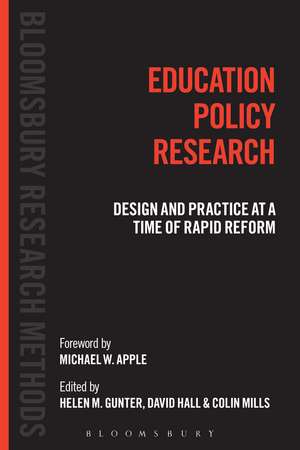
Education Policy Research: Design and Practice at a Time of Rapid Reform
Editat de Professor Helen M. Gunter, David Hall, Colin Millsen Limba Engleză Paperback – 23 oct 2014
Education Policy Research presents new research findings on the realities of how educational practice can be understood and explained, so enabling researchers to take a reflexive stance towards their own work. The editors and contributors take seriously the need to rethink their data and consider the contribution of research dispositions and practices to ongoing change and development. At the same time, the chapters give recognition to what research and researchers can and cannot do, contributing to the ongoing debates about the value of - and the urgent ongoing need for - social science research.
Preț: 264.17 lei
Preț vechi: 318.48 lei
-17%
Puncte Express: 396
Carte tipărită la comandă
Livrare economică 08-22 iunie
Specificații
ISBN-13: 9781472509093
ISBN-10: 1472509099
Pagini: 216
Dimensiuni: 156 x 234 x 18 mm
Greutate: 0.26 kg
Ediția:New.
Editura: Bloomsbury Publishing
Colecția Bloomsbury Academic
Locul publicării:London, United Kingdom
ISBN-10: 1472509099
Pagini: 216
Dimensiuni: 156 x 234 x 18 mm
Greutate: 0.26 kg
Ediția:New.
Editura: Bloomsbury Publishing
Colecția Bloomsbury Academic
Locul publicării:London, United Kingdom
V-ar putea interesa
-
 The Demands of Liberal EducationMeira Levinson-31%Preț: 350.35 lei505.83 lei
 -
 How to Be a Brilliant TeacherTrevor WrightPreț: 281.60 lei
 -
 Preț: 328.49 lei
 -
 Preț: 380.20 lei
 -
 FredDavid HallPreț: 119.17 lei
 -
 Manchester's FinestDavid Hall-20%Preț: 72.43 lei90.02 lei
 -
 Fred Dibnahs Age Of SteamDavid HallPreț: 110.33 lei
 -
 The Passionate Mind of Maxine Greene: 'I am ... not yet'William F. Pinar-15%Preț: 441.71 lei519.67 lei
 -
 Global Trends in Educational PolicyDavid P. Baker-9%Preț: 738.63 lei811.68 lei
 -
 Does Religious Education Work?: A Multi-dimensional InvestigationProfessor James C. Conroy-34%Preț: 921.77 lei1388.31 lei
 -
 St AugustineRyan N. S. Topping-17%Preț: 257.73 lei311.73 lei
 -
 John DeweyProfessor Richard Pring-17%Preț: 265.01 lei318.95 lei
 -
 Michel FoucaultDr Lynn Fendler-17%Preț: 258.11 lei311.95 lei
 -
 Paulo FreireDaniel Schugurensky-24%Preț: 259.40 lei343.07 lei
 -
 Jerome BrunerDavid R. Olson-17%Preț: 257.45 lei311.02 lei
 -
 St Thomas AquinasVivian Boland OP-17%Preț: 266.24 lei319.52 lei
 -
 Robert OwenProfessor Robert A. Davis-24%Preț: 258.99 lei342.80 lei
 -
 Authority and the TeacherWilliam H. Kitchen-26%Preț: 190.37 lei257.22 lei
 -
 Teaching as the Practice of WisdomDavid Smith-18%Preț: 195.87 lei239.75 lei
Cuprins
Foreword, Michael Apple
Introduction: Working Towards Critical Social Explanation, Helen M. Gunter, David Hall and Colin Mills
Part I: Embedded Researchers
1. Embedded research: contextualising managerialisation in a local authority, James R. Duggan (Manchester Metropolitan University, UK)
2. Student Action Research: fluidity and researcher identities, Patricia M. Davies (University of Manchester, UK)
3. Navigating research partnerships as a critical secretary, Harriet Rowley (Manchester Metropolitan University, UK)
4. School - university partnerships: border crossings as 'a legal alien', Maija Salokangas (Trinity College Dublin, Ireland)
Part II: Insider and Outsider Researchers
5. Negotiating trust: researching the practice of school business managers, Paul Armstrong (University of Manchester, UK)
6. Leading Primary Schools: Adopting and Shaping Practice for a Changing Climate, Maureen Cain (University of Manchester, UK)
7. Promoting researcher well-being: emerging and changing identites, Carl Emery (University of Manchester, UK)
8. New teachers and Masters-level study: researching tensions in the policy-practice interface, Cate Goodlad (University of Manchester, UK) and John Hull (University of Manchester, UK)
Part III: Researchers as theorisers
9. School-university Research Partnerships: Knowledge Production and the Impact of Rapid Reform, Ruth McGinity (University of Manchester, UK)
10. Competing identities of the academic researcher in studies of higher education participation: Ambassador or Observer?, Steven Jones (University of Manchester, UK)
11. Virtue and ethics in education policy research: the case of "personalised learning" and "voice", Stephen Rogers (University of Manchester, UK)
Conclusion: Thinking with Theory at a Time of Rapid Reform, Helen M. Gunter, David Hall and Colin Mills
Index
Introduction: Working Towards Critical Social Explanation, Helen M. Gunter, David Hall and Colin Mills
Part I: Embedded Researchers
1. Embedded research: contextualising managerialisation in a local authority, James R. Duggan (Manchester Metropolitan University, UK)
2. Student Action Research: fluidity and researcher identities, Patricia M. Davies (University of Manchester, UK)
3. Navigating research partnerships as a critical secretary, Harriet Rowley (Manchester Metropolitan University, UK)
4. School - university partnerships: border crossings as 'a legal alien', Maija Salokangas (Trinity College Dublin, Ireland)
Part II: Insider and Outsider Researchers
5. Negotiating trust: researching the practice of school business managers, Paul Armstrong (University of Manchester, UK)
6. Leading Primary Schools: Adopting and Shaping Practice for a Changing Climate, Maureen Cain (University of Manchester, UK)
7. Promoting researcher well-being: emerging and changing identites, Carl Emery (University of Manchester, UK)
8. New teachers and Masters-level study: researching tensions in the policy-practice interface, Cate Goodlad (University of Manchester, UK) and John Hull (University of Manchester, UK)
Part III: Researchers as theorisers
9. School-university Research Partnerships: Knowledge Production and the Impact of Rapid Reform, Ruth McGinity (University of Manchester, UK)
10. Competing identities of the academic researcher in studies of higher education participation: Ambassador or Observer?, Steven Jones (University of Manchester, UK)
11. Virtue and ethics in education policy research: the case of "personalised learning" and "voice", Stephen Rogers (University of Manchester, UK)
Conclusion: Thinking with Theory at a Time of Rapid Reform, Helen M. Gunter, David Hall and Colin Mills
Index
Recenzii
This is more than a 'how to do it' text. It is both practical and theoretical, it is challenging and critical, thought-provoking and innovative whilst at the same time offering new knowledge to support the policy research arena as it grapples with new challenges . . . It should be a text that graces all university library shelves and one identified as compulsory reading for all PhD and Ed doctoral students as they plan their research design
This book is not just worthwhile, it is necessary. It asks difficult questions, transgresses boundaries and takes a stand. It is daring and careful, thoughtful and strident, focused and wide-ranging. It is more important than ever that we think about the what, how and why of educational research and this book will help us with that challenge and enable us as researchers to know who we want to be now.
In this era of fast-paced, neoliberal policy churn, ideology trumps research. This collection of reflections on educational research gives us hope that research can be reflexive, relevant and timely. It suggests new research sites, new relationships with participants, and new ways of communicating our work to new audiences.
This book provides a lens on the harsh realities of English education and education policy. Many of the contributors are emerging, early career researchers. They provide fresh insights into the ways in which activist scholarship can be practised at a time when optimistic and critical intellectual research are sorely needed.
This book is not just worthwhile, it is necessary. It asks difficult questions, transgresses boundaries and takes a stand. It is daring and careful, thoughtful and strident, focused and wide-ranging. It is more important than ever that we think about the what, how and why of educational research and this book will help us with that challenge and enable us as researchers to know who we want to be now.
In this era of fast-paced, neoliberal policy churn, ideology trumps research. This collection of reflections on educational research gives us hope that research can be reflexive, relevant and timely. It suggests new research sites, new relationships with participants, and new ways of communicating our work to new audiences.
This book provides a lens on the harsh realities of English education and education policy. Many of the contributors are emerging, early career researchers. They provide fresh insights into the ways in which activist scholarship can be practised at a time when optimistic and critical intellectual research are sorely needed.