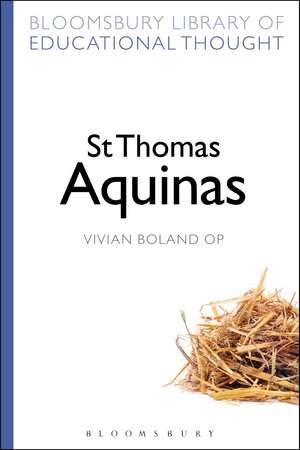
St Thomas Aquinas: Bloomsbury Library of Educational Thought
Autor Vivian Boland OP Professor Richard Baileyen Limba Engleză Paperback – 23 oct 2014
In this text, Vivian Boland offers a short biography of Aquinas focused on his personal experiences as a student and teacher. The book then provides a critical exposition of the texts in which Aquinas develops his views about education and includes a short account of the reception and influence of his thinking. Finally, it considers in some detail the most significant points of contact between Aquinas's educational thought and current concerns - his conviction about the goodness of the world, his holistic understanding of human experience and his contributions to virtue theory - and highlights the continuing relevance and influence of this work and thinking within educational philosophy today.
Din seria Bloomsbury Library of Educational Thought
- 15%
 Preț: 277.21 lei
 - 15%
 Preț: 278.74 lei
 - 17%
 Preț: 257.73 lei
 - 16%
 Preț: 276.68 lei
 - 16%
 Preț: 270.09 lei
 - 15%
 Preț: 278.24 lei
 - 15%
 Preț: 280.89 lei
 - 23%
 Preț: 272.31 lei
 - 16%
 Preț: 278.18 lei
 - 15%
 Preț: 283.51 lei
 - 15%
 Preț: 277.21 lei
 - 23%
 Preț: 272.05 lei
 - 23%
 Preț: 277.21 lei
 - 23%
 Preț: 270.57 lei
 - 24%
 Preț: 259.81 lei
 -
 Preț: 332.11 lei
 - 25%
 Preț: 258.55 lei
 - 24%
 Preț: 258.99 lei
 - 24%
 Preț: 258.81 lei
Preț: 278.68 lei
Preț vechi: 329.91 lei
-16%
Puncte Express: 418
Carte tipărită la comandă
Livrare economică 07-21 decembrie
Livrare prin curier în România Termenul estimat este afișat lângă disponibilitate.
Transport gratuit de la 400.00 lei Plată online sau ramburs, în funcție de opțiunile comenzii.
Retur gratuit în 14 zile Comandă securizată și suport în română.
Specificații
ISBN-13: 9781472518903
ISBN-10: 147251890X
Pagini: 250
Ilustrații: black & white illustrations
Dimensiuni: 156 x 234 x 14 mm
Greutate: 0.39 kg
Ediția:New.
Editura: Bloomsbury Publishing
Colecția Bloomsbury Academic
Seria Bloomsbury Library of Educational Thought
Locul publicării:London, United Kingdom
ISBN-10: 147251890X
Pagini: 250
Ilustrații: black & white illustrations
Dimensiuni: 156 x 234 x 14 mm
Greutate: 0.39 kg
Ediția:New.
Editura: Bloomsbury Publishing
Colecția Bloomsbury Academic
Seria Bloomsbury Library of Educational Thought
Locul publicării:London, United Kingdom
V-ar putea interesa
-
 A Sociology of EducatingDr Roland Meighan-9%Preț: 344.97 lei377.50 lei
 -
 Developing a QuestionnaireDr Bill Gillham-23%Preț: 196.24 lei254.72 lei
 -
 Progress and Inequality in Comprehensive EducationAnthony G. Green-18%Preț: 929.63 lei1133.69 lei
 -
 The Sociology of Comprehensive SchoolingPaul Bellaby-18%Preț: 892.20 lei1088.04 lei
 -
 Preț: 494.75 lei
 -
 -18%Preț: 924.04 lei1126.88 lei
 -
 Teacher Education for Diversity: Conversations from the Global SouthElizabeth WaltonPreț: 368.68 lei
 -
 -18%Preț: 1110.11 lei1353.79 lei
 -
 -18%Preț: 1256.91 lei1532.82 lei
 -
 The Rediscovery of TeachingGert BiestaPreț: 430.05 lei
 -
 -18%Preț: 1245.04 lei1518.35 lei
 -
 Educational Effectiveness Theory: Further developments in a multilevel contextKatharina Maag Merki-18%Preț: 1110.98 lei1354.84 lei
 -
 R. S. PetersStefaan E. Cuypers-46%Preț: 830.70 lei1526.85 lei
 -
 Mary WollstonecraftSusan Laird-15%Preț: 278.74 lei328.07 lei
 -
 St AugustineRyan N. S. Topping-17%Preț: 257.73 lei311.73 lei
 -
 Education Policy Research: Design and Practice at a Time of Rapid ReformProfessor Helen M. Gunter-15%Preț: 285.03 lei335.41 lei
 -
 Jerome BrunerDavid R. Olson-15%Preț: 277.21 lei326.55 lei
 -
 Robert OwenProfessor Robert A. Davis-24%Preț: 258.99 lei342.80 lei
 -
 Social Justice for the Oppressed: Critical Educators and Intellectuals Speak OutPierre Wilbert OrelusPreț: 143.86 lei
 -
 -25%Preț: 177.86 lei238.07 lei
 -
 Teachable Moments: Tales of Triumph and Lessons Gone AwryDennis M. Fare-26%Preț: 178.35 lei240.43 lei
 -
 Gifted or Just Plain Smart?: Teaching the 99th Percentile Made EasierAudrey M. Quinlan-25%Preț: 140.49 lei187.67 lei
 -
 -24%Preț: 182.67 lei241.15 lei
 -
 -24%Preț: 252.84 lei334.54 lei
 -
 The Philosophy of Education: An IntroductionProfessor Richard Bailey-22%Preț: 244.73 lei314.00 lei
Cuprins
Series Editor's Preface
Foreword
Introduction
Part I: An Intellectual Biography of Thomas Aquinas
1. Learning: Monte Cassino, Naples, Paris, and Cologne
2. Teaching: Paris, Naples, Orvieto, and Rome
3. Reading, Disputing, Repeating
4. Sources and Resources
5. Openness and Criticism
6. Thomas Opts for the Dominicans and for Aristotle
Part II: Critical Exposition of Aquinas's Work
II (A): Can One Human Being Teach Another?
7. Thomas on Teaching: Contexts
8. Thomas on Teaching: In II Sentences 9 and 28
9. Thomas on Teaching: Quaestiones disputatae de veritate 11
10. Thomas on Teaching: Summa theologiae I 117
II (B): Knowledge, Truth, Faith Reason
11. Knowledge
12. Truth
13. Faith and Reason, Theology and Philosophy
II (C): Pedagogy
14. Towards a 'Sound Educational Method': In Boethii de Trinitate 5-6
15. Kinds of Speculative Sciences
16. Method in the Speculative Sciences
17. From Sensation and Imagination to Understanding and Wisdom
18. The Roots of Aquinas's Pedagogical Concern: Scholastic, Aristotelian, Christian
19. From Socrates to Jesus
20. The Most Excellent of Teachers
Part III: The Reception and Influence of Aquinas's Work
21. From Controversial Theologian to Doctor of the Church
22. The Second Scholasticism
23. The Third Scholasticism
24. The Twentieth Century
25. Thomists on Education in the Twentieth Century
26. Interpreting Aquinas Today
Part IV: The Relevance of Aquinas's Work Today
IV (A): Creation
27. The Meaning of Creation
28. The Goodness of Creation
29. God's Complete Freedom
IV (B): The Human Being
30. Aquinas Opts for a 'Holistic Anthropology'
31. The Unity and Integrity of the Human Being
32. Praise of the Body
33. The Image of God
IV (C): On Virtue
34. Virtue Theory
35. Dispositions
36. Shaping Character, Strengthening Dispositions
IV (D): On Virtues
37. Intellectual and Moral Virtues
38. Cardinal Virtues: Pieper and Geach
39. Contemporary Receptions of Aquinas on Virtue: Hauerwas and MacIntyre
40. Criticisms of Virtue Theory
41. Virtues for Learning and Teaching
42. Human Flourishing: Action, Contemplation, and Teaching
Bibliography
Index of Persons and Subjects
Foreword
Introduction
Part I: An Intellectual Biography of Thomas Aquinas
1. Learning: Monte Cassino, Naples, Paris, and Cologne
2. Teaching: Paris, Naples, Orvieto, and Rome
3. Reading, Disputing, Repeating
4. Sources and Resources
5. Openness and Criticism
6. Thomas Opts for the Dominicans and for Aristotle
Part II: Critical Exposition of Aquinas's Work
II (A): Can One Human Being Teach Another?
7. Thomas on Teaching: Contexts
8. Thomas on Teaching: In II Sentences 9 and 28
9. Thomas on Teaching: Quaestiones disputatae de veritate 11
10. Thomas on Teaching: Summa theologiae I 117
II (B): Knowledge, Truth, Faith Reason
11. Knowledge
12. Truth
13. Faith and Reason, Theology and Philosophy
II (C): Pedagogy
14. Towards a 'Sound Educational Method': In Boethii de Trinitate 5-6
15. Kinds of Speculative Sciences
16. Method in the Speculative Sciences
17. From Sensation and Imagination to Understanding and Wisdom
18. The Roots of Aquinas's Pedagogical Concern: Scholastic, Aristotelian, Christian
19. From Socrates to Jesus
20. The Most Excellent of Teachers
Part III: The Reception and Influence of Aquinas's Work
21. From Controversial Theologian to Doctor of the Church
22. The Second Scholasticism
23. The Third Scholasticism
24. The Twentieth Century
25. Thomists on Education in the Twentieth Century
26. Interpreting Aquinas Today
Part IV: The Relevance of Aquinas's Work Today
IV (A): Creation
27. The Meaning of Creation
28. The Goodness of Creation
29. God's Complete Freedom
IV (B): The Human Being
30. Aquinas Opts for a 'Holistic Anthropology'
31. The Unity and Integrity of the Human Being
32. Praise of the Body
33. The Image of God
IV (C): On Virtue
34. Virtue Theory
35. Dispositions
36. Shaping Character, Strengthening Dispositions
IV (D): On Virtues
37. Intellectual and Moral Virtues
38. Cardinal Virtues: Pieper and Geach
39. Contemporary Receptions of Aquinas on Virtue: Hauerwas and MacIntyre
40. Criticisms of Virtue Theory
41. Virtues for Learning and Teaching
42. Human Flourishing: Action, Contemplation, and Teaching
Bibliography
Index of Persons and Subjects
Recenzii
A series that recognizes the importance of theorizing for educational thought and to that end seeks to gather together the thoughts and ideas of important educational thinkers.
Aquinas' theory of education is based upon a perceptive account of human person as a rational animal. In this book, Vivian Boland shows the subtlety and breadth of Aquinas' understanding of human intellectual life, looking at the connections between sensation and reason, communal pedagogy and personal virtue, the creative causality of God and the reality of free will. His work makes St. Thomas' thought accessible and illustrates well its perennial relevance.
The publication of this paperback edition of Vivian Boland's St Thomas Aquinas will be welcomed by anyone engaged in the process of teaching and learning for it underscores that this is a venerable tradition. Here Boland reassesses the life and thought of St Thomas Aquinas in an engaging and assessable style. There are four sections to the book: part 1 sets the scene of who is Thomas Aquinas; part 2 is a critically engagement with Aquinas's thought about teaching and learning; part 3 considers the reception and influence of the work; and part 4 considers the argument that Aquinas's approach to teaching and learning is rooted in theological convictions and is philosophically coherent.
It was once fashionable in philosophy courses to jump from the study of Plato and Aristotle to that of the 17th century Empiricists and Rationalists, as though nothing of importance was said in between. So it was with educational theory and ideas. But Vivian Boland's book fills the gap, showing how Aquinas' extensive philosophical writings, covering the main themes of philosophy, led to a distinctive understanding of education which is extremely relevant to today. Those themes in ethics and epistemology illuminated what it means to be human, and the central place of reason, knowledge and virtue in that humanity. Those perceptions are central, it is argued, to the aims of education and thereby to the role of the teacher. Moreover, the book, like Aquinas, does not remain in the realm of pure philosophy, but shows, too, how the educational ideas are manifested in a distinctive scholastic pedagogy from which we can learn. The book is not just about Aquinas as a philosopher, but also about Aquinas as a teacher.
Aquinas' theory of education is based upon a perceptive account of human person as a rational animal. In this book, Vivian Boland shows the subtlety and breadth of Aquinas' understanding of human intellectual life, looking at the connections between sensation and reason, communal pedagogy and personal virtue, the creative causality of God and the reality of free will. His work makes St. Thomas' thought accessible and illustrates well its perennial relevance.
The publication of this paperback edition of Vivian Boland's St Thomas Aquinas will be welcomed by anyone engaged in the process of teaching and learning for it underscores that this is a venerable tradition. Here Boland reassesses the life and thought of St Thomas Aquinas in an engaging and assessable style. There are four sections to the book: part 1 sets the scene of who is Thomas Aquinas; part 2 is a critically engagement with Aquinas's thought about teaching and learning; part 3 considers the reception and influence of the work; and part 4 considers the argument that Aquinas's approach to teaching and learning is rooted in theological convictions and is philosophically coherent.
It was once fashionable in philosophy courses to jump from the study of Plato and Aristotle to that of the 17th century Empiricists and Rationalists, as though nothing of importance was said in between. So it was with educational theory and ideas. But Vivian Boland's book fills the gap, showing how Aquinas' extensive philosophical writings, covering the main themes of philosophy, led to a distinctive understanding of education which is extremely relevant to today. Those themes in ethics and epistemology illuminated what it means to be human, and the central place of reason, knowledge and virtue in that humanity. Those perceptions are central, it is argued, to the aims of education and thereby to the role of the teacher. Moreover, the book, like Aquinas, does not remain in the realm of pure philosophy, but shows, too, how the educational ideas are manifested in a distinctive scholastic pedagogy from which we can learn. The book is not just about Aquinas as a philosopher, but also about Aquinas as a teacher.
Notă biografică
Vivian Boland OP is professor aggregatus in the Faculty of Theology at the Angelicum University in Rome. He taught at St Mary's University, Twickenham, and at Blackfriars Hall, Oxford and is author and editor of several books, including St Thomas Aquinas in the Bloomsbury Library of Educational Thought (2014).