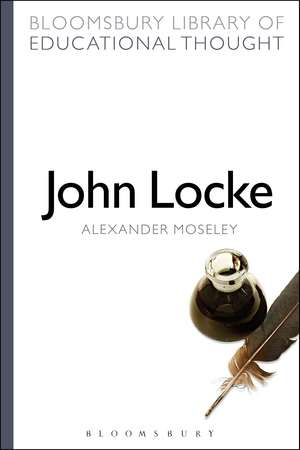
John Locke: Bloomsbury Library of Educational Thought
Autor Dr Alexander Moseley Professor Richard Baileyen Limba Engleză Paperback – 23 oct 2014
Alexander Mosely sets Locke's educational writings in their context with a sensitive reading of what Locke understood by 'education' and highlights the relevance of the study of Locke's work to our understanding of education today.
Din seria Bloomsbury Library of Educational Thought
- 16%
 Preț: 270.57 lei
 - 16%
 Preț: 272.05 lei
 - 17%
 Preț: 257.73 lei
 - 16%
 Preț: 276.68 lei
 - 16%
 Preț: 270.09 lei
 - 16%
 Preț: 271.57 lei
 - 15%
 Preț: 274.13 lei
 - 23%
 Preț: 272.31 lei
 - 16%
 Preț: 278.18 lei
 - 16%
 Preț: 276.68 lei
 - 16%
 Preț: 278.68 lei
 - 15%
 Preț: 277.21 lei
 - 23%
 Preț: 272.05 lei
 - 23%
 Preț: 270.57 lei
 - 23%
 Preț: 270.57 lei
 - 24%
 Preț: 259.81 lei
 -
 Preț: 324.25 lei
 - 25%
 Preț: 258.55 lei
 - 24%
 Preț: 258.99 lei
Preț: 258.81 lei
Preț vechi: 342.69 lei
-24%
Puncte Express: 388
Carte tipărită la comandă
Livrare economică 28 noiembrie-12 decembrie
Livrare prin curier în România Termenul estimat este afișat lângă disponibilitate.
Transport gratuit de la 400.00 lei Plată online sau ramburs, în funcție de opțiunile comenzii.
Retur gratuit în 14 zile Comandă securizată și suport în română.
Specificații
ISBN-13: 9781472519023
ISBN-10: 1472519027
Pagini: 248
Dimensiuni: 156 x 234 x 14 mm
Greutate: 0.39 kg
Editura: Bloomsbury Publishing
Colecția Bloomsbury Academic
Seria Bloomsbury Library of Educational Thought
Locul publicării:London, United Kingdom
ISBN-10: 1472519027
Pagini: 248
Dimensiuni: 156 x 234 x 14 mm
Greutate: 0.39 kg
Editura: Bloomsbury Publishing
Colecția Bloomsbury Academic
Seria Bloomsbury Library of Educational Thought
Locul publicării:London, United Kingdom
V-ar putea interesa
-
 A Dictionary of AstronomyIan Ridpath-19%Preț: 99.76 lei122.73 lei
 -
 1001 Inventions: The Enduring Legacy of Muslim CivilizationSalim T S Al-HassaniPreț: 204.36 lei
 -
 -11%Preț: 42.76 lei48.09 lei
Cuprins
Series Editor's Preface
Foreword
Part I: Intellectual Biography
1. Introduction
2. Educational Experience
3. Somerset
4. Puritanism
5. Dr Samuel Crook
6. Parents
7. Westminster - Busby
8. Oxford - Owen
9. The Scientific and Philosophical Revolution
10. Robert Boyle
11. Rene Descartes
12. Humanism
13. The Renaissance Child
14. Montaigne
15. Comenius
16. Port Royal Schools
17. Ashley Cooper and Locke's Intellectual Break
18. Locke's Later Years
Part II: Critical Assessment of Locke's Educational Theories
19. Introduction
20. Philosophical Overview
21. Innatism
22. Ideas
23. Words
24. Knowledge
25. Criticisms of the Essay Locke's Theory of Education
26. Aristotelian Roots
27. Education's Purpose
28. Faith and Religion
29. Breeding
30. Nature/Nurture Debate
31. Freedom and Will
32. Early Education
33. Middle Education
34. Scholarly Education
35. But Not for the Poor
36. Political Man and his Education
37. Continued Study
38. Summary
Part III: The Reception and Influence of Locke's Work
39. Immediate Response and Impact
40. Philosophical Legacy
41. The Two Bishops' Responses: Berkeley
42. Locke's Legacy in the Philosophy of Education
The Eighteenth Century
The Rousseau Distortion
Kant
Adam Smith
Wollstonecraft
The Nineteenth Century
The Twentieth Century
Part IV: The Relevance of John Locke Today
43. Introduction
44. On Being Relevant
45. The Political-Educational Model
46. Education's Usefulness
47. Lockean Realism
48. Critique of Schools and Families
49. State Education
50. The 'State as Parent' Critique
51. Free Market Education
52. School Curricula
Bibliography
Index
Foreword
Part I: Intellectual Biography
1. Introduction
2. Educational Experience
3. Somerset
4. Puritanism
5. Dr Samuel Crook
6. Parents
7. Westminster - Busby
8. Oxford - Owen
9. The Scientific and Philosophical Revolution
10. Robert Boyle
11. Rene Descartes
12. Humanism
13. The Renaissance Child
14. Montaigne
15. Comenius
16. Port Royal Schools
17. Ashley Cooper and Locke's Intellectual Break
18. Locke's Later Years
Part II: Critical Assessment of Locke's Educational Theories
19. Introduction
20. Philosophical Overview
21. Innatism
22. Ideas
23. Words
24. Knowledge
25. Criticisms of the Essay Locke's Theory of Education
26. Aristotelian Roots
27. Education's Purpose
28. Faith and Religion
29. Breeding
30. Nature/Nurture Debate
31. Freedom and Will
32. Early Education
33. Middle Education
34. Scholarly Education
35. But Not for the Poor
36. Political Man and his Education
37. Continued Study
38. Summary
Part III: The Reception and Influence of Locke's Work
39. Immediate Response and Impact
40. Philosophical Legacy
41. The Two Bishops' Responses: Berkeley
42. Locke's Legacy in the Philosophy of Education
The Eighteenth Century
The Rousseau Distortion
Kant
Adam Smith
Wollstonecraft
The Nineteenth Century
The Twentieth Century
Part IV: The Relevance of John Locke Today
43. Introduction
44. On Being Relevant
45. The Political-Educational Model
46. Education's Usefulness
47. Lockean Realism
48. Critique of Schools and Families
49. State Education
50. The 'State as Parent' Critique
51. Free Market Education
52. School Curricula
Bibliography
Index