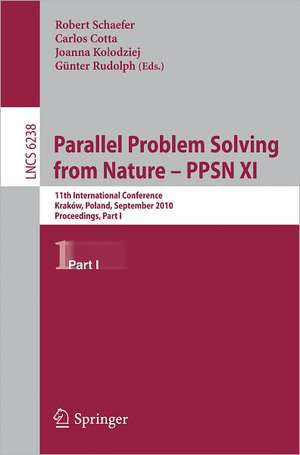
Parallel Problem Solving from Nature, PPSN XI: 11th International Conference, Krakov, Poland, September 11-15, 2010, Proceedings, Part I: Lecture Notes in Computer Science, cartea 6238
Editat de Robert Schaefer, Carlos Cotta, Joanna Kolodziej, Günter Rudolphen Limba Engleză Paperback – 3 sep 2010
Relevanța acestui volum pentru cercetătorii care urmăresc acreditări academice în informatică și inteligență artificială este dată de rigoarea științifică a seriei Lecture Notes in Computer Science. Volumul de față, Parallel Problem Solving from Nature, PPSN XI, reprezintă a doua parte a lucrărilor celei de-a 11-a conferințe internaționale PPSN, un eveniment de referință pentru comunitatea calculului natural. Suntem de părere că selecția strictă a celor 128 de lucrări dintr-un total de 232 de propuneri garantează un nivel calitativ înalt, esențial pentru literatura de specialitate.
Această ediție extinde cadrul propus de Artificial Evolution de Jin-Kao Hao cu date noi din perioada 2010, axându-se pe o diversitate mai mare de metaheuristici și sisteme bio-inspirate. În timp ce alte lucrări similare se concentrează pe algoritmi genetici clasici, Parallel Problem Solving from Nature, PPSN XI explorează frontierele interdependenței dintre modelarea dependențelor și structura problemelor, folosind generatoare de peisaje randomizate pentru a compara performanța algoritmilor.
Structura volumului este una tematică, debutând cu o secțiune densă dedicată teoriei calculului evolutiv. Primele capitole analizează riguros aspecte precum convergența log-liniară și ratele de mutație adaptive pentru probleme specifice (LeadingOnes), progresând apoi către analiza peisajelor de fitness și benchmarking. Această organizare permite cititorului o tranziție logică de la fundamentele matematice la aplicații complexe, precum optimizarea funcțiilor monotone și utilizarea matricelor de covarianță în mutațiile diferențiale. Editura Springer Berlin, Heidelberg menține standardul tehnic ridicat prin includerea de grafice și demonstrații matematice esențiale pentru înțelegerea limitelor inferioare ale timpului de execuție pentru algoritmii evolutivi.
Din seria Lecture Notes in Computer Science
- 20%
 Preț: 558.53 lei
 - 20%
 Preț: 571.88 lei
 - 20%
 Preț: 675.83 lei
 - 20%
 Preț: 1020.28 lei
 - 20%
 Preț: 620.33 lei
 - 20%
 Preț: 560.93 lei
 - 20%
 Preț: 633.70 lei
 - 20%
 Preț: 731.82 lei
 - 20%
 Preț: 1359.66 lei
 - 20%
 Preț: 560.93 lei
 - 20%
 Preț: 733.68 lei
 - 20%
 Preț: 828.44 lei
 - 15%
 Preț: 558.12 lei
 - 20%
 Preț: 793.92 lei
 - 20%
 Preț: 560.93 lei
 - 20%
 Preț: 748.63 lei
 - 20%
 Preț: 562.49 lei
 - 20%
 Preț: 1246.46 lei
 - 20%
 Preț: 449.81 lei
 - 20%
 Preț: 556.96 lei
 - 20%
 Preț: 562.49 lei
 - 20%
 Preț: 851.78 lei
 - 20%
 Preț: 313.10 lei
 - 18%
 Preț: 945.44 lei
 - 20%
 Preț: 314.86 lei
 - 20%
 Preț: 560.93 lei
 - 20%
 Preț: 606.22 lei
 - 20%
 Preț: 1033.45 lei
 - 20%
 Preț: 563.29 lei
 - 20%
 Preț: 733.68 lei
 - 20%
 Preț: 1137.10 lei
 - 20%
 Preț: 735.28 lei
 - 20%
 Preț: 1079.23 lei
 - 20%
 Preț: 584.42 lei
 - 20%
 Preț: 854.16 lei
 - 15%
 Preț: 672.87 lei
 - 20%
 Preț: 1032.47 lei
 - 20%
 Preț: 617.17 lei
 - 20%
 Preț: 1022.15 lei
 - 20%
 Preț: 984.64 lei
 - 20%
 Preț: 620.33 lei
 - 20%
 Preț: 402.28 lei
 - 20%
 Preț: 316.28 lei
 - 20%
 Preț: 663.69 lei
 - 20%
 Preț: 320.24 lei
 - 20%
 Preț: 343.12 lei
 - 20%
 Preț: 313.87 lei
Preț: 638.15 lei
Preț vechi: 750.76 lei
-15%
Carte disponibilă
Livrare economică 14-28 noiembrie
Specificații
ISBN-10: 3642158439
Pagini: 764
Ilustrații: XXI, 742 p. 211 illus.
Greutate: 1.07 kg
Ediția:2010
Editura: Springer Berlin, Heidelberg
Colecția Springer
Seriile Lecture Notes in Computer Science, Theoretical Computer Science and General Issues
Locul publicării:Berlin, Heidelberg, Germany
V-ar putea interesa
-
 Evolution That Anyone Can UnderstandBernard MarcusPreț: 366.24 lei
 -
 Preț: 146.79 lei
 -
 Algorithms and Architectures for Parallel ProcessingJoanna Kolodziej-20%Preț: 345.90 lei432.37 lei
 -
 Engineering Mineralized and Load Bearing TissuesLuiz E. Bertassoni-18%Preț: 991.51 lei1209.16 lei
 -
 Evolutionary Multi-Criterion OptimizationHeike TrautmannPreț: 417.09 lei
 -
 Bats: In a World of EchoesJohan EklöfPreț: 336.33 lei
 -
 The Parasite ChroniclesBoo H. KwaPreț: 288.67 lei
 -
 Theoretical and Applied Aspects of Systems BiologyFabricio Alves Barbosa Da Silva-15%Preț: 668.72 lei786.73 lei
 -
 Plants and People in the African PastAnna Maria Mercuri-24%Preț: 1223.04 lei1609.27 lei
 -
 Preț: 396.47 lei
 -
 -20%Preț: 1032.48 lei1290.60 lei
 -
 -20%Preț: 318.00 lei397.50 lei
 -
 -20%Preț: 333.31 lei416.64 lei
 -
 Applications of Evolutionary ComputationCecilia Di Chio-20%Preț: 669.89 lei837.36 lei
 -
 Algorithms in BioinformaticsMihai PopPreț: 394.22 lei
 -
 FarbenNorbert WelschPreț: 285.27 lei
 -
 Eingriff in die EvolutionJennifer A. DoudnaPreț: 211.79 lei
Public țintă
Professional/practitionerDe ce să citești această carte
Această resursă este indispensabilă profesioniștilor și cercetătorilor din domeniul calculului bio-inspirat. Cititorul câștigă acces la metodologii de peer-review riguroase și la soluții de ultimă oră pentru probleme de optimizare complexă. Este un instrument valoros pentru cei care doresc să înțeleagă fundamentele teoretice ale inteligenței colective și să aplice algoritmi memetici în scenarii reale, oferind un avantaj competitiv în cercetarea academică și dezvoltarea de software avansat.
Cuprins
Caracteristici
Descriere
We are very pleased to present to you this LNCS volume, the proceedings of the 11th International Conference on Parallel Problem Solving from Nature (PPSN 2010). PPSN is one of the most respected and highly regarded c- ference series in evolutionary computation, and indeed in natural computation aswell.Thisbiennialeventwas'rstheldinDortmundin1990, andtheninBr- sels (1992), Jerusalem (1994), Berlin (1996), Amsterdam (1998), Paris (2000), Granada (2002), Birmingham (2004), Reykjavik (2006) and again in Dortmund in 2008. PPSN 2010 received 232 submissions. After an extensive peer review p- cess involving more than 180 reviewers, the program committee chairs went through all the review reports and ranked the papers according to the revi- ers comments. Each paper wasevaluated by at least three reviewers.Additional reviewers from the appropriate branches of science were invoked to review into disciplinary papers. The top 128 papers were ?nally selected for inclusion in the proceedings and presentation at the conference. This represents an acceptance rate of 55%, which guarantees that PPSN will continue to be one of the c- ferences of choice for bio-inspired computing and metaheuristics researchers all over the world who value the quality over the size of a conference. The papers included in the proceedingsvolumes covera wide range of topics, fromevolutionarycomputationto swarmintelligence, frombio-inspiredcomp- ing to real-world applications. Machine learning and mathematical games s- portedbyevolutionaryalgorithmsaswellasmemetic, agent-orientedsystemsare also represented. They all are the latest and best in natural computation. The proceedings are composed of two volumes divided into nine thematic sections."