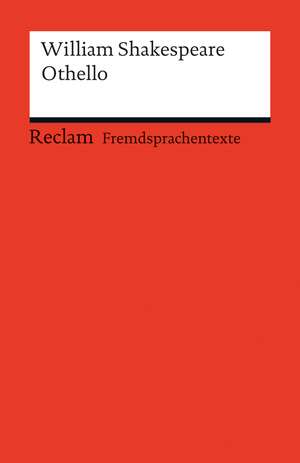
Othello: Reclam Universal-Bibliothek, cartea 19882
Autor William Shakespeare Editat de Dieter Hamblocken Limba Engleză Paperback – 4 noi 2013
Observăm că această ediție a tragediei Othello, publicată de Dover Publications Inc. în seria Dover Thrift Editions, transformă textul clasic într-un instrument de lucru esențial prin ancorarea directă a teoriei literare în contextul istoric al epocii. Aplicabilitatea practică a volumului rezidă în capacitatea sa de a explica nu doar intriga, ci și mecanismele sociale ale Angliei elisabetane care au influențat scriitura lui William Shakespeare. Structura cărții este riguros organizată: după o introducere biografică și o analiză a teatrului shakespearian, textul piesei este susținut de două anexe fundamentale (Appendix A și B) care explorează sursele literare primare, precum Cinthio, și documente rare, cum sunt scrisorile Reginei Elisabeta I privind deportările. Subliniem că acest aparat critic oferă o progresie logică de la narațiunea propriu-zisă la înțelegerea profundă a temelor de rasism și politică externă. Reținem că această versiune reprezintă o alternativă viabilă la The Oxford Shakespeare: Othello pentru cursurile de literatură universală, cu avantajul unui format compact și al unei selecții de documente de arhivă care facilitează cercetarea interdisciplinară. În contextul operei autorului, Othello se situează în perioada marilor tragedii, fiind o piesă mult mai concentrată pe psihologia domestică și pe distrugerea intimității față de natura politică a lucrării Henry IV Parts 1 & 2 sau elementele fantastice din The Tempest.
Din seria Reclam Universal-Bibliothek
-
 Preț: 33.18 lei
 -
 Preț: 66.72 lei
 -
 Preț: 52.06 lei
 -
 Preț: 48.47 lei
 -
 Preț: 49.86 lei
 -
 Preț: 68.27 lei
 -
 Preț: 52.87 lei
 -
 Preț: 33.39 lei
 -
 Preț: 40.87 lei
 -
 Preț: 42.67 lei
 -
 Preț: 56.59 lei
 -
 Preț: 56.11 lei
 -
 Preț: 58.60 lei
 -
 Preț: 48.72 lei
 -
 Preț: 60.00 lei
 -
 Preț: 51.58 lei
 -
 Preț: 41.87 lei
 -
 Preț: 52.87 lei
 -
 Preț: 47.43 lei
 -
 Preț: 51.32 lei
 -
 Preț: 51.29 lei
 -
 Preț: 40.49 lei
 -
 Preț: 50.28 lei
 -
 Preț: 43.23 lei
 -
 Preț: 28.89 lei
 -
 Preț: 56.60 lei
 -
 Preț: 54.06 lei
 -
 Preț: 57.40 lei
 -
 Preț: 45.67 lei
 -
 Preț: 57.03 lei
 -
 Preț: 62.59 lei
 -
 Preț: 51.40 lei
 -
 Preț: 48.64 lei
 -
 Preț: 66.03 lei
 -
 Preț: 66.81 lei
 -
 Preț: 53.21 lei
 -
 Preț: 63.38 lei
 -
 Preț: 66.38 lei
 -
 Preț: 172.11 lei
 -
 Preț: 55.49 lei
 -
 Preț: 57.14 lei
 -
 Preț: 60.71 lei
 -
 Preț: 43.63 lei
 -
 Preț: 51.67 lei
 -
 Preț: 51.49 lei
 -
 Preț: 52.13 lei
 -
 Preț: 55.44 lei
 -
 Preț: 54.98 lei
 -
 Preț: 56.97 lei
 -
 Preț: 52.17 lei
Preț: 47.91 lei
Carte disponibilă
Livrare economică 30 octombrie-05 noiembrie
Livrare express 17-23 octombrie pentru 14.43 lei
Specificații
ISBN-10: 3150198828
Pagini: 190
Dimensiuni: 96 x 147 x 14 mm
Greutate: 0.1 kg
Editura: Reclam Philipp Jun.
Seriile Reclam Universal-Bibliothek, Fremdsprachentexte
V-ar putea interesa
-
 MacbethWilliam ShakespearePreț: 29.48 lei
 -
 King LearWilliam ShakespearePreț: 28.01 lei
 -
 HamletCollins GcsePreț: 28.01 lei
 -
 The TempestWilliam ShakespearePreț: 29.03 lei
 -
 Romeo and JulietWilliam ShakespearePreț: 29.50 lei
 -
 CLASSICS AS YOU LIKE ITWilliam ShakespearePreț: 28.01 lei
 -
 The Merchant of VeniceWilliam ShakespearePreț: 28.95 lei
 -
 On the Shoulders of GiantsStephen Hawking-16%Preț: 134.69 lei160.89 lei
 -
 God Created the IntegersStephen Hawking-15%Preț: 120.30 lei142.12 lei
 -
 Titus AndronicusWilliam Shakespeare-18%Preț: 46.90 lei57.46 lei
 -
 The Tipping Point: How Little Things Can Make a Big DifferenceMalcolm Gladwell-27%Preț: 68.42 lei93.17 lei
 -
 Preț: 381.07 lei
 -
 Cambridge Checkpoint English Coursebook 9Marian Cox-8%Preț: 177.42 lei192.52 lei
 -
 Cambridge IGCSE and O Level Geography CoursebookGary CambersPreț: 323.30 lei
 -
 Preț: 371.25 lei
 -
 Preț: 149.61 lei
 -
 Songs of Ourselves, Volume 2Mary WilmerPreț: 125.06 lei
 -
 Preț: 316.42 lei
 -
 Holes: The iconic childhood-defining phenomenonLouis Sachar-33%Preț: 43.22 lei64.94 lei
 -
 RevolverMarcus Sedgwick-26%Preț: 53.04 lei71.89 lei
 -
 The Tragedy of MacbethWilliam ShakespearePreț: 34.79 lei
 -
 Merchant of VeniceWilliam ShakespearePreț: 29.34 lei
 -
 HamletWilliam ShakespearePreț: 30.38 lei
 -
 Twelfth NightWilliam ShakespearePreț: 29.27 lei
 -
 Midsummer Night''s DreamWilliam ShakespearePreț: 35.95 lei
 -
 MacbethWilliam ShakespearePreț: 29.67 lei
 -
 King LearWilliam ShakespearePreț: 29.68 lei
 -
 The RepublicPlatoPreț: 54.31 lei
De ce să citești această carte
Recomandăm această ediție studenților și pasionaților de dramaturgie care doresc să înțeleagă rădăcinile istorice ale tensiunilor rasiale și sociale din opera lui Shakespeare. Cititorul câștigă acces la documente de epocă și analize comparative care explică transformarea lui Othello dintr-un erou militar într-o victimă a manipulării. Este o resursă academică accesibilă, ideală pentru pregătirea examenelor de literatură engleză sau pentru analiza spectacolelor de teatru contemporane.
Despre autor
William Shakespeare (1564–1616), supranumit „Bardul din Avon”, este considerat cel mai important dramaturg al lumii. Cariera sa în Londra, ca actor și proprietar al companiei „King’s Men”, a coincis cu o perioadă de efervescență culturală fără precedent. Deși a început cu comedii și drame istorice, maturitatea sa artistică este definită de marile tragedii scrise între 1590 și 1613. Opera sa, care include 38 de piese și 154 de sonete, a fost publicată postum în ediția „First Folio” (1623). Shakespeare rămâne un punct de referință universal, textele sale fiind adaptate constant în cinematografie și operă.
Notă biografică
Descriere scurtă
For more than seventy years, the Folger Shakespeare Library editions have been the standard classroom and reading editions of Shakespeare's plays. Used in high schools, colleges, universities, and theaters around the world, each volume combines the complete original text with expert editorial guidance that makes Shakespeare's language more accessible while preserving every nuance of the play.
In Othello, Shakespeare creates powerful drama from a marriage between the exotic Moor Othello and the Venetian lady Desdemona that begins with elopement and mutual devotion and ends with jealous rage and death. Shakespeare builds many differences into his hero and heroine, including race, age, and cultural background. Yet most readers and audiences believe the couple’s strong love would overcome these differences were it not for Iago, who sets out to destroy Othello. Iago’s false insinuations about Desdemona’s infidelity draw Othello into his schemes.
Whether you're reading Othello for school, teaching it in the classroom, preparing for AP English Literature, studying Shakespeare in college, performing the play, or simply returning to one of the greatest works of English literature, this edition provides the context and guidance to help you read Shakespeare with confidence.
This Folger Shakespeare Library edition includes:
- Shakespeare's complete original text, carefully edited from the best early printed version of the play
- Clear explanatory notes conveniently placed on facing pages
- Scene-by-scene plot summaries for quick review and study
- An introduction to Shakespeare's language and dramatic style
- A guide to the play's most famous speeches, quotations, and memorable lines
- A scholarly introduction exploring the play's historical background, themes, characters, and enduring significance
- An essay by acclaimed Shakespeare scholar Susan Snyder
- Illustrations and images from the Folger Shakespeare Library's world-renowned collections
- An annotated guide for further reading and study
The Folger Shakespeare Library in Washington, DC, is home to the world's largest collection of Shakespeare's printed works and one of the world's leading centers for Shakespeare scholarship, performance, and education. Every Folger Shakespeare Library edition combines authoritative scholarship with practical classroom support, making it an ideal choice for students, educators, actors, book clubs, and anyone seeking an accessible, reliable edition of Shakespeare's original plays.
Descriere
The Oxford ShakespeareGeneral Editor: Stanley WellsThe Oxford Shakespeare offers authoritative texts from leading scholars in editions designed to interpret and illuminate the plays for modern readers- A new, modern-spelling text, collated and edited from all existing printings- Extensive introduction gives full attention to the play's bold treatment of racial themes, gender, and social relations- Detailed performance history designed to meet the needs of theatre professionals- On-page commentary and notes explain language, word-play, and staging- Appendices on music in the play and a full translation of the Italian novella from which the story derives- Illustrated with production photographs and related art- Full index to introduction and commentary- Durable sewn binding for lasting use'not simply a better text but a new conception of Shakespeare. This is a major achievement of twentieth-century scholarship.' ABOUT THE SERIES: For over 100 years Oxford World's Classics has made available the widest range of literature from around the globe. Each affordable volume reflects Oxford's commitment to scholarship, providing the most accurate text plus a wealth of other valuable features, including expert introductions by leading authorities, helpful notes to clarify the text, up-to-date bibliographies for further study, and much more.
Recenzii
This edition features a variety of interleaved materials—from maps and manuscripts to illustrations and extended discussions of myth and politics—that provide a context for the social and cultural allusions in the play. Appendices offer excerpts from Shakespeare’s key sources and historical materials on marriage, jealousy, and the treatment of people of African descent in Renaissance England.
A collaboration between Broadview Press and the Internet Shakespeare Editions project at the University of Victoria, the editions developed for this series have been comprehensively annotated and draw on the authoritative texts newly edited for the ISE. This innovative series allows readers to access extensive and reliable online resources linked to the print edition.
“The Tragedy of Othello, the Moor of Venice has found here its ideal edition for our times. In addition to Jessica Slight’s unfussy and accessible text, the Broadview/Internet Shakespeare Edition offers an up-to-date selection of images, sources, analogs, and historical readings, many of them not seen before in connection with Othello. Race, ethnicity, sexuality, religion, household governance, and early modern psychology receive broad and deep attention, inviting readers to encounter Shakespeare’s play in strikingly contemporary terms.” — Bruce R. Smith, University of Southern California
Cuprins
ACKNOWLEDGEMENTS
INTRODUCTION
SHAKESPEARE’S LIFE
SHAKESPEARE’S THEATER
WILLIAM SHAKESPEARE AND OTHELLO
A BRIEF CHRONOLOGY
THE DATE OF THE PLAY
A NOTE ON THE TEXT
THE TRAGEDY OF OTHELLO, THE MOOR OF VENICE
APPENDIX A: SOURCES AND EARLY ANALOGS
- From Cinthio, Gli Heccatommithi (1565)
- From Geoffrey Fenton, Certain Tragical Discourses (1567)
- From George Peele, The Battle of Alcazar (1588–89)
- From Robert Greene, Selimus (1594)
- From William Shakespeare, Titus Andronicus (1594)
- From William Shakespeare, Shakespeare’s Sonnets, Sonnets 57 and 58 (1609)
- From Thomas Coryate, Coryats Crudities (1611)
- From Maurice G. Dowling, Othello Travestie (1836)
- Prayers for Protection against Ottoman Attacks
- a. A form to be used in common prayer (1565)
b. Matthew Parker, Archbishop of Canterbury,A form to be used in common prayer (1566) - Elizabeth I, Letters Permitting Deportation of Blackamoors from England (1596–97)
- a. 11 July 1596
b. 18 July 1596 - From Robert Cleaver, A Godly Form of Household Government for the Ordering of Private Families (1598)
- From Thomas Wright, The Passions of the Mind in General (1604)
- From Ste[phen?] B., Counsel to the Husband: To the Wife Instruction (1608)
- From Nicholas Coeffeteau, “Of Jealousy, Whether it Be an Effect and Sign of Love” (1621)