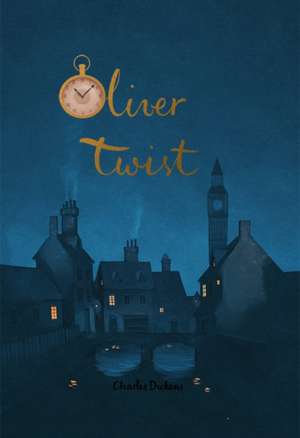
Oliver Twist: Wordsworth Collector's Editions
Autor Charles Dickensen Limba Engleză Hardback – 15 aug 2022
Observăm cum în Anglia anilor 1830, pe fondul unei industrializări galopante, Charles Dickens plasează începutul periplului lui Oliver într-un azil de săraci, un spațiu al privațiunilor care devine simbolul eșecului social victorian. Această alegere a locului și timpului nu este întâmplătoare; ea servește drept fundament pentru o critică acerbă a Legii Săracilor din 1834, transformând suferința individuală a unui orfan într-un manifest politic. Remarcăm o structură narativă care pendulează între atmosfera sumbră a mahalalelor londoneze și momente de o ironie fină, o dualitate care a definit vocea lui Dickens. Oliver Twist amintește de Jane Eyre de Maggie Pearson prin tema copilului vulnerabil care trebuie să navigheze singur printr-un sistem opresiv și prin atmosfera evocativă a începuturilor dificile, dar se diferențiază prin realismul social visceral și prin explorarea mediului infracțional urban. Dacă în Great Expectations autorul analizează ascensiunea socială și deziluzia, în Oliver Twist el se concentrează pe supraviețuirea pură în fața corupției, oferind o perspectivă mai directă și mai furioasă asupra inechității. Apreciem modul în care experiențele personale ale autorului — munca forțată într-o fabrică de cremă de ghete și trauma încarcerării tatălui său — se reflectă în construcția antagonistului Fagin. Tonul contemplativ, dar incisiv, transformă lectura într-o experiență care depășește simplul roman de aventuri, fiind o radiografie a unei societăți în care bunătatea este o formă de rezistență.
Din seria Wordsworth Collector's Editions
-
 Preț: 74.09 lei
 -
 Preț: 74.61 lei
 -
 Preț: 71.41 lei
 -
 Preț: 73.78 lei
 -
 Preț: 73.45 lei
 -
 Preț: 72.76 lei
 -
 Preț: 73.45 lei
 -
 Preț: 71.42 lei
 -
 Preț: 72.75 lei
 -
 Preț: 72.56 lei
 -
 Preț: 75.48 lei
 -
 Preț: 76.23 lei
 -
 Preț: 60.53 lei
 -
 Preț: 60.53 lei
 -
 Preț: 62.52 lei
 -
 Preț: 74.49 lei
 -
 Preț: 74.33 lei
 -
 Preț: 70.71 lei
 -
 Preț: 78.11 lei
 -
 Preț: 70.41 lei
 -
 Preț: 73.86 lei
 -
 Preț: 78.59 lei
 -
 Preț: 72.28 lei
 -
 Preț: 71.98 lei
 -
 Preț: 73.45 lei
 -
 Preț: 60.91 lei
 -
 Preț: 70.98 lei
 -
 Preț: 74.33 lei
 -
 Preț: 70.54 lei
 -
 Preț: 78.69 lei
 -
 Preț: 72.28 lei
 -
 Preț: 74.03 lei
 -
 Preț: 74.20 lei
 -
 Preț: 71.27 lei
 -
 Preț: 74.61 lei
 -
 Preț: 76.75 lei
 -
 Preț: 59.70 lei
 -
 Preț: 71.31 lei
Preț: 74.91 lei
Carte disponibilă
Livrare economică 02-16 noiembrie
Livrare express 16-22 octombrie pentru 30.17 lei
Specificații
ISBN-10: 1840228326
Pagini: 464
Dimensiuni: 137 x 180 x 39 mm
Greutate: 0.43 kg
Editura: WORDSWORTH EDITIONS LTD
Colecția Wordsworth Collector's Editions
Seria Wordsworth Collector's Editions
V-ar putea interesa
-
 Jane EyreCharlotte BrontëPreț: 28.01 lei
 -
 Gulliver's TravelsJonathan SwiftPreț: 28.01 lei
 -
 The Picture of Dorian GrayOscar WildePreț: 28.01 lei
 -
 -19%Preț: 52.53 lei64.66 lei
 -
 Love in the Time of CholeraGabriel García Márquez-19%Preț: 58.69 lei72.05 lei
 -
 Preț: 92.63 lei
 -
 Great ExpectationsCharles DickensPreț: 51.08 lei
 -
 More Than AllegoryBernardo KastrupPreț: 100.26 lei
 -
 -22%Preț: 128.50 lei165.27 lei
 -
 DecameronGiovanni BoccaccioPreț: 47.67 lei
 -
 A Portrait of the Artist as a Young ManJames JoycePreț: 36.06 lei
 -
 FrankensteinMary ShelleyPreț: 30.61 lei
 -
 David CopperfieldCharles DickensPreț: 39.94 lei
 -
 Don QuixoteMiguel de CervantesPreț: 28.01 lei
 -
 Three Men in a Boat & Three Men on the BummelJerome K. JeromePreț: 36.87 lei
 -
 Hunchback of Notre-DameVictor HugoPreț: 38.68 lei
 -
 The Jungle Book & The Second Jungle BookRudyard KiplingPreț: 38.00 lei
 -
 A Christmas CarolCharles DickensPreț: 35.59 lei
De ce să citești această carte
Recomandăm această ediție cititorilor care doresc să descopere rădăcinile romanului social modern. Prin Oliver Twist, câștigați nu doar o poveste clasică despre triumful moralității, ci și o lecție de istorie vie despre Londra victoriană. Este o lectură esențială pentru a înțelege cum literatura poate deveni un instrument de schimbare socială, oferind în același timp personaje memorabile care au modelat cultura universală.
Despre autor
Charles Dickens (1812–1870) a fost cel mai influent romancier al epocii victoriene și un critic social neobosit. Marcat de o copilărie în care a fost forțat să lucreze într-o fabrică de negru de fum în timp ce tatăl său era la închisoarea datornicilor, Dickens a transpus aceste traume în operele sale. Cariera sa a început în jurnalism, experiență care i-a rafinat spiritul de observație și i-a alimentat dorința de reformă. Autor prolific, a scris 15 romane, printre care A Tale of Two Cities și David Copperfield, fiind recunoscut pentru geniul său în crearea unor personaje tipologice și pentru campaniile sale susținute în favoarea drepturilor copiilor și a educației.
Descriere
Notă biografică
When the family fortunes improved, Charles went back to school, after which he became an office boy, a freelance reporter and finally an author. With Pickwick Papers (1836-7) he achieved immediate fame; in a few years he was easily the post popular and respected writer of his time. It has been estimated that one out of every ten persons in Victorian England was a Dickens reader. Oliver Twist (1837), Nicholas Nickleby (1838-9) and The Old Curiosity Shop (1840-41) were huge successes. Martin Chuzzlewit (1843-4) was less so, but Dickens followed it with his unforgettable, A Christmas Carol (1843), Bleak House (1852-3), Hard Times (1854) and Little Dorrit (1855-7) reveal his deepening concern for the injustices of British Society. A Tale of Two Cities (1859), Great Expectations (1860-1) and Our Mutual Friend (1864-5) complete his major works.
Dickens's marriage to Catherine Hoggarth produced ten children but ended in separation in 1858. In that year he began a series of exhausting public readings; his health gradually declined. After putting in a full day's work at his home at Gads Hill, Kent on June 8, 1870, Dickens suffered a stroke, and he died the following day.
Textul de pe ultima copertă
One of the most swiftly moving and unified of Charles Dickens' great novels, Oliver Twist is also famous for its recreation through the splendidly realized figures of Fagin, Nancy, the Artful Dodger, and the evil Bill Sikes--of the vast London under--world of pickpockets, thieves, prostitutes, and abandoned children.
Extras
Treats of the place where Oliver Twist was Born; and of the Circumstances attending his Birth.
Among other public buildings in a certain town, which for many reasons it will be prudent to refrain from mentioning, and to which I will assign no fictitious name, there is one anciently common to most towns, great or small: to wit, a workhouse; and in this workhouse was born: on a day and date which I need not trouble myself to repeat, inasmuch as it can be of no possible consequence to the reader, in this stage of the business at all events: the item of mortality whose name is prefixed to the head of this chapter.
For a long time after it was ushered into this world of sorrow and trouble, by the parish surgeon, it remained a matter of considerable doubt whether the child would survive to bear any name at all; in which case it is somewhat more than probable that these memoirs would never have appeared; or, if they had, that being comprised within a couple of pages, they would have possessed the inestimable merit of being the most concise and faithful specimen of biography, extant in the literature of any age or country.
Although I am not disposed to maintain that the being born in a workhouse, is in itself the most fortunate and enviable circumstance that can possibly befal a human being, I do mean to say that in this particular instance, it was the best thing for Oliver Twist that could by possibility have occurred. The fact is, that there was considerable difficulty in inducing Oliver to take upon himself the office of respiration,-a troublesome practice, but one which custom has rendered necessary to our easy existence; and for some time he lay gasping on a little flock mattress, rather unequally poised between this world and the next: the balance being decidedly in favour of the latter. Now, if, during this brief period, Oliver had been surrounded by careful grandmothers, anxious aunts, experienced nurses, and doctors of profound wisdom, he would most inevitably and indubitably have been killed in no time. There being nobody by, however, but a pauper old woman, who was rendered rather misty by an unwonted allowance of beer; and a parish surgeon who did such matters by contract; Oliver and Nature fought out the point between them. The result was, that, after a few struggles, Oliver breathed, sneezed, and proceeded to advertise to the inmates of the workhouse the fact of a new burden having been imposed upon the parish, by setting up as loud a cry as could reasonably have been expected from a male infant who had not been possessed of that very useful appendage, a voice, for a much longer space of time than three minutes and a quarter.
As Oliver gave this first proof of the free and proper action of his lungs, the patchwork coverlet which was carelessly flung over the iron bedstead, rustled; the pale face of a young woman was raised feebly from the pillow; and a faint voice imperfectly articulated the words, "Let me see the child, and die."
The surgeon had been sitting with his face turned towards the fire: giving the palms of his hands, a warm and a rub alternately. As the young woman spoke, he rose, and advancing to the bed's head, said, with more kindness than might have been expected of him:
"Oh, you must not talk about dying yet."
"Lor bless her dear heart, no!" interposed the nurse, hastily depositing in her pocket a green glass bottle, the contents of which she had been tasting in a corner with evident satisfaction. "Lor bless her dear heart, when she has lived as long as I have, sir, and had thirteen children of her own, and all on 'em dead except two, and them in the wurkus with me, she'll know better than to take on in that way, bless her dear heart! Think what it is to be a mother, there's a dear young lamb, do."
Apparently this consolatory perspective of a mother's prospects, failed in producing its due effect. The patient shook her head, and stretched out her hand towards the child.
The surgeon deposited it in her arms. She imprinted her cold white lips passionately on its forehead; passed her hands over her face; gazed wildly round; shuddered; fell back-and died. They chafed her breast, hands, and temples; but the blood had stopped for ever. They talked of hope and comfort. They had been strangers too long.
"It's all over, Mrs. Thingummy!" said the surgeon at last.
"Ah, poor dear, so it is!" said the nurse, picking up the cork of the green bottle which had fallen out on the pillow as she stooped to take up the child. "Poor dear!"
"You needn't mind sending up to me, if the child cries, nurse," said the surgeon, putting on his gloves with great deliberation. "It's very likely it will be troublesome. Give it a little gruel7 if it is." He put on his hat, and, pausing by the bed-side on his way to the door, added "She was a good-looking girl, too; where did she come from?"
"She was brought here last night," replied the old woman, "by the overseer's order. She was found lying in the street. She had walked some distance, for her shoes were worn to pieces; but where she came from, or where she was going to, nobody knows."
From the Trade Paperback edition.
Recenzii
Oliver Twist was first published in serialised form (with illustrations by George Cruikshank) in Bentley’s Miscellany between February 1837 and April 1839. It was issued with some corrections and revisions in ten numbers in 1846 by Bradbury and Evans (which then also issued the same text in a single volume). Each of these ten numbers, including the Cruikshank illustrations and the advertisements, is included in this facsimile reprint of the 1846 edition.
This is one of a series from Broadview Press of facsimile reprint editions—editions that provide readers with a direct sense of these works as the Victorians themselves experienced them.