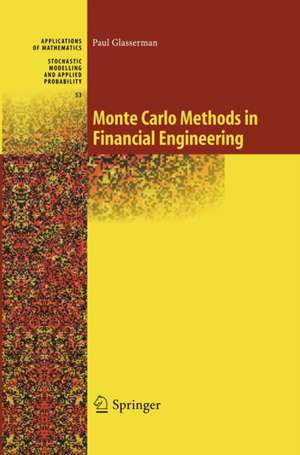
Monte Carlo Methods in Financial Engineering
Autor Paul Glassermanen Limba Engleză Hardback – 7 aug 2003
Ceea ce diferențiază lucrarea Monte Carlo Methods in Financial Engineering de alte manuale tehnice este rigoarea cu care Paul Glasserman transformă simularea dintr-un simplu instrument de calcul într-un vehicul de explorare a conceptelor fundamentale din ingineria financiară. Remarcăm o tranziție fluidă de la fundamentele matematice la implementări complexe, volumul fiind structurat pentru a servi atât ca fundament teoretic, cât și ca ghid practic pentru evaluarea derivatelor și gestionarea riscului. Ca și Hui Wang în Monte Carlo Simulation with Applications to Finance, autorul distilează experiență reală în principii acționabile, însă Glasserman plasează un accent mult mai puternic pe eficiența computațională și pe tratarea riguroasă a modelelor în timp continuu. Textul este organizat strategic în trei secțiuni distincte. Prima parte stabilește bazele generării numerelor aleatoare și a drumurilor de eșantionare (sample paths), în timp ce a doua secțiune se concentrează pe metode de creștere a preciziei, precum reducerea varianței și metodele Quasi-Monte Carlo. Ultima parte abordează subiecte avansate, esențiale în industria actuală: estimarea senzitivităților de preț și evaluarea opțiunilor americane. Reținem că această lucrare extinde preocupările autorului din Stochastic Networks, unde analiza stabilității și a evenimentelor rare era centrală, aplicând acum aceleași standarde de precizie în contextul piețelor financiare. Această abordare face ca volumul să fie indispensabil pentru cei care doresc să înțeleagă nu doar 'cum' să simuleze, ci și 'de ce' anumite modele funcționează mai bine în condiții de volatilitate.
Preț: 528.26 lei
Preț vechi: 636.45 lei
-17%
Carte indisponibilă temporar
Specificații
ISBN-10: 0387004513
Pagini: 616
Ilustrații: XIII, 596 p. 4 illus.
Dimensiuni: 160 x 241 x 39 mm
Greutate: 1.03 kg
Ediția:2003
Editura: Springer
Colecția Stochastic Modelling and Applied Probability
Locul publicării:New York, NY, United States
V-ar putea interesa
-
 The Complete Guide to Option Pricing FormulasEspen Gaarder Haug-14%Preț: 337.03 lei392.07 lei
 -
 Exploring Monte Carlo MethodsWilliam L. Dunn-30%Preț: 444.26 lei638.61 lei
 -
 An Introduction to Quantitative FinanceStephen Blyth-11%Preț: 375.51 lei420.27 lei
 -
 Mastering Financial CalculationsBob Steiner-15%Preț: 490.15 lei576.66 lei
 -
 SimulationSheldon M. Ross-31%Preț: 515.83 lei749.22 lei
 -
 Paul Wilmott on Quantitative Finance 2e +CD 3V SetPaul Wilmott-23%Preț: 1407.02 lei1827.30 lei
 -
 Numerical Methods in Finance with C++Maciej J. Capi¿skiPreț: 329.19 lei
 -
 Quantitative Methods for FinanJohn TeallPreț: 550.93 lei
 -
 Financial Mathematics: A Comprehensive Treatment in Discrete TimeGiuseppe Campolieti-8%Preț: 513.76 lei558.44 lei
 -
 Introduction to Stochastic Calculus Applied to FinanceDamien LambertonPreț: 455.29 lei
 -
 -18%Preț: 800.09 lei975.71 lei
 -
 The Mathematics of Financial ModelsKannoo Ravindran-8%Preț: 488.94 lei531.46 lei
 -
 Foundations of the Pricing of Financial DerivativesRobert E Brooks-8%Preț: 526.42 lei572.19 lei
 -
 An Introduction to Mathematical Finance with ApplicationsArlie O. Petters-19%Preț: 527.08 lei650.72 lei
 -
 A Cookbook with Probability OneDamiano RosselloPreț: 464.72 lei
 -
 Computation and Simulation for FinanceCónall Kelly-17%Preț: 414.78 lei499.74 lei
 -
 Mathematical Finance: Theory Review and ExercisesEmanuela Rosazza GianinPreț: 357.66 lei
Public țintă
GraduateDe ce să citești această carte
Această carte este resursa definitivă pentru masteranzii în inginerie financiară și practicienii care implementează modele de risc. Cititorul va câștiga o înțelegere profundă a metodelor de simulare, învățând să optimizeze algoritmii pentru o precizie maximă. Este un instrument esențial pentru oricine dorește să stăpânească evaluarea activelor complexe și managementul riscului de credit folosind tehnici stochastice avansate.
Descriere scurtă
This book develops the use of Monte Carlo methods in finance and it also uses simulation as a vehicle for presenting models and ideas from financial engineering. It divides roughly into three parts. The first part develops the fundamentals of Monte Carlo methods, the foundations of derivatives pricing, and the implementation of several of the most important models used in financial engineering. The next part describes techniques for improving simulation accuracy and efficiency. The final third of the book addresses special topics: estimating price sensitivities, valuing American options, and measuring market risk and credit risk in financial portfolios.
The most important prerequisite is familiarity with the mathematical tools used to specify and analyze continuous-time models in finance, in particular the key ideas of stochastic calculus. Prior exposure to the basic principles of option pricing is useful but not essential.
The book is aimed at graduate students in financial engineering, researchers in Monte Carlo simulation, and practitioners implementing models in industry.
Mathematical Reviews, 2004: "... this book is very comprehensive, up-to-date and useful tool for those who are interested in implementing Monte Carlo methods in a financial context."
Cuprins
Recenzii
From the reviews:
"This recent book is a valuable addition to the references devoted to Monte Carlo methods. … the author succeeded in choosing the most actual topics in financial engineering and in presenting them in an appropriate way by keeping a suitable balance between mathematical rigour and an audience friendly language. … To help the reader, three appendices provide basic results on convergence concepts … . A large bibliography of 358 entries accompanies this text. In short, the reader will find this book extremely lucid and useful." (Radu Theodorescu, Zentralblatt MATH, Vol. 1038 (13), 2004)
"To keep it short, let me summarize the recension in one phrase: Paul Glausserman’s book is a ‘strong buy’ for everybody in the financial community. … one gets 596 pages full of valuable information on all aspects of Monte Carlo simulation. … Altogether, I can encourage everyone interested in Monte Carlo methodsin finance to read the book. It is very well written … comes with a carefully selected bibliography (358 references) and a helpful index, thus making it really worth the buy." (Ralf Werner, OR – Spectrum Operations Research Spectrum, Issue 27, 2005)
"Glasserman’s new book is a remarkable presentation of the current state of the art of Monte Carlo Methods in Financial Engineering. … lot of material which is sometimes hard to access has been composed into one volume. … a high quality monograph which is both suitable as a reference for practitioners and researchers as well as a textbook … . The list of references is by itself a valuable aspect. The refreshing writing style of the author is tailor-made for the thirsty reader … ." (Uwe Wystup, www.mathfinance.de, November, 2003)
"Paul Glasserman has written an astonishingly good book that bridges financial engineering and the Monte Carlo method. The book will appeal to graduate students, researchers, and most of all, practicing financial engineers. It is an advanced book. … The presentation is masterful. … You will learn plenty of financial engineering amidst the pages. The writing is a pleasure to read. Topics are timely and relevant. Glasserman’s is a must-have book for financial engineers." (www.riskbook.com, Dezember, 2003)
"This book is divided into three parts. … the aim of the author is … to give a precise description of the different techniques in order to facilitate their implementation. In my opinion, this book is a very comprehensive, up-to-date and useful tool for those who are interested in implementing Monte Carlo methods in a financial context." (Benjamin Jourdain, Mathematical Reviews, 2004g)
"The publication of this book is an important event in computational finance. For many years, Monte Carlo methods have been successfully applied to solve diverse problems in financial mathematics. By publishing this book the author deserves much credit for avery good attempt to lift such applications to a new level. … the book may well become a major reference in the field of applications of Monte Carlo methods in financial engineering. This is because the book is well structured and well written … ." (A Zhigljavsky, Journal of the Operational Research Society, Vol. 57, 2006)