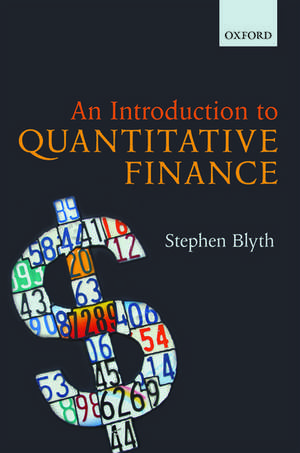
An Introduction to Quantitative Finance
Autor Stephen Blythen Limba Engleză Paperback – 7 noi 2013
Preț: 375.51 lei
Preț vechi: 420.27 lei
-11%
Puncte Express: 563
Carte tipărită la comandă
Livrare economică 10-16 decembrie
Livrare express 03-07 noiembrie pentru 73.19 lei
Livrare prin curier în România Termenul estimat este afișat lângă disponibilitate.
Transport gratuit de la 400.00 lei Plată online sau ramburs, în funcție de opțiunile comenzii.
Retur gratuit în 14 zile Comandă securizată și suport în română.
Specificații
ISBN-13: 9780199666591
ISBN-10: 0199666598
Pagini: 192
Ilustrații: 36 b/w line drawings
Dimensiuni: 157 x 233 x 11 mm
Greutate: 0.3 kg
Editura: OUP OXFORD
Colecția OUP Oxford
Locul publicării:Oxford, United Kingdom
ISBN-10: 0199666598
Pagini: 192
Ilustrații: 36 b/w line drawings
Dimensiuni: 157 x 233 x 11 mm
Greutate: 0.3 kg
Editura: OUP OXFORD
Colecția OUP Oxford
Locul publicării:Oxford, United Kingdom
V-ar putea interesa
-
 Mathematical Finance: A Very Short IntroductionMark H. A. Davis-19%Preț: 57.92 lei71.23 lei
 -
 Mastering Derivatives MarketsFrancesca Taylor-15%Preț: 467.61 lei550.13 lei
 -
 Mastering Financial CalculationsBob Steiner-15%Preț: 490.15 lei576.66 lei
 -
 Intermediate Financial TheoryJean-Pierre Danthine-33%Preț: 444.06 lei666.40 lei
 -
 Paul Wilmott on Quantitative Finance 2e +CD 3V SetPaul Wilmott-23%Preț: 1407.02 lei1827.30 lei
 -
 Paul Wilmott Introduces Quantitative FinancePaul Wilmott-19%Preț: 451.26 lei557.11 lei
 -
 Numerical Methods in Finance with C++Maciej J. Capi¿skiPreț: 329.19 lei
 -
 Quantitative Methods for FinanJohn TeallPreț: 550.93 lei
 -
 Financial Mathematics: A Comprehensive Treatment in Discrete TimeGiuseppe Campolieti-8%Preț: 513.76 lei558.44 lei
 -
 The Mathematics of Financial ModelsKannoo Ravindran-8%Preț: 488.94 lei531.46 lei
 -
 Foundations of the Pricing of Financial DerivativesRobert E Brooks-8%Preț: 526.42 lei572.19 lei
 -
 An Introduction to Mathematical Finance with ApplicationsArlie O. Petters-19%Preț: 527.08 lei650.72 lei
 -
 A Cookbook with Probability OneDamiano RosselloPreț: 464.72 lei
 -
 An Introduction to the Modern Martingale Theory and ApplicationsWilfredo Urbina-Romero-13%Preț: 403.77 lei464.10 lei
 -
 Mathematical Finance: Theory Review and ExercisesEmanuela Rosazza GianinPreț: 357.66 lei
 -
 Financial MathematicsAndrea PascucciPreț: 458.33 lei
Recenzii
Short and to the point, uncluttered, unfancy, free of the faux rigor of most modern finance textbooks, written by a practitioner, that hits most of the essential principles of quantitative finance.
The author writes elegantly, and combines precision of expression with topical real-world examples in a way that makes this an exceptional work.
It is all too rare to find clear thinking, based on first principles, combined with practical understanding of financial markets. This is precisely what Stephen Blyth offers, drawing equally on his mathematical and statistical training and his career in quantitative finance. This book beautifully explains both the profound implications of no-arbitrage theory for the prices of fixed-income derivative securities, and also the pitfalls in practical applications.
The author writes elegantly, and combines precision of expression with topical real-world examples in a way that makes this an exceptional work.
It is all too rare to find clear thinking, based on first principles, combined with practical understanding of financial markets. This is precisely what Stephen Blyth offers, drawing equally on his mathematical and statistical training and his career in quantitative finance. This book beautifully explains both the profound implications of no-arbitrage theory for the prices of fixed-income derivative securities, and also the pitfalls in practical applications.
Notă biografică
Stephen Blyth is managing director and head of public markets at the Harvard Management Company, the subsidiary of Harvard University responsible for the management of the University's endowment. He is also Professor of the Practice of Statistics at Harvard University.Before joining Harvard in 2006, Professor Blyth was managing director and head of the Global Rates proprietary trading group at Deutsche Bank in London, and managing director in the Interest Rate Group at Morgan Stanley in New York. Professor Blyth is a frequent speaker at international finance conferences and has written widely on issues facing practitioners in applied quantitative finance and in derivative markets. He holds a PhD in Statistics from Harvard University and an MA in Mathematics with first class honours from Christ's College, Cambridge University, where he is a Lady Margaret Beaufort Fellow. He was formerly a Lecturer in Mathematics at Imperial College London.
Cuprins
- I Introduction and Preliminaries
- 1: Introduction
- 2: Preliminaries
- II Forwards, Swaps and Options
- 3: Forward contracts and forward prices
- 4: Forward rates and libor
- 5: Interest rate swaps
- 6: Futures contracts
- 7: No-arbitrage principle
- 8: Options
- III Replication, risk-neutrality and the fundamental theorem
- 9: Replication and risk-neutrality on the binomial tree
- 10: Martingales, numeraires and the fundamental theorem
- 11: Continuous time limit and Black-Scholes formula
- 12: Option price and probability duality
- IV Interest Rate Options
- 13: Caps, floors and swaptions
- 14: Cancellable swaps and Bermudan swaptions
- 15: Additional topics in interest rate derivatives
- V Through Continuous Time
- 16: Rough guide to continuous time