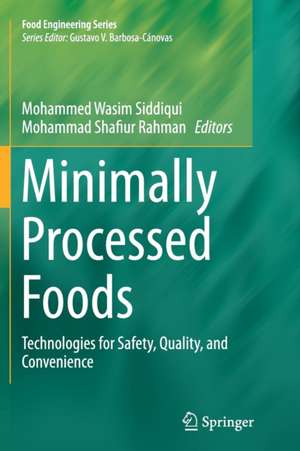
Minimally Processed Foods: Food Engineering Series
Editat de Mohammed Wasim Siddiqui, Mohammad Shafiur Rahmanen Limba Engleză Paperback – 23 aug 2016
Ca și Vijay K. Juneja în Microbial Safety of Minimally Processed Foods, editorii acestui volum distilează experiența reală în principii acționabile, însă Minimally Processed Foods extinde spectrul dincolo de siguranța microbiană, explorând tehnologiile care susțin întregul lanț de valoare al produselor de tip 'convenience'. Apreciem modul în care Mohammed Wasim Siddiqui și Mohammad Shafiur Rahman reușesc să echilibreze cerințele consumatorilor pentru alimente proaspete, fără conservanți chimici, cu rigoarea necesară procesării industriale. Această lucrare ocupă un loc central în opera lui Mohammed Wasim Siddiqui. Dacă în Postharvest Management of Horticultural Crops autorul se concentra pe strategiile de pre- și post-recoltă pentru prelungirea vieții la raft, aici el face pasul către tehnologia de procesare propriu-zisă. Ne-a atras atenția structura logică a celor 12 capitole, care ghidează cititorul de la fundamentele 'hurdle technology' către aplicații specifice pe categorii de produse sensibile: fructe și legume fresh-cut, semipreparate (ready meals) și produse de panificație parțial coapte. Găsim în această carte analize detaliate despre tehnologii non-termale, precum presiunea înaltă sau ultrasunetele, prezentate ca soluții viabile pentru menținerea calității senzoriale și nutriționale. Progresia conținutului este una tehnică, abordând succesiv operațiunile unitare (spălare, curățare, tăiere), metodele de ambalare activă și impactul iradierii asupra produselor din carne și pește, oferind o perspectivă integrată asupra ingineriei alimentare moderne.
Din seria Food Engineering Series
- 18%
 Preț: 1010.81 lei
 - 18%
 Preț: 937.28 lei
 - 15%
 Preț: 573.18 lei
 - 18%
 Preț: 1450.04 lei
 - 18%
 Preț: 996.92 lei
 - 18%
 Preț: 951.24 lei
 -
 Preț: 372.96 lei
 - 15%
 Preț: 669.62 lei
 - 18%
 Preț: 926.28 lei
 - 18%
 Preț: 1914.37 lei
 - 15%
 Preț: 664.57 lei
 - 18%
 Preț: 1101.74 lei
 - 18%
 Preț: 1548.41 lei
 - 18%
 Preț: 997.15 lei
 - 18%
 Preț: 1431.46 lei
 - 18%
 Preț: 1238.74 lei
 - 18%
 Preț: 1272.10 lei
 - 23%
 Preț: 963.99 lei
 - 15%
 Preț: 672.80 lei
 - 18%
 Preț: 997.76 lei
 -
 Preț: 387.51 lei
 - 18%
 Preț: 993.09 lei
 - 15%
 Preț: 722.40 lei
 - 18%
 Preț: 1005.79 lei
 - 15%
 Preț: 664.35 lei
 - 18%
 Preț: 956.41 lei
 - 18%
 Preț: 913.05 lei
 - 15%
 Preț: 670.48 lei
 - 15%
 Preț: 670.25 lei
 - 15%
 Preț: 670.93 lei
 -
 Preț: 473.32 lei
 - 15%
 Preț: 670.93 lei
 - 18%
 Preț: 999.09 lei
 - 18%
 Preț: 975.99 lei
 - 15%
 Preț: 667.19 lei
 - 18%
 Preț: 1632.19 lei
 - 18%
 Preț: 2175.87 lei
 - 15%
 Preț: 680.59 lei
 - 18%
 Preț: 1200.42 lei
 - 18%
 Preț: 1266.30 lei
 - 15%
 Preț: 632.97 lei
Preț: 644.90 lei
Preț vechi: 758.71 lei
-15%
Carte tipărită la comandă
Livrare economică 04-18 decembrie
Specificații
ISBN-10: 331934790X
Pagini: 320
Ilustrații: XII, 306 p. 37 illus., 21 illus. in color.
Dimensiuni: 155 x 235 x 18 mm
Greutate: 0.49 kg
Ediția:Softcover reprint of the original 1st ed. 2015
Editura: Springer
Colecția Food Engineering Series
Seria Food Engineering Series
Locul publicării:Cham, Switzerland
V-ar putea interesa
-
 Introduction to Food EngineeringR. Paul Singh-31%Preț: 684.09 lei996.56 lei
 -
 Preț: 127.77 lei
 -
 Food Safety: Quality Control and ManagementMohammed Kuddus-8%Preț: 444.81 lei483.49 lei
 -
 Best Before: The Evolution and Future of Processed FoodNicola Temple-27%Preț: 64.97 lei89.47 lei
 -
 Microbial Control and Food PreservationVijay K. Juneja-18%Preț: 1447.44 lei1765.17 lei
 -
 Handbook of Food PreservationM. Shafiur Rahman-14%Preț: 1820.10 lei2116.39 lei
 -
 How Not to Eat Ultra-ProcessedNichola Ludlam-RainePreț: 140.54 lei
 -
 New Topics in Food EngineeringMariann A. Comeau-27%Preț: 1636.48 lei2229.41 lei
 -
 Advances in Food Science & TechnologyA K Haghi-27%Preț: 1548.98 lei2110.35 lei
 -
 Food EngineeringBrendan C Siegler-27%Preț: 1991.99 lei2713.61 lei
 -
 -26%Preț: 1249.05 lei1684.29 lei
 -
 Handbook of Research on Food Science and Technology: Volume 2: Food Biotechnology and MicrobiologyMonica Lizeth Chavez-Gonzalez-15%Preț: 581.47 lei684.09 lei
 -
 -15%Preț: 462.41 lei544.01 lei
 -
 Smart and Sustainable Food TechnologiesShalini Sehgal-24%Preț: 1008.82 lei1327.40 lei
 -
 Microbial Decontamination of FoodManzoor Ahmad Shah-24%Preț: 885.44 lei1165.04 lei
De ce să citești această carte
Această resursă este esențială pentru cercetătorii și inginerii din industria alimentară care doresc să implementeze tehnologii de conservare verzi și non-termale. Cititorul câștigă o înțelegere profundă a modului în care poate asigura siguranța microbiologică fără a compromite prospețimea naturală, obținând soluții practice pentru dezvoltarea produselor gata de consum care să răspundă standardelor actuale de calitate și nutriție.
Despre autor
Mohammed Wasim Siddiqui este o figură proeminentă la Universitatea Agricolă Bihar din India, specializat în managementul post-recoltă și tehnologia alimentară. Expertiza sa vastă în fiziologia plantelor și conservarea prospețimii este reflectată în numeroase volume publicate la edituri de prestigiu. Mohammad Shafiur Rahman, de la Universitatea Sultan Qaboos din Oman, este recunoscut pentru contribuțiile sale în ingineria proprietăților alimentare. Împreună, cei doi editori combină perspectivele academice și practice pentru a oferi soluții tehnologice avansate în cadrul seriei Food Engineering Series publicată de Springer.
Descriere scurtă
About the Editors
Mohammed Wasim Siddiqui, Bihar Agricultural University, Sabour, Bhagalpur, India
Mohammad Shafiur Rahman, Sultan Qaboos University, Al-khod, Oman
Cuprins
Notă biografică
Professor Shafiur Rahman is the author/co-author of over 300 technical articles including more than 100 journal papers and 8 books. He is the author of the internationally acclaimed and award-wining Food Properties Handbook, and editor of the popular Handbook of Food Preservation published by CRC Press, Florida. First editions received the bestseller recognition and the second edition is now released. First edition was translated into Spanish. He was invited to serve as one of the Associate Editors for the Handbook of Food Science, Engineering and Technology, and one of the Editors for the Handbook of Food and Bioprocess Modeling Techniques published by CRC Press, FL. He has initiated the International Journal of Food Properties and serving as thefounding Editor-in-Chief for more than 15 years, and serving in the editorial boards of 10 international journals and book series. He is a member in the Food Engineering Series Editorial Board of Springer Science, New York. He is serving as a Section Editor for the Sultan Qaboos University journal Agricultural Sciences. He has initiated and served as the Founding Chair of the International Conference on Food Properties (iCFP). He received the HortResearch Chairman's Award, BRAP Award, CAMS Outstanding Researcher Award 2003, and SQU Distinction in Research Award 2008. In 2008, Professor Rahman has ranked among the top five Leading Scientists and Engineers of 57 OIC Member Countries in the Agroscience Discipline.