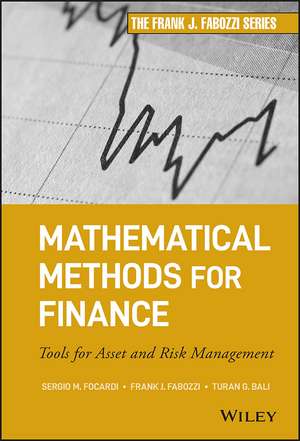
Mathematical Methods for Finance
Autor Sergio M Focardien Limba Engleză Hardback – 13 sep 2013
Multe programe de formare în finanțe sugerează că stăpânirea evaluării derivatelor este suficientă pentru a naviga pe piețele moderne. Apreciem însă că Mathematical Methods for Finance demonstrează contrariul: succesul în finanțele cantitative necesită o bază matematică mult mai largă, care să susțină nu doar prețuirea activelor, ci și deciziile complexe de management de portofoliu și risc de credit. Ne-a atras atenția modul în care autorii reușesc să integreze concepte de la teoria mulțimilor și distanțe, până la calcul diferențial și integrale stocastice, oferind un cadru unitar pentru realitățile pieței. Complementar volumului Mathematics and Statistics for Financial Risk Management, care se concentrează pe tehnici specifice de risc, lucrarea de față acoperă o zonă mult mai vastă, furnizând fundamentele de algebră matriceală și ecuații diferențiale necesare pentru a înțelege arhitectura oricărui model financiar. Sergio M Focardi și Frank J Fabozzi continuă aici direcția începută în Financial Modeling of the Equity Market, dar trec de la specificitatea managementului de capital la o abordare transversală a metodelor cantitative. Dacă în Financial Econometrics accentul era pus pe modelarea seriilor de timp, acest volum servește drept fundament teoretic indispensabil, explicând mecanismele matematice care stau la baza tuturor acestor modele. Reținem rigoarea cu care sunt tratate aplicațiile practice, transformând abstracțiile matematice în instrumente de lucru pentru profesioniștii din investiții și contabilitate.
Preț: 752.46 lei
Preț vechi: 826.87 lei
-9%
Carte tipărită la comandă
Livrare economică 30 noiembrie-14 decembrie
Specificații
ISBN-10: 1118312635
Pagini: 320
Dimensiuni: 152 x 231 x 33 mm
Greutate: 0.52 kg
Editura: Wiley
Locul publicării:Hoboken, United States
V-ar putea interesa
-
 Mathematical Finance: A Very Short IntroductionMark H. A. Davis-20%Preț: 57.32 lei71.23 lei
 -
 An Introduction to Quantitative FinanceStephen Blyth-11%Preț: 373.44 lei420.27 lei
 -
 Mastering Financial CalculationsBob Steiner-15%Preț: 439.05 lei516.53 lei
 -
 Statistics for FinanceErik Lindström-8%Preț: 446.40 lei485.21 lei
 -
 Intermediate Financial TheoryJean-Pierre Danthine-33%Preț: 444.06 lei666.40 lei
 -
 Paul Wilmott on Quantitative Finance 2e +CD 3V SetPaul Wilmott-23%Preț: 1407.02 lei1827.30 lei
 -
 Paul Wilmott Introduces Quantitative FinancePaul Wilmott-19%Preț: 451.26 lei557.11 lei
 -
 Market Risk Analysis, Quantitative Methods in FinanceCarol AlexanderPreț: 441.25 lei
 -
 Market Risk Analysis, Practical Financial EconometricsCarol Alexander-19%Preț: 423.60 lei522.95 lei
 -
 Numerical Methods in Finance with C++Maciej J. Capi¿skiPreț: 329.19 lei
 -
 Mathematics for Economics and Finance: Methods and ModellingMartin Anthony-8%Preț: 349.41 lei379.04 lei
 -
 Quantitative Methods for FinanJohn L TeallPreț: 550.93 lei
 -
 Financial Mathematics: A Comprehensive Treatment in Discrete TimeGiuseppe Campolieti-8%Preț: 513.76 lei558.44 lei
 -
 Introduction to Stochastic Calculus Applied to FinanceDamien LambertonPreț: 455.29 lei
 -
 Mathematics of Financial ModelRavindran-8%Preț: 474.59 lei515.86 lei
 -
 The Elements of Quantitative InvestingGiuseppe A. Paleologo-8%Preț: 450.09 lei489.23 lei
 -
 An Introduction to Mathematical Finance with ApplicationsArlie O. Petters-15%Preț: 490.51 lei577.07 lei
 -
 Mathematical Finance: Theory Review and ExercisesEmanuela Rosazza GianinPreț: 357.66 lei
 -
 Statistical Quantitative Methods in FinanceSamit Ahlawat-20%Preț: 225.43 lei281.78 lei
Public țintă
Investment and accounting professionals.De ce să citești această carte
Această carte este esențială pentru profesioniștii care doresc să treacă de la utilizarea mecanică a modelelor la înțelegerea profundă a matematicii din spatele lor. Veți câștiga competențe în calcul stocastic și algebră liniară, aplicabile direct în managementul riscului și al portofoliului. Este resursa ideală pentru a vă consolida autoritatea tehnică într-un domeniu din ce în ce mai dominat de date și algoritmi.
Despre autor
Sergio M Focardi este recunoscut la nivel mondial ca unul dintre cei mai importanți autori în domeniul finanțelor de nivel înalt, îmbinând expertiza academică cu o vastă experiență practică. Alături de Frank J Fabozzi, o figură legendară în educația financiară și editor al seriei care îi poartă numele la Wiley, și Turan G Bali, aceștia formează o echipă de elită. Lucrările lor colective au definit standardele moderne în modelarea financiară, econometrie și investiții cantitative, fiind utilizate atât de practicienii de pe Wall Street, cât și în mediul academic de prestigiu.