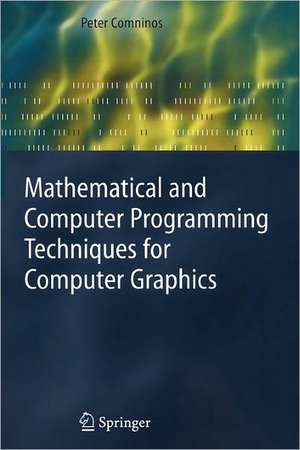
Mathematical and Computer Programming Techniques for Computer Graphics
Autor Peter Comninosen Limba Engleză Paperback – 13 oct 2010
Metodologia propusă de Peter Comninos în Mathematical and Computer Programming Techniques for Computer Graphics se bazează pe o simbioză între rigoarea matematică și implementarea software. Remarcăm o structură didactică ce debutează cu „Survival Kits” esențiale — seturi de instrumente pentru algebra vectorială și matricială — care pregătesc terenul pentru dezvoltarea propriu-zisă de biblioteci grafice. Spre deosebire de abordările pur teoretice, volumul pune accent pe design patterns specifice arhitecturii grafice, ghidând cititorul prin implementarea rutinelor în limbajul C.
Pe linia practică a lucrării Mathematical Structures for Computer Graphics de Janke, dar cu un focus mult mai pronunțat pe implementarea directă de cod și rutine de programare, acest volum demistifică trecerea de la ecuație la pixel. Dacă în Heterogeneous Objects Modelling and Applications autorul explora frontierele modelării geometrice complexe, aici se concentrează pe fundamentele robuste necesare oricărui sistem grafic: transformări 2D și 3D, algoritmi de clipping și proiecție.
Structura cuprinsului indică o progresie logică, culminând cu tehnici avansate de randare și modele de iluminare bazate pe principii fizice (Physically Based Lighting). Observăm că autorul nu se limitează la prezentarea algoritmilor, ci încurajează explorarea și experimentarea cu date, oferind o bibliotecă de rutine gata de utilizat. Este o resursă tehnică ce tratează grafica pe calculator nu doar ca pe o succesiune de imagini, ci ca pe o disciplină inginerească ce necesită o înțelegere profundă a spațiilor vectoriale și a algoritmilor de vizualizare.
Preț: 961.50 lei
Preț vechi: 1201.87 lei
-20%
Carte tipărită la comandă
Livrare economică 15-29 iunie
Specificații
ISBN-10: 184996954X
Pagini: 568
Ilustrații: XX, 548 p.
Dimensiuni: 155 x 235 x 30 mm
Greutate: 0.79 kg
Ediția:Softcover reprint of hardcover 1st ed. 2006
Editura: SPRINGER LONDON
Colecția Springer
Locul publicării:London, United Kingdom
V-ar putea interesa
-
 -29%Preț: 560.66 lei789.23 lei
 -
 Concrete MathematicsRonald Graham-20%Preț: 522.53 lei653.17 lei
 -
 Foundations of 3D Computer GraphicsSteven J Gortler-20%Preț: 400.80 lei501.00 lei
 -
 Hughes, J: Computer GraphicsJohn F. Hughes-14%Preț: 914.16 lei1062.98 lei
 -
 -25%Preț: 140.46 lei186.34 lei
 -
 Coding the MatrixPhilip N. KleinPreț: 271.20 lei
 -
 The Computer Graphics ManualDavid Salomon-20%Preț: 1206.73 lei1508.40 lei
 -
 Fundamentals of Computer GraphicsSteve Marschner-20%Preț: 431.33 lei539.17 lei
 -
 Real-Time Rendering, Fourth EditionTomas Akenine-Mo¨ller-20%Preț: 679.05 lei848.82 lei
 -
 -15%Preț: 642.92 lei756.38 lei
 -
 Computer Graphics with Open GLDonald Hearn-20%Preț: 556.52 lei695.65 lei
 -
 BEGINNING C++ THROUGH GAME-3EMichael Dawson-24%Preț: 362.09 lei479.43 lei
 -
 Mathematics for Computer GraphicsJohn Vince-20%Preț: 466.99 lei583.74 lei
 -
![Game Graphics Programming [With CDROM]: A Practical Approach [With CDROM]](https://i1.books-express.ro/bt/9781584505167/game-graphics-programming-with-cdrom.jpg) -12%Preț: 452.95 lei517.59 lei
-12%Preț: 452.95 lei517.59 lei -
 Mathematics for Computer Graphics and Game ProgrammingD. P. Kothari-20%Preț: 322.28 lei402.84 lei
 -
 -20%Preț: 234.14 lei292.68 lei
 -
 Math for ProgrammingRonald T. Kneusel-36%Preț: 228.59 lei355.84 lei
 -
 Introduction to Computer GraphicsKarsten Lehn-20%Preț: 290.93 lei363.66 lei
Public țintă
ResearchDe ce să citești această carte
Recomandăm această lucrare cercetătorilor și dezvoltatorilor care doresc să înțeleagă „motorul” din spatele bibliotecilor grafice moderne. Veți câștiga nu doar cunoștințe teoretice, ci și abilitatea practică de a scrie cod în C pentru manipularea obiectelor 2D și 3D. Este un ghid tehnic excelent pentru cei care preferă să implementeze propriile soluții în loc să utilizeze exclusiv motoare grafice preexistente.
Cuprins
Recenzii
"This book introduces the mathematics and related computer programming techniques used in computer graphics. … Using lots of code examples, the reader is encouraged to explore and experiment with data and computer programs and to master the related mathematical techniques. … This parallel approach of exposing the students to the mathematical theory and showing them how to incorporate it into example programs is the major strength of this book. This approach both demystifies the mathematics and demonstrates its relevance to 2D and 3D computer graphics." (Sonia Pérez Díaz, Zentralblatt MATH, Vol. 1090 (16), 2006)
Textul de pe ultima copertă
Written for students with a minimum prerequisite knowledge of mathematics, the reader should have had some basic exposure to topics such as functions, trigonometric functions, elementary geometry and number theory, and also to have some familiarity with computer programming languages such as C. The material presented in this book has been used successfully with final year undergraduate and masters students studying Computer Graphics and Computer Animation. A simple but effective set of routines are included, organised as a library, covering both 2D and 3D graphics – taking a parallel approach to mathematical theory, and showing the reader how to incorporate it into example programs. This approach both demystifies the mathematics and demonstrates its relevance to 2D and 3D computer graphics.