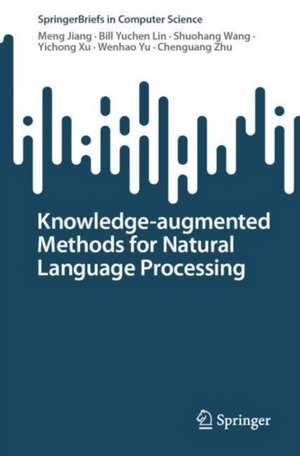
Knowledge-augmented Methods for Natural Language Processing: SpringerBriefs in Computer Science
Autor Meng Jiang, Bill Yuchen Lin, Shuohang Wang, Yichong Xu, Wenhao Yu, Chenguang Zhuen Limba Engleză Paperback – 14 mai 2024
În industria inteligenței artificiale și a procesării limbajului natural, trecerea de la simple corelații statistice la sisteme capabile de raționament informat reprezintă noua frontieră tehnologică. În volumul Knowledge-augmented Methods for Natural Language Processing, descoperim o analiză tehnică riguroasă a modului în care modelele de limbaj de mari dimensiuni, precum GPT-4 sau ChatGPT, pot fi optimizate prin infuzia de cunoștințe externe. Reținem că, deși aceste modele excelează în generarea de text coerent, ele suferă adesea din cauza lipsei ancorării în fapte concrete, entități și relații din lumea reală.
Structura volumului reflectă o progresie logică, de la identificarea surselor de cunoaștere la implementarea metodelor de augmentare specifice pentru Natural Language Understanding (NLU) și Natural Language Generation (NLG). Găsim în această carte soluții practice pentru integrarea „commonsense knowledge”, element esențial pentru a depăși limitările antrenamentului bazat strict pe perechi intrare-ieșire. Ca și Uday Kamath în Large Language Models: A Deep Dive, autorii distilează experiența reală din cercetare în principii acționabile, oferind o perspectivă clară asupra modului în care arhitecturile neurale pot procesa nu doar text, ci și structuri de date complexe.
Această lucrare din seria SpringerBriefs in Computer Science se distinge prin focalizarea pe mecanismele de „knowledge injection”. Spre deosebire de abordările care tratează modelele ca pe niște cutii negre, echipa de autori condusă de Meng Jiang și Chenguang Zhu propune metode sistematice de îmbunătățire a reprezentărilor lingvistice. Abordarea lor tehnică este complementară cu viziunea lui Gerhard Paaß din Foundation Models for Natural Language Processing, însă pune un accent mult mai puternic pe depășirea barierelor pur statistice în favoarea unei inteligențe augmentate informațional.
Din seria SpringerBriefs in Computer Science
- 20%
 Preț: 318.06 lei
 - 20%
 Preț: 175.41 lei
 - 20%
 Preț: 324.81 lei
 - 20%
 Preț: 312.38 lei
 - 20%
 Preț: 315.57 lei
 -
 Preț: 448.42 lei
 - 20%
 Preț: 334.13 lei
 -
 Preț: 394.76 lei
 -
 Preț: 477.41 lei
 - 20%
 Preț: 353.26 lei
 - 20%
 Preț: 311.84 lei
 -
 Preț: 379.07 lei
 - 20%
 Preț: 364.93 lei
 - 20%
 Preț: 338.72 lei
 - 20%
 Preț: 323.75 lei
 - 20%
 Preț: 311.04 lei
 - 20%
 Preț: 309.78 lei
 - 20%
 Preț: 321.60 lei
 - 20%
 Preț: 310.23 lei
 - 20%
 Preț: 325.87 lei
 - 47%
 Preț: 251.63 lei
 - 20%
 Preț: 309.30 lei
 - 20%
 Preț: 311.50 lei
 -
 Preț: 392.17 lei
 -
 Preț: 359.92 lei
 - 20%
 Preț: 310.73 lei
 - 20%
 Preț: 310.73 lei
 -
 Preț: 361.22 lei
 - 20%
 Preț: 311.84 lei
 - 20%
 Preț: 310.56 lei
 - 20%
 Preț: 310.73 lei
 - 20%
 Preț: 311.84 lei
 - 20%
 Preț: 311.04 lei
 - 20%
 Preț: 309.93 lei
 - 20%
 Preț: 311.18 lei
 - 20%
 Preț: 310.23 lei
 - 20%
 Preț: 311.04 lei
 - 20%
 Preț: 323.94 lei
 - 20%
 Preț: 311.18 lei
 - 20%
 Preț: 309.78 lei
 - 20%
 Preț: 321.39 lei
 - 20%
 Preț: 310.73 lei
 - 20%
 Preț: 325.21 lei
 - 20%
 Preț: 309.93 lei
 - 20%
 Preț: 311.50 lei
 - 20%
 Preț: 333.12 lei
 - 20%
 Preț: 312.17 lei
 -
 Preț: 362.51 lei
 - 20%
 Preț: 312.17 lei
Preț: 282.99 lei
Preț vechi: 353.75 lei
-20%
Carte disponibilă
Livrare economică 04-18 noiembrie
Specificații
ISBN-10: 9819707498
Pagini: 95
Ilustrații: IX, 95 p. 18 illus., 15 illus. in color.
Dimensiuni: 155 x 235 mm
Ediția:2024
Editura: Springer Nature Singapore
Colecția Springer
Seria SpringerBriefs in Computer Science
Locul publicării:Singapore, Singapore
V-ar putea interesa
-
 -20%Preț: 303.17 lei378.97 lei
 -
 -20%Preț: 249.68 lei312.11 lei
 -
 Introduction to Natural Language ProcessingJacob Eisenstein-29%Preț: 507.39 lei714.77 lei
 -
 ChatGPT and the Future of AITerrence J. Sejnowski-20%Preț: 107.12 lei133.89 lei
 -
 Large Language ModelsStephan Raaijmakers-20%Preț: 89.62 lei112.02 lei
 -
 -39%Preț: 394.79 lei646.62 lei
 -
 -20%Preț: 823.96 lei1029.96 lei
 -
 -33%Preț: 616.33 lei915.67 lei
 -
 Deep Learning for Natural Language ProcessingStephan Raaijmakers-20%Preț: 309.66 lei387.07 lei
 -
 -20%Preț: 466.99 lei583.74 lei
 -
 Effective Conversational AIAndrew Freed-20%Preț: 369.22 lei461.53 lei
 -
 How Large Language Models WorkDrew Farris-20%Preț: 338.92 lei423.64 lei
 -
 LLMs in ActionImmanuel Trummer-20%Preț: 219.46 lei274.33 lei
 -
 Knowledge Graphs and LLMs in ActionAlessandro Negro-20%Preț: 350.04 lei437.55 lei
 -
 Deep Learning Crash CourseGiovanni Volpe-35%Preț: 290.84 lei445.88 lei
 -
 Last Words: Large Language Models and the AI ApocalypsePaul Kockelman-20%Preț: 63.31 lei79.14 lei
 -
 Large Language Models: A Deep DiveUday Kamath-20%Preț: 428.62 lei535.77 lei
 -
 Natural Language GenerationEhud Reiter-20%Preț: 351.13 lei438.91 lei
 -
 Engineering Information Systems with Large Language ModelsFrancesca de Luzi-24%Preț: 1002.12 lei1318.58 lei
 -
 Beyond and After Prompt Engineering: The Future of AI CommunicationVladimir Geroimenko-20%Preț: 1176.18 lei1470.23 lei
De ce să citești această carte
Pentru inginerii ML și cercetătorii în AI, această carte oferă fundamentul teoretic și practic necesar pentru a construi sisteme NLP mai precise și mai puțin predispuse la halucinații. Cititorul câștigă o înțelegere profundă a tehnicilor de augmentare a modelelor cu date externe, trecând dincolo de simpla utilizare a unor API-uri pre-antrenate către arhitecturi hibride care combină puterea statistică cu rigoarea bazelor de cunoștințe.
Despre autor
Echipa de autori este formată din cercetători și experți de prestigiu în domeniul inteligenței artificiale, printre care Meng Jiang și Chenguang Zhu, aceștia activând în instituții de vârf unde dezvoltă soluții de ultimă oră pentru procesarea limbajului natural. Expertiza lor acoperă un spectru larg de aplicații ale învățării profunde; spre exemplu, în lucrări precum Deep Learning for Polymer Discovery, aceștia au demonstrat cum arhitecturile neurale avansate pot fi aplicate în domenii științifice complexe pentru predicția proprietăților și design invers. Această versatilitate în aplicarea modelelor de deep learning se reflectă în rigoarea cu care tratează augmentarea modelelor de limbaj în volumul de față.
Descriere scurtă
Cuprins
Notă biografică
Bill Yuchen Lin is a postdoctoral young investigator at Allen Institute for AI (AI2), advised by Prof. Yejin Choi. He received his PhD from University of Southern California in 2022, advised by Prof. Xiang Ren. His research goal is to teach machines to think, talk, and act with commonsense knowledge and commonsense reasoning ability as humans do. Towards this ultimate goal, he has been developing knowledge-augmented reasoning methods (e.g., KagNet, MHGRN, DrFact) and constructing benchmark datasets (e.g., CommonGen, RiddleSense, X-CSR) that require commonsense knowledge and complex reasoning for both NLU and NLG. He initiated an online compendium of commonsense reasoning research, which serves as a portal for the community.
Dr. Shuohang Wang is a senior researcher in the Knowledge and Language Team of Cognitive Service Research Group. His research mainly focuses on question answering, multilingual NLU, summarization with deep learning, reinforcement learning, and few-shot learning. He served as area chair or senior PC member for ACL, EMNLP, and AAAI. He co-organized AAAI’23 workshop on Knowledge Augmented Methods for NLP.
Dr. Yichong Xu is a senior researcher in the Knowledge and Language Team of Cognitive Service Research Group. His research focuses on the combination of knowledge and NLP, with applications to question answering, summarization, and multimodal learning. He led the effort to achieve the human parity on the CommonsenseQA benchmark. He has held tutorials on knowledge-augmented NLP methods in ACL and WSDM. Prior to joining Microsoft, Dr. Xu got his Ph.D. in machine learning from Carnegie Mellon University.
Wenhao Yu is a Ph.D. candidate in the Department of Computer Science and Engineering at the University of Notre Dame. His research lies in language model + knowledge for solving knowledge-intensive applications, such as open-domain question answering and commonsense reasoning. He has published over 15 conference papers and presented 3 tutorials in machine learning and natural language processing conferences, including ICLR, ICML, ACL, and EMNLP. He was the recipient of Bloomberg Ph.D. Fellowship in 2022 and won the Best Paper Award at SoCal NLP in 2022.He was a research intern in Microsoft Research and Allen Institute for AI.
Dr. Chenguang Zhu is a principal research manager in Microsoft Cognitive Services Research Group, where he leads the Knowledge and Language Team. His research covers knowledge-enhanced language model, text summarization, and prompt learning. Dr. Zhu has led teams to achieve human parity in CommonsenseQA, HellaSwag, and CoQA, and first places in CommonGen, FEVER, ARC, and SQuAD v1.0. He holds a Ph.D. degree in Computer Science from Stanford University. Dr. Zhu has published over 100 papers on NLP and knowledge-augmented methods. He has held tutorials and workshops in knowledge-augmented NLP in conferences like ACL, AAAI, and WSDM. He has published the book Machine Reading Comprehension: Algorithm and Practice published in Elsevier.