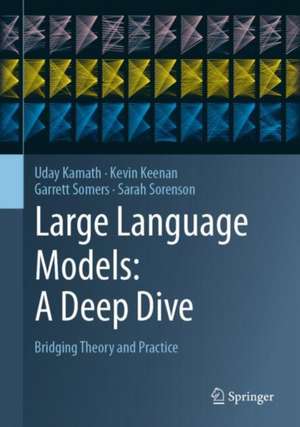
Large Language Models: A Deep Dive
Autor Uday Kamath, Kevin Keenan, Garrett Somers, Sarah Sorensonen Limba Engleză Hardback – 21 aug 2024
Notăm cu interes apariția Large Language Models: A Deep Dive, un volum de referință care se adresează cercetătorilor, inginerilor de date și arhitecților de sisteme AI care doresc să treacă dincolo de utilizarea superficială a interfețelor conversaționale. Lucrarea propune o incursiune tehnică riguroasă în mecanismele interne ale modelelor de limbaj de mari dimensiuni, de la bazele arhitecturii Transformer până la provocările complexe ale alinierii valorice prin învățare prin recompensă. Reținem precizia cu care autorii, conduși de Uday Kamath, structurează materialul: progresia este logică, pornind de la modele pre-antrenate și evoluând spre tehnici avansate de adaptare. Complementar volumului Building Applications with Large Language Models, care se concentrează pe arhitecturi specifice precum PaLM sau LLaMA, acest titlu oferă o perspectivă mai extinsă asupra întregului ecosistem, incluzând peste 50 de strategii pentru combaterea halucinațiilor și a problemelor de etică. În timp ce Mastering Prompt Engineering analizează în profunzime optimizarea interacțiunii prin text, Large Language Models: A Deep Dive plasează ingineria prompturilor într-un context mai larg, integrând-o cu sisteme de tip Retrieval-Augmented Generation (RAG) și implementări multimodale ce procesează audio și video. Această lucrare reprezintă o evoluție naturală în opera autorilor, care au documentat anterior tranziția către modelele moderne în Transformers for Machine Learning și au explorat interpretarea algoritmilor în Explainable Artificial Intelligence. Credem că valoarea adăugată constă în cele 9 tutoriale practice compatibile cu Google Colab, care transformă conceptele teoretice în abilități de implementare directă pentru sarcini complexe de procesare a limbajului natural.
Preț: 428.84 lei
Preț vechi: 536.04 lei
-20%
Carte disponibilă
Livrare economică 12-26 noiembrie
Specificații
ISBN-10: 3031656466
Pagini: 508
Ilustrații: Approx. 400 p.
Dimensiuni: 183 x 260 x 33 mm
Greutate: 1.09 kg
Ediția:2024
Editura: Springer
Locul publicării:Cham, Switzerland
V-ar putea interesa
-
 Using Artificial Intelligence Absolute Beginner's GuideMichael Miller-20%Preț: 201.72 lei252.15 lei
 -
 -20%Preț: 303.17 lei378.97 lei
 -
 -20%Preț: 249.68 lei312.11 lei
 -
 Understanding Deep LearningSimon J. D. Prince-20%Preț: 636.22 lei795.27 lei
 -
 Large Language ModelsStephan Raaijmakers-20%Preț: 91.43 lei114.29 lei
 -
 -39%Preț: 394.79 lei646.62 lei
 -
 -20%Preț: 823.96 lei1029.96 lei
 -
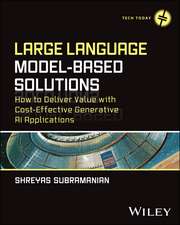 Large Language Model-Based SolutionsShreyas Subramanian-20%Preț: 289.38 lei361.73 lei
 -
 Agentic AI For DummiesPam Baker-20%Preț: 145.95 lei182.44 lei
 -
 The Essential Book of AIAnne Rooney-20%Preț: 76.61 lei95.77 lei
 -
 AI Agents in ActionMicheal Lanham-20%Preț: 340.84 lei426.05 lei
 -
 Effective Conversational AIAndrew Freed-20%Preț: 369.22 lei461.53 lei
 -
 How Large Language Models WorkDrew Farris-20%Preț: 343.59 lei429.49 lei
 -
 Build a Large Language Model (from Scratch)Sebastian Raschka-20%Preț: 342.35 lei427.93 lei
 -
 Llms in ProductionChristopher Brousseau-20%Preț: 337.81 lei422.26 lei
 -
 LLMs in ActionImmanuel Trummer-20%Preț: 219.46 lei274.33 lei
 -
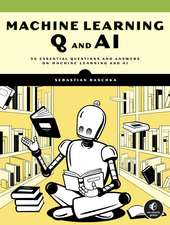 -20%Preț: 249.08 lei311.36 lei
 -
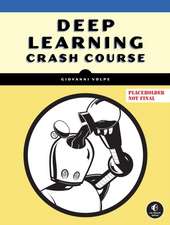 Deep Learning Crash CourseGiovanni Volpe-35%Preț: 290.92 lei445.81 lei
 -
 Engineering Information Systems with Large Language ModelsFrancesca de Luzi-24%Preț: 1016.50 lei1337.51 lei
 -
 AI for the Rest of Us: An Illustrated IntroductionSairam Sundaresan-45%Preț: 82.03 lei148.23 lei
De ce să citești această carte
Pentru specialiștii care vor să stăpânească arhitectura LLM dincolo de API-uri, acest volum oferă fundamentul tehnic necesar. Câștigați acces la peste 100 de tehnici de optimizare și 200 de benchmark-uri, esențiale pentru dezvoltarea unor modele robuste și etice. Este resursa ideală pentru a înțelege cum să integrați RAG și capabilități multimodale în aplicații industriale reale, beneficiind de expertiza unor autori consacrați în domeniul AI.
Despre autor
Echipa de autori, condusă de Uday Kamath, reunește experți de top în inteligență artificială și procesarea limbajului natural. Uday Kamath are o experiență vastă în dezvoltarea de soluții de învățare automată pentru industrii complexe, fiind autorul unor titluri de referință precum Deep Learning for NLP and Speech Recognition și Mastering Java Machine Learning. Alături de Kevin Keenan, Garrett Somers și Sarah Sorenson, acesta a contribuit la democratizarea conceptelor avansate de AI, punând accent pe echilibrul dintre rigoarea matematică și aplicabilitatea practică. Lucrările lor anterioare despre arhitecturile Transformer și etica în AI sunt considerate standarde în literatura tehnică actuală.
Descriere scurtă
Large Language Models (LLMs) have emerged as a cornerstone technology, transforming how we interact with information and redefining the boundaries of artificial intelligence. LLMs offer an unprecedented ability to understand, generate, and interact with human language in an intuitive and insightful manner, leading to transformative applications across domains like content creation, chatbots, search engines, and research tools. While fascinating, the complex workings of LLMs—their intricate architecture, underlying algorithms, and ethical considerations—require thorough exploration, creating a need for a comprehensive book on this subject.
This book provides an authoritative exploration of the design, training, evolution, and application of LLMs. It begins with an overview of pre-trained language models and Transformer architectures, laying the groundwork for understanding prompt-based learning techniques. Next, it dives into methods for fine-tuning LLMs, integrating reinforcement learning for value alignment, and the convergence of LLMs with computer vision, robotics, and speech processing. The book strongly emphasizes practical applications, detailing real-world use cases such as conversational chatbots, retrieval-augmented generation (RAG), and code generation. These examples are carefully chosen to illustrate the diverse and impactful ways LLMs are being applied in various industries and scenarios.
Readers will gain insights into operationalizing and deploying LLMs, from implementing modern tools and libraries to addressing challenges like bias and ethical implications. The book also introduces the cutting-edge realm of multimodal LLMs that can process audio, images, video, and robotic inputs. With hands-on tutorials for applying LLMs to natural language tasks, this thorough guide equips readers with both theoretical knowledge and practical skills for leveraging the full potential of large language models.
This comprehensive resource is appropriate for a wide audience: students, researchers and academics in AI or NLP, practicing data scientists, and anyone looking to grasp the essence and intricacies of LLMs.
Key Features:
- Over 100 techniques and state-of-the-art methods, including pre-training, prompt-based tuning, instruction tuning, parameter-efficient and compute-efficient fine-tuning, end-user prompt engineering, and building and optimizing Retrieval-Augmented Generation systems, along with strategies for aligning LLMs with human values using reinforcement learning
- Over 200 datasets compiled in one place, covering everything from pre- training to multimodal tuning, providing a robust foundation for diverse LLM applications
- Over 50 strategies to address key ethical issues such as hallucination, toxicity, bias, fairness, and privacy. Gain comprehensive methods for measuring, evaluating, and mitigating these challenges to ensure responsible LLM deployment
- Over 200 benchmarks covering LLM performance across various tasks, ethical considerations, multimodal applications, and more than 50 evaluation metrics for the LLM lifecycle
- Nine detailed tutorials that guide readers through pre-training, fine- tuning, alignment tuning, bias mitigation, multimodal training, and deploying large language models using tools and libraries compatible with Google Colab, ensuring practical application of theoretical concepts
- Over 100 practical tips for data scientists and practitioners, offering implementation details, tricks, and tools to successfully navigate the LLM life- cycle and accomplish tasks efficiently
Cuprins
1. Large Language Models: An Introduction.- 2. Pre-trained Models.- 3. Prompt-based Learning.- 4. LLM Adaptation and Utilization.- 5. Tuning for LLM Alignment.- 6. LLM Challenges and Solutions.- 7. Retrieval-Augmented Generation.- 8. LLMs in Production.- 9. Multimodal LLMs.- 10. LLMs: Evolution and New Frontiers.- Appendix.
Recenzii
– Ajit Jaokar, University of Oxford
I found this book on Large Language Models to be an invaluable guide and has now become my go to resource, as my team and I look to harness the power of LLMs within our product. With its comprehensive coverage and practical insights, this book is a must-read for anyone looking to understand and leverage the transformative power of LLMs in today’s AI-driven world.
--Shalini Govil Pai, Google
I found the book incredibly versatile and engaging, suitable for both developers and AI enthusiasts. The final chapter, which looks ahead at the future of Generative AI, is particularly insightful. I highly recommend it.
--Eduardo Ordaxo, Amazon
Notă biografică
Uday Kamath has 25 years of experience in analytical development and a Ph.D. in scalable machine learning. His significant contributions span numerous journals, conferences, books, and patents. Notable books include Applied Causal Inference, Explainable Artificial Intelligence, Transformers for Machine Learning, Deep Learning for NLP and Speech Recognition, Mastering Java Machine Learning, and Machine Learning: End-to-End Guide for Java Developers. Currently serving as the Chief Analytics Officer for Smarsh, his role encompasses spearheading data science and research in communication AI. He is also an active member of the Board of Advisors for entities, including commercial companies like Falkonry and academic institutions such as the Center for Human-Machine Partnership at GMU.
Kevin Keenan, Ph.D has more than 15 years of experience in the application of statistics, data analytics, and machine learning to real-world data across academia, cybersecurity, and financial services. Within these domains, he has specialized in the rigorous application of the scientific method, especially within scrappy commercial environments, where data quality and completeness are never ideal but from which immense value and insight can still be derived. With 8+ years of experience using NLP to surface human-mediated corporate, legal, and regulatory risk from communications and deep packet network traffic data, Kevin has successfully delivered machine learning applied to unstructured data at huge scales. He is the author of four published scientific papers in the academic field of Evolutionary Genetics, with over 1,400 citations, and is the author and maintainer of the open-source "diveRsity" project for population genetics research in the R statistical programming language.
Sarah Sorenson has spent over 15 years working in the software industry. She is a polyglot programmer, having done full-stack development in Python, Java, C#, and JavaScript at various times. She has spent the past ten years building machine learning capabilities and putting them into operation, primarily in the financial services domain. She has extensive experience in the application of machine learning to fraud detection and, most recently, has specialized in the development and deployment of NLP models for regulatory compliance on large-scale communications data at some of the world’s top banks.
Garrett Somers has been doing data-intensive research for over 10 years. Trained as an astrophysicist, he began his career studying X-ray emissions from distant black holes, before authoring his dissertation on numerical models of the evolving structure, spin, and magnetic fields of stars. He is the first author of eight peer-reviewed astrophysics articles totaling over 400 citations and the contributing author of an additional twenty-seven (over 4,000 citations in total). In 2019, he began a career in data science, specializing in applications of natural language processing to behavioral analysis in large communication corpora.