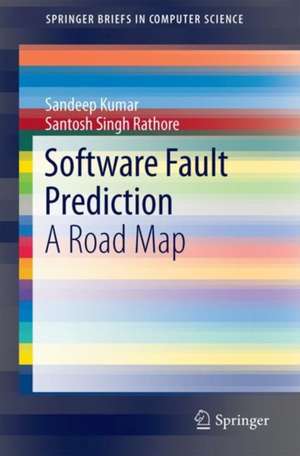
Software Fault Prediction: A Road Map: SpringerBriefs in Computer Science
Autor Sandeep Kumar, Santosh Singh Rathoreen Limba Engleză Paperback – 18 iun 2018
Lucrarea Software Fault Prediction se adresează profesioniștilor și cercetătorilor care dețin cunoștințe solide de inginerie software și statistică, oferind un fundament tehnic pentru construcția sistemelor robuste. Fiind publicată în seria SpringerBriefs in Computer Science, cartea adoptă un format dens și aplicat, eliminând redundanța în favoarea specificațiilor metodologice.
Recomandăm parcurgerea acestui volum ca pe o hartă a fiabilității sistemelor complexe. Structura este riguros secvențială: după stabilirea conceptelor de bază și a arhitecturii procesului în primele două capitole, autorii trec rapid la analiza critică a modelelor existente și a seturilor de date disponibile. Un aspect distinctiv este capitolul dedicat problemelor inerente seturilor de date de defecte software, un punct critic adesea ignorat în literatura generalistă. Cititorul care a aplicat ideile din Fault Prediction Modeling for the Prediction of Number of Software Faults de Santosh Singh Rathore va găsi aici o extindere necesară, trecând de la simpla predicție a numărului de erori la o evaluare comparativă a performanței diferitelor tehnici de clasificare.
În contextul operei autorului Sandeep Kumar, acest volum reprezintă o aplicare specifică a expertizei sale în inteligență artificială, vizibilă și în lucrarea Handbook of Research on Emerging Trends and Applications of Machine Learning. Dacă în lucrările anterioare accentul cădea pe algoritmi, aici accentul este pus pe metrici de performanță și pe predicția binară (prezența sau absența defectelor), oferind un instrumentar de lucru indispensabil pentru faza de testare și asigurare a calității.
Din seria SpringerBriefs in Computer Science
- 20%
 Preț: 312.38 lei
 - 20%
 Preț: 324.81 lei
 -
 Preț: 448.42 lei
 - 20%
 Preț: 315.57 lei
 -
 Preț: 404.69 lei
 - 20%
 Preț: 175.41 lei
 - 20%
 Preț: 282.99 lei
 -
 Preț: 477.41 lei
 - 20%
 Preț: 353.26 lei
 - 20%
 Preț: 310.56 lei
 -
 Preț: 379.07 lei
 - 20%
 Preț: 311.84 lei
 - 20%
 Preț: 323.75 lei
 - 20%
 Preț: 311.84 lei
 - 20%
 Preț: 311.04 lei
 - 20%
 Preț: 309.93 lei
 - 20%
 Preț: 310.23 lei
 - 20%
 Preț: 310.23 lei
 - 20%
 Preț: 323.94 lei
 - 20%
 Preț: 309.78 lei
 - 20%
 Preț: 309.30 lei
 - 20%
 Preț: 311.50 lei
 -
 Preț: 392.17 lei
 - 20%
 Preț: 325.21 lei
 - 20%
 Preț: 309.78 lei
 - 20%
 Preț: 310.73 lei
 - 20%
 Preț: 310.73 lei
 -
 Preț: 361.22 lei
 - 20%
 Preț: 311.84 lei
 - 20%
 Preț: 329.53 lei
 - 20%
 Preț: 310.73 lei
 - 20%
 Preț: 309.78 lei
 - 20%
 Preț: 311.04 lei
 - 20%
 Preț: 321.60 lei
 - 20%
 Preț: 311.18 lei
 - 20%
 Preț: 325.87 lei
 - 20%
 Preț: 311.04 lei
 - 47%
 Preț: 251.63 lei
 - 20%
 Preț: 311.18 lei
 -
 Preț: 359.92 lei
 - 20%
 Preț: 321.39 lei
 - 20%
 Preț: 309.93 lei
 - 20%
 Preț: 310.73 lei
 - 20%
 Preț: 311.50 lei
 -
 Preț: 360.85 lei
 - 20%
 Preț: 312.17 lei
 -
 Preț: 362.51 lei
 - 20%
 Preț: 312.17 lei
 - 20%
 Preț: 235.15 lei
Preț: 318.06 lei
Preț vechi: 397.57 lei
-20%
Carte disponibilă
Livrare economică 28 octombrie-11 noiembrie
Livrare express 13-17 octombrie pentru 21.37 lei
Specificații
ISBN-10: 9811087148
Pagini: 117
Ilustrații: XI, 72 p. 8 illus., 1 illus. in color.
Dimensiuni: 155 x 235 x 7 mm
Greutate: 0.17 kg
Ediția:1st ed. 2018
Editura: Springer Nature Singapore
Colecția Springer
Seria SpringerBriefs in Computer Science
Locul publicării:Singapore, Singapore
V-ar putea interesa
-
 -20%Preț: 212.82 lei266.02 lei
 -
 Reliability Engineering in the CloudCarlos RojasPreț: 313.93 lei
 -
 Modern Software EngineeringDavid Farley-20%Preț: 223.84 lei279.80 lei
 -
 Computer Architecture: A Quantitative ApproachJohn L. Hennessy-40%Preț: 530.11 lei881.24 lei
 -
 -39%Preț: 391.86 lei645.65 lei
 -
 Lessons Learned in Software Testing - A Context- Driven ApproachBret Pettichord-20%Preț: 258.03 lei322.54 lei
 -
 Software Estimation: Demystifying the Black ArtSteve McConnell-20%Preț: 216.56 lei270.70 lei
 -
 Code Complete: A practical handbook of software constructionSteve McConnell-20%Preț: 284.96 lei356.20 lei
 -
 -20%Preț: 377.89 lei472.36 lei
 -
 Coding For Dummies, All New EditionPaul McFedries-20%Preț: 115.33 lei144.16 lei
 -
 Agentic AI For DummiesPam Baker-20%Preț: 145.74 lei182.17 lei
 -
 Modern Software Testing TechniquesIstván Forgács-20%Preț: 216.44 lei270.55 lei
 -
 Software Architecture FundamentalsMahbouba Gharbi-20%Preț: 239.69 lei299.61 lei
 -
 -20%Preț: 844.88 lei1056.10 lei
 -
 Troubleshooting Java, Second EditionLaurentiu Spilca-20%Preț: 335.43 lei419.29 lei
 -
 Software TechnologiesHans-Georg Fill-20%Preț: 782.31 lei977.88 lei
 -
 Applied OSS Reliability Assessment Modeling, AI and ToolsYoshinobu Tamura-20%Preț: 471.01 lei588.76 lei
 -
 AI and MicroservicesDileep Kumar Pandiya-20%Preț: 263.90 lei329.88 lei
 -
 .NET 10 RevealedKajetan Duszy¿ski-20%Preț: 240.60 lei300.75 lei
De ce să citești această carte
Recomandăm această carte inginerilor QA și cercetătorilor care doresc să implementeze modele predictive pentru reducerea costurilor de dezvoltare. Cititorul câștigă o înțelegere clară a modului în care pot fi utilizate seturile de date istorice pentru a identifica modulele software predispuse la erori, optimizând astfel alocarea resurselor de testare prin metode validate statistic.
Despre autor
Sandeep Kumar și Santosh Singh Rathore sunt academicieni și cercetători recunoscuți în domeniul ingineriei software și al inteligenței artificiale. Sandeep Kumar are o vastă experiență editorială, contribuind la lucrări fundamentale despre Machine Learning și sisteme sustenabile, precum Artificial Intelligence and Sustainable Computing. Expertiza sa interdisciplinară, care acoperă de la biotehnologie la informatică biofarmaceutică, îi permite să abordeze predicția defectelor software dintr-o perspectivă sistemică riguroasă, specifică standardelor Springer.
Cuprins
Notă biografică
Dr Santosh Singh Rathore is currently working as an Assistant Professor in the Department of Computer Science and Engineering, National Institute of Technology (NIT) Jalandhar,India. He received his PhD degree from the Indian Institute of Technology Roorkee (IITR) and his master’s degree (M.Tech.) from the Indian Institute of Information Technology Design and Manufacturing (IIITDM) Jabalpur, India. His research interests include Software Fault Prediction, Software Quality Assurance, Empirical Software Engineering, Object-Oriented Software Development and Object-Oriented Metrics. He has published research papers in various peer-reviewed journals and international conference proceedings.
Textul de pe ultima copertă
The book will beof immense benefit to all readers who are interested in starting research in this area. In addition, it offers experienced researchers a valuable overview of the latest work in this area.