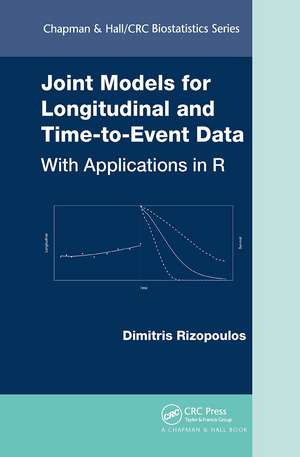
Joint Models for Longitudinal and Time-to-Event Data: With Applications in R: Chapman & Hall/CRC Biostatistics Series
Autor Dimitris Rizopoulosen Limba Engleză Paperback – 21 ian 2023
All illustrations put forward can be implemented in the R programming language via the freely available package JM written by the author.
All the R code used in the book is available at:
http://jmr.r-forge.r-project.org/
Din seria Chapman & Hall/CRC Biostatistics Series
- 9%
 Preț: 1388.37 lei
 - 9%
 Preț: 1135.32 lei
 - 9%
 Preț: 821.61 lei
 - 9%
 Preț: 969.20 lei
 -
 Preț: 455.93 lei
 - 5%
 Preț: 1079.79 lei
 -
 Preț: 492.93 lei
 - 15%
 Preț: 436.67 lei
 - 18%
 Preț: 1134.64 lei
 - 18%
 Preț: 892.90 lei
 -
 Preț: 481.14 lei
 - 18%
 Preț: 790.65 lei
 - 5%
 Preț: 1167.92 lei
 - 18%
 Preț: 924.53 lei
 - 15%
 Preț: 530.47 lei
 - 18%
 Preț: 1264.82 lei
 - 15%
 Preț: 552.07 lei
 - 5%
 Preț: 853.71 lei
 - 5%
 Preț: 877.12 lei
 - 18%
 Preț: 925.30 lei
 - 15%
 Preț: 561.84 lei
 - 18%
 Preț: 925.80 lei
 - 15%
 Preț: 540.75 lei
 - 18%
 Preț: 1125.63 lei
 - 18%
 Preț: 930.08 lei
 - 18%
 Preț: 1010.49 lei
 - 15%
 Preț: 562.20 lei
 -
 Preț: 491.22 lei
 - 5%
 Preț: 1315.61 lei
 - 15%
 Preț: 530.47 lei
 - 18%
 Preț: 722.07 lei
 -
 Preț: 490.14 lei
 - 18%
 Preț: 883.66 lei
 - 5%
 Preț: 467.20 lei
 - 18%
 Preț: 1264.91 lei
 - 5%
 Preț: 1085.31 lei
 - 18%
 Preț: 928.48 lei
 -
 Preț: 477.59 lei
 - 18%
 Preț: 1150.78 lei
 - 5%
 Preț: 2299.17 lei
 -
 Preț: 481.14 lei
 - 8%
 Preț: 435.55 lei
Preț: 439.99 lei
Puncte Express: 660
Carte disponibilă
Livrare economică 09-23 noiembrie
Livrare express 23-29 octombrie pentru 34.42 lei
Livrare prin curier în România Termenul estimat este afișat lângă disponibilitate.
Transport gratuit pentru acest produs Plată online sau ramburs, în funcție de opțiunile comenzii.
Retur gratuit în 14 zile Comandă securizată și suport în română.
Specificații
ISBN-13: 9781032477565
ISBN-10: 1032477563
Pagini: 278
Ilustrații: 36
Dimensiuni: 156 x 234 x 18 mm
Greutate: 0.44 kg
Ediția:1
Editura: CRC Press
Colecția Chapman and Hall/CRC
Seria Chapman & Hall/CRC Biostatistics Series
ISBN-10: 1032477563
Pagini: 278
Ilustrații: 36
Dimensiuni: 156 x 234 x 18 mm
Greutate: 0.44 kg
Ediția:1
Editura: CRC Press
Colecția Chapman and Hall/CRC
Seria Chapman & Hall/CRC Biostatistics Series
V-ar putea interesa
-
 Statistics in MedicineRobert H. Riffenburgh-28%Preț: 537.23 lei749.62 lei
 -
 Time Series: A Biostatistical IntroductionPeter Diggle-10%Preț: 332.57 lei371.17 lei
 -
 Presenting Medical Statistics from Proposal to PublicationJanet L. Peacock-21%Preț: 414.43 lei527.21 lei
 -
 -11%Preț: 427.72 lei480.57 lei
 -
 The Elements of Statistical LearningTrevor Hastie-20%Preț: 546.54 lei683.17 lei
 -
 -8%Preț: 437.71 lei475.77 lei
 -
 -9%Preț: 1388.37 lei1525.67 lei
 -
 Handbook of Regression Analysis With Applications in RJeffrey S. Simonoff-23%Preț: 803.24 lei1043.17 lei
 -
 R-ticulateMartin Bader-23%Preț: 655.33 lei851.08 lei
 -
 Nonparametric Hypothesis TestingStefano Bonnini-19%Preț: 498.79 lei615.78 lei
 -
 Statistical Analysis with R For DummiesJoseph Schmuller-20%Preț: 145.37 lei181.71 lei
 -
 Statistical Analysis with Python For DummiesJoseph SchmullerPreț: 197.44 lei
 -
 -8%Preț: 436.19 lei474.11 lei
 -
 Longitudinal Structural Equation Modeling, Second EditionTodd D. Little-15%Preț: 594.84 lei699.81 lei
 -
 -15%Preț: 461.63 lei543.09 lei
 -
 -9%Preț: 824.13 lei905.64 lei
 -
 The Art of R ProgrammingNorman Matloff-35%Preț: 253.50 lei392.87 lei
 -
 -8%Preț: 612.34 lei665.59 lei
 -
 Statistics for ScientistsUmberto Michelucci-20%Preț: 275.88 lei344.84 lei
 -
 Stochastic Models, Statistics and Their ApplicationsAnsgar Steland-20%Preț: 1193.96 lei1492.45 lei
Public țintă
Professional Practice & DevelopmentCuprins
Introduction. Analysis of Longitudinal Data. Analysis of Time-to-Event Data. Joint Models for Longitudinal and Time-to-Event Data. Extensions of the Standard Joint Model. Diagnostics. Survival Probabilities and Prospective Accuracy Measures.
Recenzii
"Overall, the book provides a nice introduction to joint models and the R package "JM". It is well written, readable, and comprehensive. With the availability of the R package for joint models, it is expected that joint models will become increasingly popular in practice, especially in medical research. In summary, the book makes an important contribution to the research and application of joint models."
—Lang Wu, Department of Statistics, The University of British Columbia, Vancouver, Canada, in the Journal of Biopharmaceutical Statistics
"The book is well written in a matter-of-fact style that makes even unfamiliar readers understand the concept of joint models and furthermore provides them with a guide for getting started with their own analysis. The more joint model-savvy reader will, on the other hand, find inspiration for further foraging into the subject of model extensions, diagnostics, prediction, and accuracy. … a handy guide for anyone with a need to analyze survival data in the presence of a time-dependent covariate that is measured several times. As the author incorporates a longitudinal model for such a covariate into the relative risk regression modeling framework, we observe the advantage of being able to account for measurement errors within our covariate; a fortification of our research outcomes. All in all a satisfying book on joint models with a solid payout for fellow researchers."
—Maral Saadati, Biometrical Journal, 55, 2013
"This new addition to the genre is based on the JM package written by the author and has been done well. … I particularly liked the sections on numerical methods, which manage to give a useful overview of what the package is actually doing but without scaring off the mathematically reluctant. The dreaded problem of non-convergence is met head-on, with an illustration and discussion of how a little knowledge of the fitting algorithms can help to overcome such problems. This alone is worth the price of the book! … To summarize, this is a very well-crafted introduction to an active research area that I would recommend to anyone interested in getting into this field or in learning to analyze such data."
—Geoff Jones, Australian & New Zealand Journal of Statistics, 2013
"The book is well written in a matter-of-fact style that makes even unfamiliar readers understand the concept of joint models and furthermore provides them with a guide for getting started with their own analysis. The more joint model-savvy reader will, on the other hand, find inspiration for further foraging into the subject of model extensions, diagnostics, prediction, and accuracy. … a handy guide for anyone with a need to analyze survival data in the presence of a time-dependent covariate that is measured several times. As the author incorporates a longitudinal model for such a covariate into the relative risk regression modeling framework, we observe the advantage of being able to account for measurement errors within our covariate; a fortification of our research outcomes. All in all a satisfying book on joint models with a solid payout for fellow researchers."
—Maral Saadati, Biometrical Journal, 55, 2013
"This new addition to the genre is based on the JM package written by the author and has been done well. … I particularly liked the sections on numerical methods, which manage to give a useful overview of what the package is actually doing but without scaring off the mathematically reluctant. The dreaded problem of non-convergence is met head-on, with an illustration and discussion of how a little knowledge of the fitting algorithms can help to overcome such problems. This alone is worth the price of the book! … To summarize, this is a very well-crafted introduction to an active research area that I would recommend to anyone interested in getting into this field or in learning to analyze such data."
—Geoff Jones, Australian & New Zealand Journal of Statistics, 2013
—Lang Wu, Department of Statistics, The University of British Columbia, Vancouver, Canada, in the Journal of Biopharmaceutical Statistics
"The book is well written in a matter-of-fact style that makes even unfamiliar readers understand the concept of joint models and furthermore provides them with a guide for getting started with their own analysis. The more joint model-savvy reader will, on the other hand, find inspiration for further foraging into the subject of model extensions, diagnostics, prediction, and accuracy. … a handy guide for anyone with a need to analyze survival data in the presence of a time-dependent covariate that is measured several times. As the author incorporates a longitudinal model for such a covariate into the relative risk regression modeling framework, we observe the advantage of being able to account for measurement errors within our covariate; a fortification of our research outcomes. All in all a satisfying book on joint models with a solid payout for fellow researchers."
—Maral Saadati, Biometrical Journal, 55, 2013
"This new addition to the genre is based on the JM package written by the author and has been done well. … I particularly liked the sections on numerical methods, which manage to give a useful overview of what the package is actually doing but without scaring off the mathematically reluctant. The dreaded problem of non-convergence is met head-on, with an illustration and discussion of how a little knowledge of the fitting algorithms can help to overcome such problems. This alone is worth the price of the book! … To summarize, this is a very well-crafted introduction to an active research area that I would recommend to anyone interested in getting into this field or in learning to analyze such data."
—Geoff Jones, Australian & New Zealand Journal of Statistics, 2013
"The book is well written in a matter-of-fact style that makes even unfamiliar readers understand the concept of joint models and furthermore provides them with a guide for getting started with their own analysis. The more joint model-savvy reader will, on the other hand, find inspiration for further foraging into the subject of model extensions, diagnostics, prediction, and accuracy. … a handy guide for anyone with a need to analyze survival data in the presence of a time-dependent covariate that is measured several times. As the author incorporates a longitudinal model for such a covariate into the relative risk regression modeling framework, we observe the advantage of being able to account for measurement errors within our covariate; a fortification of our research outcomes. All in all a satisfying book on joint models with a solid payout for fellow researchers."
—Maral Saadati, Biometrical Journal, 55, 2013
"This new addition to the genre is based on the JM package written by the author and has been done well. … I particularly liked the sections on numerical methods, which manage to give a useful overview of what the package is actually doing but without scaring off the mathematically reluctant. The dreaded problem of non-convergence is met head-on, with an illustration and discussion of how a little knowledge of the fitting algorithms can help to overcome such problems. This alone is worth the price of the book! … To summarize, this is a very well-crafted introduction to an active research area that I would recommend to anyone interested in getting into this field or in learning to analyze such data."
—Geoff Jones, Australian & New Zealand Journal of Statistics, 2013
Notă biografică
Dimitris Rizopoulos is an Assistant Professor at the Department of Biostatistics of the Erasmus University Medical Center in the Netherlands. Dr. Rizopoulos received his M.Sc. in Statistics in 2003 from the Athens University of Economics and Business, and a Ph.D. in Biostatistics in 2008 from the Katholieke Universiteit Leuven.
Dr. Rizopoulos wrote his dissertation, as well as a number of methodological articles on various aspects of joint models for longitudinal and time-to-event data. He currently serves as an Associate Editor for Biometrics and Biostatistics, and has been a guest editor for a special issue in joint modeling techniques in Statistical Methods in Medical Research.
Dr. Rizopoulos wrote his dissertation, as well as a number of methodological articles on various aspects of joint models for longitudinal and time-to-event data. He currently serves as an Associate Editor for Biometrics and Biostatistics, and has been a guest editor for a special issue in joint modeling techniques in Statistical Methods in Medical Research.
Descriere
Longitudinal studies often investigate how a marker that is repeatedly measured in time is associated with a time to an event of interest. An example is prostate cancer studies where longitudinal PSA level measurements are collected in conjunction with the time-to-recurrence. This book provides a full treatment of joint models for longitudinal a