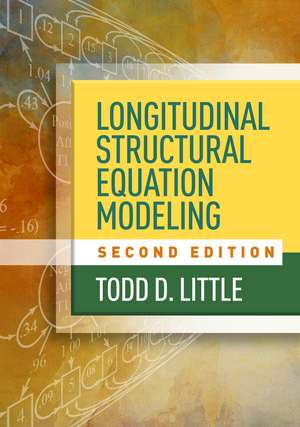
Longitudinal Structural Equation Modeling, Second Edition
Autor Todd D. Littleen Limba Engleză Hardback – 7 feb 2024
Evoluția metodologiilor de cercetare în științele sociale a impus în ultimul deceniu o trecere de la analizele statice la modele capabile să surprindă dinamica schimbării umane în timp. Putem afirma că a doua ediție a lucrării Longitudinal Structural Equation Modeling reprezintă un răspuns direct la această nevoie de rafinare statistică, integrând progrese recente care nu erau disponibile la momentul primei ediții. Descoperim aici o structură riguroasă care ghidează cititorul de la fundamentele conceptuale ale SEM și problemele de design în studiile longitudinale, până la tehnici avansate de modelare a proceselor de dezvoltare.
Notăm cu interes adăugarea unor secțiuni esențiale despre modelul RI-CLPM și SEM Bayesian, elemente care transformă această ediție dintr-o actualizare minoră într-un instrument de lucru indispensabil. Autorul Todd D. Little își valorifică expertiza recunoscută în tehnici de eficientizare a indicatorilor, temă explorată anterior în Parceling in Structural Equation Modeling, oferind acum un cadru mai larg pentru analiza schimbării intra-individuale. Spre deosebire de The Oxford Handbook of Quantitative Methods in Psychology, Vol. 1, unde abordarea este enciclopedică, volumul de față este focalizat aplicat pe mecanismele longitudinale.
Această ediție constituie o alternativă solidă la An Introduction to Latent Variable Growth Curve Modeling pentru cursurile de psihometrie sau metodologie avansată, cu avantajul unei acoperiri mai vaste a modelelor hibride și a tratamentului datelor lipsă prin pachete software moderne precum PcAux. Organizarea capitolelor, care includ glosare și recomandări bibliografice adnotate, facilitează o progresie logică de la construcția modelului de măsurare la testarea efectelor experimentale complexe.
Preț: 594.84 lei
Preț vechi: 699.81 lei
-15%
Carte disponibilă
Livrare economică 10-24 noiembrie
Livrare express 24-30 octombrie pentru 102.62 lei
Specificații
ISBN-10: 1462553141
Pagini: 616
Dimensiuni: 178 x 254 x 37 mm
Greutate: 1.22 kg
Ediția:2nd edition
Editura: Guilford Publications
Colecția Guilford Press
De ce să citești această carte
Recomandăm această lucrare cercetătorilor și studenților avansați care doresc să stăpânească analiza datelor longitudinale. Cititorul câștigă acces la tehnici de ultimă oră, precum modelarea mixtă și SEM Bayesian, explicate printr-o metodologie orientată spre decizie. Este un ghid practic esențial care elimină barierele tehnice prin exemple concrete și fișiere de sintaxă gata de utilizat în proiecte de cercetare reale.
Despre autor
Todd D. Little este profesor de psihologie la Universitatea din Kansas, unde coordonează programul de formare cantitativă. Cu un doctorat în psihologia dezvoltării obținut la University of California - Riverside, cercetările sale se concentrează pe autoreglare și pe aplicarea analizelor cantitative complexe în studiul schimbării comportamentale. Este recunoscut la nivel internațional pentru contribuțiile sale în domeniul modelării prin ecuații structurale și pentru capacitatea de a sintetiza metodologii statistice dificile în ghiduri accesibile pentru comunitatea academică.
Notă biografică
Recenzii
"As with the first edition, Little has created not just a wonderful academic resource, but a longitudinal research companion. The second edition features incredibly lucid explanations, useful modeling tips, an extremely accessible style, and cutting-edge updated and new content. Graduate students as well as applied researchers will feel a lot more confident planning for, wading into, and making sense of the intricacies of their longitudinal and developmental phenomena."--Gregory R. Hancock, PhD, Department of Human Development and Quantitative Methodology, University of Maryland, College Park
"In its second edition, this remains the definitive text on longitudinal SEM. The biggest strength of all the chapters is that they follow a clear organization and flow. Basic issues are presented first, followed by more advanced issues, and, finally, an example or two of the topic, with real data."--Kristin D. Mickelson, PhD, School of Social and Behavioral Sciences, Arizona State University
"Longitudinal SEM is tricky, even for people who have experience with factor analysis and other related models. I recommend the second edition of this book to applied researchers looking for a nontechnical overview. It will help readers build their intuitive understanding of the models, which can provide a foundation for future study."--Ed Merkle, PhD, Department of Psychological Sciences, University of Missouri–Columbia
"The equation boxes are a really nice touch that make it easier for readers to decipher the content in the equations. I am used to seeing notation detailed in paragraph-style text under an equation, but I am sold--this is a much clearer presentation style."--Sarah Depaoli, PhD, Department of Psychological Sciences, University of California, Merced-
Cuprins
1. Overview and Foundations of Structural Equation Modeling
- An Overview of the Conceptual Foundations of SEM
- Sources of Variance in Measurement
- Characteristics of Indicators and Constructs
- A Simple Taxonomy of Indicators and Their Roles
- Rescaling Variables
- Parceling
- What Changes and How?
- Some Advice for SEM Programming
- Philosophical Issues and How I Approach Research
- Summary
- Key Terms and Concepts Introduced in This Chapter
- Recommended Readings
2. Design Issues in Longitudinal Studies
- Timing of Measurements and Conceptualizing Time
- Modeling Developmental Processes in Context
- Summary
- Key Terms and Concepts Introduced in This Chapter
- Recommended Readings
3. Modern Approaches to Missing Data in Longitudinal Studies
- Planning for Missing Data
- Planned Missing Data Designs in Longitudinal Research
- Summary
- Key Terms and Concepts Introduced in This Chapter
- Recommended Readings
4. The Measurement Model
- Drawing and Labeling Conventions
- Defining the Parameters of a Construct
- Scale Setting
- Identification
- Adding Means to the Model: Scale Setting and Identification with Means
- Adding a Longitudinal Component to the CFA Model
- Adding Phantom/Rescaling Constructs to the CFA Model
- Summary
- Key Terms and Concepts Introduced in This Chapter
- Recommended Readings
5. Model Fit, Sample Size, and Power
- Model Fit and Types of Fit Indices
- Sample Size
- Power
- Summary
- Key Terms and Concepts Introduced in This Chapter
- Recommended Readings
6. The Longitudinal CFA Model
- Factorial Invariance
- A Small (Nearly Perfect) Data Example
- A Larger Example Followed by Tests of the Latent Construct Relations
- An Application of a Longitudinal SEM to a Repeated‑Measures Experiment
- Summary
- Key Terms and Concepts Introduced in This Chapter
- Recommended Readings
7. Specifying and Interpreting a Longitudinal Panel Model
- Basics of a Panel Model
- The Basic Simplex Change Process
- Building a Panel Model
- Illustrative Examples of Panel Models
- Summary
- Key Terms and Concepts Introduced in This Chapter
- Recommended Readings
8. Multiple-Group Longitudinal Models
- A Multiple-Group SEM
- A Multiple-Group Longitudinal Model for Conducting an Intervention Evaluation
- A Dynamic P-Technique Multiple‑Group Longitudinal Model
- Summary
- Key Terms and Concepts Introduced in This Chapter
- Recommended Readings
9. The Random Intercept Cross-Lagged Panel Model, Danny Osborne and Todd D. Little
- Problems with Traditional Cross-Lagged Panel Models
- The Random Intercept Cross‑Lagged Panel Model
- Illustrative Examples of the RI‑CLPM
- Extensions to the RI‑CLPM
- Final Considerations
- Summary
- Key Terms and Concepts Introduced in This Chapter
- Recommended Readings
10. Mediation and Moderation
- Making the Distinction between Mediators and Moderators
- Moderation
- Summary
- Key Terms and Concepts Introduced in This Chapter
- Recommended Readings
11. Multilevel Growth Curves and Multilevel SEM
- Longitudinal Growth Curve Model
- Multivariate Growth Curve Models
- Multilevel Longitudinal Model
- Summary
- Key Terms and Concepts Introduced in This Chapter
- Recommended Readings
12. Longitudinal Mixture Modeling: Finding Unknown Groups, E. Whitney G. Moore and Todd D. Little
- General Background
- Analysis Types
- Finite Mixture Modeling Overview
- Latent Class Analysis
- Latent Profile Analysis
- Latent Transition Analysis
- Other LTA Modeling Approaches
- Developments and Extensions into the Future of Finite Mixture Modeling
- Summary
- Key Terms and Concepts Introduced in This Chapter
- Recommended Readings
13. Bayesian Longitudinal Structural Equation Modeling, Mauricio Garnier-Villarreal and Todd D. Little
- The Bayesian Perspective
- Bayesian Inference
- Advantages of a Bayesian Framework
- MCMC Estimation
- Bayesian Structural Equation Modeling
- Information Criteria
- Bayes Factor
- Applied Example
- Summary
- Key Terms and Concepts Introduced in This Chapter
- Recommended Readings
14. Jambalaya: Complex Construct Representations and Decompositions
- Multitrait–Multimethod Models
- Pseudo‑MTMM Models
- Bifactor and Higher‑Order Factor Models
- Contrasting Different Variance Decompositions
- Digestif
- Key Terms and Concepts Introduced in This Chapter
- Recommended Readings
References
Author Index
Subject Index
About the Author
Descriere scurtă
New to This Edition:
*Chapter on missing data, with a spotlight on planned missing data designs and the R-based package PcAux.
*Chapter on longitudinal mixture modeling, with Whitney Moore.
*Chapter on the random intercept cross-lagged panel model (RI-CLPM), with Danny Osborne.
*Chapter on Bayesian SEM, with Mauricio Garnier.
*Revised throughout with new developments and discussions, such as how to test models of experimental effects.