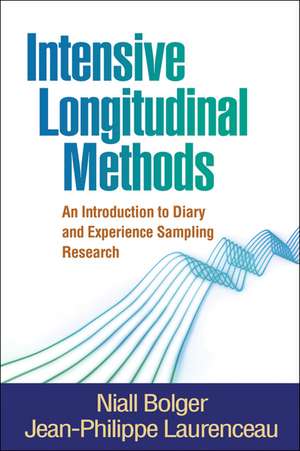
Intensive Longitudinal Methods: An Introduction to Diary and Experience Sampling Research: Methodology in the Social Sciences
Autor Niall Bolger, Jean-Philippe Laurenceauen Limba Engleză Hardback – 9 apr 2013
Descoperim în Intensive Longitudinal Methods un volum care vine să completeze o lacună critică în literatura de specialitate: lipsa unui ghid practic integrat pentru analiza proceselor psihologice și sociale care se desfășoară în timp real, în contexte naturale. În timp ce manualele clasice de statistică se concentrează pe măsurători punctuale, lucrarea semnată de Niall Bolger și Jean-Philippe Laurenceau oferă instrumentele necesare pentru a studia dinamica zilnică a indivizilor și grupurilor prin metode de eșantionare a experienței.
Considerăm că forța acestui volum rezidă în abordarea aplicată a modelelor multinivel pentru designuri intra-subiect (within-subject). Cartea este organizată progresiv: începe cu definirea și justificarea metodelor intensive, trece prin tipologia designurilor de cercetare și fundamentele datelor longitudinale, culminând cu tehnici avansate de modelare pentru rezultate continue sau categoriale. Spre deosebire de Handbook of Research Methods for Studying Daily Life, care oferă o privire de ansamblu enciclopedică asupra instrumentelor de măsurare, acest volum este mult mai focalizat pe execuția statistică și pe prezentarea rezultatelor pentru publicare.
Credem că experiența de lectură este facilitată de numeroasele exemple practice. Autorii nu se limitează la teorie, ci oferă seturi de date ce pot fi procesate în diverse medii software, de la SPSS la R. Această lucrare continuă preocuparea lui Niall Bolger pentru studiul individului în mediul său, temă centrală și în Persons in Context, dar aici accentul se mută de pe cadrul sociologic pe rigoarea metodologică necesară capturării schimbării în timp real.
Din seria Methodology in the Social Sciences
- 8%
 Preț: 501.84 lei
 - 15%
 Preț: 644.31 lei
 - 9%
 Preț: 654.93 lei
 - 8%
 Preț: 626.26 lei
 -
 Preț: 441.14 lei
 - 8%
 Preț: 483.60 lei
 - 15%
 Preț: 592.74 lei
 - 15%
 Preț: 513.12 lei
 - 15%
 Preț: 570.22 lei
 -
 Preț: 341.59 lei
 -
 Preț: 390.20 lei
 -
 Preț: 518.89 lei
 -
 Preț: 435.59 lei
 - 8%
 Preț: 511.92 lei
 - 24%
 Preț: 359.40 lei
 - 11%
 Preț: 392.41 lei
 - 10%
 Preț: 367.05 lei
 - 22%
 Preț: 405.79 lei
 - 10%
 Preț: 356.08 lei
 - 9%
 Preț: 506.26 lei
Preț: 436.19 lei
Preț vechi: 474.11 lei
-8%
Carte disponibilă
Livrare economică 12-26 noiembrie
Livrare express 28 octombrie-03 noiembrie pentru 35.15 lei
Specificații
ISBN-10: 146250678X
Pagini: 256
Ilustrații: Illustrations
Dimensiuni: 156 x 234 x 22 mm
Greutate: 0.5 kg
Ediția:1
Editura: Guilford Publications
Colecția Guilford Press
Seria Methodology in the Social Sciences
V-ar putea interesa
-
 Statistics in MedicineRobert H. Riffenburgh-28%Preț: 537.23 lei749.62 lei
 -
 Explanation in Causal Inference: Methods for Mediation and InteractionTyler VanderWeele-32%Preț: 832.54 lei1223.71 lei
 -
 Statistical Concepts - A Second CourseDebbie L. Hahs-Vaughn-13%Preț: 486.78 lei559.52 lei
 -
 Oh's Intensive Care ManualJonathan M. Handy-29%Preț: 692.37 lei971.74 leiRecomandat
 -
 MeditationsMarcus AureliusPreț: 34.00 lei
 -
 Research Methods and Statistics in PsychologyHugh Coolican-8%Preț: 466.30 lei506.85 lei
 -
 An Introduction to Applied Statistics: With Step-By-Step SPSS InstructionsJr. Edward T. Vieira-9%Preț: 669.64 lei735.86 lei
 -
 -9%Preț: 1388.37 lei1525.67 lei
 -
 -18%Preț: 499.50 lei609.15 lei
 -
 Preț: 382.13 lei
 -
 Designing Small Evaluation StudiesElizabeth Tipton-18%Preț: 500.82 lei610.76 lei
 -
 The Cambridge Handbook of Research Methods in Clinical PsychologyAidan G C Wright-5%Preț: 1637.96 lei1724.16 lei
 -
 Preț: 409.53 lei
 -
 -8%Preț: 483.60 lei525.66 lei
 -
 Dyadic Data AnalysisDavid A. KennyPreț: 450.29 lei
 -
 Longitudinal Structural Equation Modeling, Second EditionTodd D. Little-15%Preț: 594.84 lei699.81 lei
 -
 -15%Preț: 444.23 lei522.63 lei
 -
 -15%Preț: 461.63 lei543.09 lei
 -
 Meta-Analysis for PsychologistsRichard Cooke-5%Preț: 303.22 lei319.18 lei
 -
 Statistics for ScientistsUmberto Michelucci-20%Preț: 279.62 lei349.53 lei
Public țintă
Professional Practice & DevelopmentDe ce să citești această carte
Recomandăm această carte cercetătorilor și studenților la doctorat care doresc să depășească limitele studiilor de laborator. Cititorul câștigă competențe clare în utilizarea modelelor multinivel pentru date de tip jurnal, beneficiind de exemple concrete și coduri de programare gata de utilizat. Este resursa esențială pentru a transforma datele brute colectate din viața cotidiană în concluzii științifice publicabile și riguroase.
Despre autor
Niall Bolger și Jean-Philippe Laurenceau sunt autorități recunoscute în metodologia cercetării psihologice. Bolger, profesor la Columbia University, s-a remarcat prin studiile sale asupra stresului și relațiilor interpersonale, explorând constant cum mediul social influențează dezvoltarea individuală, temă abordată și în lucrarea sa Persons in Context. Laurenceau, profesor la University of Delaware, este expert în studiul proceselor dinamice în cupluri. Împreună, au sintetizat zeci de ani de experiență în cercetare longitudinală pentru a crea acest manual de referință în cadrul seriei Methodology in the Social Sciences.
Descriere scurtă
Cuprins
1.1 What Are Intensive Longitudinal Methods?
1.2 Applications of Intensive Longitudinal Methods
1.3 Why Use Intensive Longitudinal Methods?
1.4 Goals for This Book and Intended Audience
1.5 Organization of This Book
1.6 Recommended Readings
2. Types of Intensive Longitudinal Designs
2.1 Chapter Overview
2.2 Strengths of Intensive Longitudinal Designs
2.3 Types of Research Questions
2.4 Types of Designs and Prototypical Examples
2.5 Limitations of Intensive Longitudinal Designs
2.6 Which Intensive Longitudinal Design Is Best for You?
2.7 Chapter Summary
2.8 Recommended Readings
3. Fundamentals of Intensive Longitudinal Data
3.1 Chapter Overview
3.2 An Example Dataset
3.3 Between-Subjects and Within-Subjects Levels of Analysis
3.4 Allowing for Between-Subjects Heterogeneity: Random Effects
3.5 Taking Account of Time
3.6 How Many Independent Units Are There in Intensive Longitudinal Datasets?
3.7 Choosing an Appropriate Zero Point For X
3.8 Chapter Summary
3.9 Recommended Readings
4. Modeling the Time Course of Continuous Outcomes
4.1 Chapter Overview
4.2 The Example Intervention Dataset
4.3 An Application of Linear Growth Curve Analysis
4.4 Example Write-Up of Intervention Study Data
4.5 Chapter Summary
4.6 Recommended Readings
5. Modeling the Within-Subject Causal Process
5.1 Chapter Overview
5.2 Conceptualizing a Within-Subject Causal Process
5.3 Example Daily Conflict and Intimacy Dataset
5.4 Multilevel Causal Model Linking Daily Conflict and Intimacy
5.5 Modeling a Process with Missing Repeated Measures Data
5.6 When the Intervals between Measurements Are Unequal
5.7 Example Write-Up of Daily Conflict Study Data
5.8 Chapter Summary
5.9 Recommended Readings
6. Modeling Categorical Outcomes
6.1 Chapter Overview
6.2 Exploring the Example Dataset
6.3 A Longitudinal Multilevel Model Linking Morning Anger to the Incidence of Daily Conflict in Couples
6.4 Implementation in SAS PROC GLIMMIX
6.5 Implementation in IBM SPSS GENLINMIXED
6.6 Implementation in Mplus
6.7 Chapter Summary
6.8 Recommended Readings
7. Psychometrics of Intensive Longitudinal Measures of Emotional States
7.1 Chapter Overview
7.2 Basic Ideas about Random Measurement Error
7.3 Making Use of Generalizability Theory
7.4 Making Use of Multilevel Confirmatory Factor Analysis
7.5 Chapter Summary
7.6 Recommended Readings
8. Design and Analysis of Intensive Longitudinal Studies of Distinguishable Dyads
8.1 Chapter Overview
8.2 Motivation for Studying the Everyday Lives of Dyads
8.3 Methodological and Design Issues in Intensive Longitudinal Studies of Distinguishable Dyads
8.4 The Multilevel Model for Intensive Longitudinal Data from Distinguishable Dyads
8.5 Example Write-Up of Dyadic Study Data
8.6 Chapter Summary
8.7 Recommended Readings
9. Within-Subject Mediation Analysis
9.1 Chapter Overview
9.2 Single-Level Mediation to Multilevel Mediation
9.3 Empirical Example
9.4 Implementing Within-Subject Mediation in Statistical Software
9.5 Interpretation of Results
9.6 Chapter Summary
9.7 Recommended Readings
10. Statistical Power for Intensive Longitudinal Designs
10.1 Chapter Overview
10.2 Approaches to Power
10.3 Power in Multilevel Models
10.4 Power for the Marital Therapy and Intimacy Example
10.5 Power for the Daily Conflicts and Intimacy Example
10.6 Power Analysis for the Daily Conflict Categorical Outcomes Example
10.7 Power for the Dyadic Process Example
10.8 Power for the Within-Subject Multilevel Mediation Example
10.9 Chapter Summary
10.10 Recommended Readings
Notă biografică
Jean-Philippe Laurenceau, PhD, is Professor of Psychology at the University of Delaware. He is an appointed member of the Social, Personality, and Interpersonal Processes grant review panel of the National Institutes of Health. Dr. Laurenceau's research focuses on understanding the processes by which partners in marital and romantic relationships develop and maintain intimacy in the context of everyday life. His methodological interests include intensive longitudinal methods for studying close relationship processes and applications of modern methods for the analysis of change in individuals and dyads.
Recenzii
"In a remarkably short period of time, intensive longitudinal designs have become a staple of the behavioral scientist's toolbox, yet researchers do not always know how to make the most of their data. This is the book we have been waiting for. Bolger and Laurenceau have written a complete, authoritative, and highly accessible volume that is sure to set the standard for years to come. Researchers and students will find this landmark volume to be an essential resource."--Harry T. Reis, PhD, Department of Clinical and Social Sciences in Psychology, University of Rochester
"Bolger and Laurenceau have put together a fantastic primer. The well-crafted and clearly explained background, examples, datasets, and programming codes make this a go-to book for learning how to prepare, analyze, and make the most of intensive longitudinal data. Both instructors and students will appreciate the straightforward, highly readable format. This book's pages are sure to get well worn."--Nilam Ram, PhD, Department of Human Development and Family Studies and Department of Psychology, The Pennsylvania State University
"A valuable and immensely practical resource from two of the world's intensive longitudinal masters. This book is a 'must read' for researchers. Each chapter provides detailed, step-by step guidance on basic to advanced analytic techniques, including exemplar data sets, visual imagery, complete statistical code, and sample write-ups. From spaghetti plots to power analysis, with Bolger and Laurenceau as expert guides, researchers will learn what to do, how to do it, and how to write it up."--Tamlin S. Conner, PhD, Department of Psychology, University of Otago, New Zealand
"This book details exactly how to analyze data gathered from diary and experience sampling studies. In clear language and with real data, it explains how to use multilevel modeling to answer common types of research questions. To make the presentation complete, syntax for SPSS, SAS, and Mplus is provided. Researchers and graduate students conducting studies of daily life will find this book indispensable. I would use it as a text in a graduate-level research methods class and as a resource when designing and conducting my own analyses."--Joel M. Hektner, PhD, Department of Human Development and Family Science, North Dakota State University
"This book couldn’t have come at a better time. All too often, investigators are not sure how to deal with the vast amounts of data they collect using diary methods, and do not fully appreciate the strengths and limitations of their data. This book, in my opinion, is the cure."--Howard Tennen, PhD, Department of Community Medicine and Health Care, University of Connecticut Health Center
"Intensive longitudinal research yields uniquely rich data, but the analyses quickly get complex. Bolger and Laurenceau give researchers the necessary tools and knowledge to conduct and analyze their own intensive longitudinal studies. Using to-the-point explanations and helpful, realistic examples, the book goes step by step through everything there is to know, from the very basics to advanced data-analytic issues--and does so in a delightfully engaging manner."--Matthias R. Mehl, PhD, Department of Psychology, University of Arizona
"The book addresses cutting-edge quantitative approaches to within-subject causal modeling of change while illustrating how researchers can combine rich qualitative data with powerful mixed-modeling approaches. I will definitely use this book in extending my own research related to these types of scenarios."--Larry R. Price, PhD, Director, Initiative for Interdisciplinary Research Design and Analysis, Texas State University