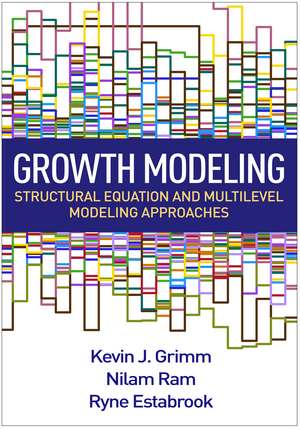
Growth Modeling: Structural Equation and Multilevel Modeling Approaches: Methodology in the Social Sciences
Autor Kevin J. Grimm, Nilam Ram, Ryne Estabrooken Limba Engleză Hardback – 2 noi 2016
Growth models are among the core methods for analyzing how and when people change. Discussing both structural equation and multilevel modeling approaches, this book leads readers step by step through applying each model to longitudinal data to answer particular research questions. It demonstrates cutting-edge ways to describe linear and nonlinear change patterns, examine within-person and between-person differences in change, study change in latent variables, identify leading and lagging indicators of change, evaluate co-occurring patterns of change across multiple variables, and more. User-friendly features include real data examples, code (for Mplus or NLMIXED in SAS, and OpenMx or nlme in R), discussion of the output, and interpretation of each model's results.
User-Friendly Features
*Real, worked-through longitudinal data examples serving as illustrations in each chapter.
*Script boxes that provide code for fitting the models to example data and facilitate application to the reader's own data.
*"Important Considerations" sections offering caveats, warnings, and recommendations for the use of specific models.
*Companion website supplying datasets and syntax for the book's examples, along with additional code in SAS/R for linear mixed-effects modeling.
Winner--Barbara Byrne Book Award from the Society of Multivariate Experimental Psychology
User-Friendly Features
*Real, worked-through longitudinal data examples serving as illustrations in each chapter.
*Script boxes that provide code for fitting the models to example data and facilitate application to the reader's own data.
*"Important Considerations" sections offering caveats, warnings, and recommendations for the use of specific models.
*Companion website supplying datasets and syntax for the book's examples, along with additional code in SAS/R for linear mixed-effects modeling.
Winner--Barbara Byrne Book Award from the Society of Multivariate Experimental Psychology
Din seria Methodology in the Social Sciences
-
 Preț: 433.26 lei
 - 8%
 Preț: 501.84 lei
 - 15%
 Preț: 618.35 lei
 - 9%
 Preț: 654.93 lei
 - 8%
 Preț: 626.26 lei
 -
 Preț: 441.14 lei
 - 8%
 Preț: 511.92 lei
 - 8%
 Preț: 475.65 lei
 - 15%
 Preț: 499.87 lei
 - 8%
 Preț: 435.55 lei
 -
 Preț: 331.62 lei
 -
 Preț: 387.82 lei
 -
 Preț: 515.72 lei
 -
 Preț: 426.14 lei
 - 24%
 Preț: 358.06 lei
 - 11%
 Preț: 358.37 lei
 - 22%
 Preț: 405.79 lei
 - 11%
 Preț: 347.66 lei
 - 9%
 Preț: 506.26 lei
Preț: 570.22 lei
Preț vechi: 670.85 lei
-15%
Puncte Express: 855
Carte disponibilă
Livrare economică 02-16 noiembrie
Livrare prin curier în România Termenul estimat este afișat lângă disponibilitate.
Transport gratuit pentru acest produs Plată online sau ramburs, în funcție de opțiunile comenzii.
Retur gratuit în 14 zile Comandă securizată și suport în română.
Specificații
ISBN-13: 9781462526062
ISBN-10: 1462526063
Pagini: 537
Dimensiuni: 178 x 254 x 35 mm
Greutate: 1.12 kg
Ediția:1
Editura: Guilford Publications
Colecția Guilford Press
Seria Methodology in the Social Sciences
ISBN-10: 1462526063
Pagini: 537
Dimensiuni: 178 x 254 x 35 mm
Greutate: 1.12 kg
Ediția:1
Editura: Guilford Publications
Colecția Guilford Press
Seria Methodology in the Social Sciences
Public țintă
Professional and Professional Practice & DevelopmentCuprins
I. Introduction and Organization
1. Overview, Goals of Longitudinal Research, and Historical Developments
Overview
Five Rationales for Longitudinal Research
Historical Development of Growth Models
Modeling Frameworks and Programs
2. Practical Preliminaries: Things to Do before Fitting Growth Models
Data Structures
Longitudinal Plots
Data Screening
Longitudinal Measurement
Time Metrics
Change Hypotheses
Incomplete Data
Moving Forward
II. The Linear Growth Model and Its Extensions
3. Linear Growth Models
Multilevel Modeling Framework
Multilevel Modeling Implementation
Structural Equation Modeling Framework
Structural Equation Modeling Implementation
Important Considerations
Moving Forward
4. Continuous Time Metrics
Multilevel Modeling Framework
Multilevel Modeling Implementation
Structural Equation Modeling Framework
Structural Equation Modeling Implementation
Important Considerations
Moving Forward
5. Linear Growth Models with Time-Invariant Covariates
Multilevel Model Framework
Multilevel Modeling Implementation
Structural Equation Modeling Framework
Structural Equation Modeling Implementation
Important Considerations
Moving Forward
6. Multiple-Group Growth Modeling
Multilevel Modeling Framework
Multilevel Modeling Implementation
Structural Equation Modeling Framework
Structural Equation Modeling Implementation
Important Considerations
Moving Forward
7. Growth Mixture Modeling
Multilevel Modeling Framework
Multilevel Modeling Implementation
Structural Equation Modeling Framework
Structural Equation Modeling Implementation
Model Fit, Model Comparison, and Class Enumeration
Important Considerations
Moving Forward
8. Multivariate Growth Models and Dynamic Predictors
Multilevel Modeling Framework
Multilevel Modeling Implementation
Structural Equation Modeling Framework
Structural Equation Modeling Implementation
Important Considerations
Moving Forward
III. Nonlinearity in Growth Modeling
9. Introduction to Nonlinearity
Organization for Nonlinear Change Models
Moving Forward
10. Growth Models with Nonlinearity in Time
Multilevel Modeling Framework
Multilevel Modeling Implementation
Structural Equation Modeling Framework
Structural Equation Modeling Implementation
Important Considerations
Moving Forward
11. Growth Models with Nonlinearity in Parameters
Multilevel Modeling Framework
Multilevel Modeling Implementation
Structural Equation Modeling Framework
Structural Equation Modeling Implementation
Important Considerations
Moving Forward
12. Growth Models with Nonlinearity in Random Coefficients
Multilevel Modeling Framework
Multilevel Modeling Implementation
Structural Equation Modeling Framework
Structural Equation Modeling Implementation
Important Considerations
Moving Forward
IV. Modeling Change with Latent Entities
13. Modeling Change with Ordinal Outcomes
Dichotomous Outcomes
Polytomous Outcomes
Illustration
Multilevel Modeling Implementation
Structural Equation Modeling Implementation
Important Considerations
Moving Forward
14. Modeling Change with Latent Variables Measured by Continuous Indicators
Common-Factor Model
Factorial Invariance over Time
Second-Order Growth Model
Illustration
Structural Equation Modeling Implementation
Important Considerations
Moving Forward
15. Modeling Change with Latent Variables Measured by Ordinal Indicators
Item Response Modeling
Second-Order Growth Model
Illustration
Important Considerations
Moving Forward
V. Latent Change Scores as a Framework for Studying Change
16. Introduction to Latent Change Score Modeling
General Model Specification
Models of Change
Illustration
Structural Equation Modeling Implementation
Important Considerations
Moving Forward
17. Multivariate Latent Change Score Models
Autoregressive Cross-Lag Model
Multivariate Growth Model
Multivariate Latent Change Score Model
Illustration
Structural Equation Modeling Implementation
Important Considerations
Moving Forward
18. Rate-of-Change Estimates in Nonlinear Growth Models
Growth Rate Models
Latent Change Score Models
Illustration
Multilevel Modeling Implementation
Structural Equation Modeling Implementation
Important Considerations
Appendix A. A Brief Introduction to Multilevel Modeling
Illustrative Example
Multilevel Modeling and Longitudinal Data
Appendix B. A Brief Introduction to Structural Equation Modeling
Illustrative Example
Structural Equation Modeling and Longitudinal Data
References
Author Index
Subject Index
About the Authors
1. Overview, Goals of Longitudinal Research, and Historical Developments
Overview
Five Rationales for Longitudinal Research
Historical Development of Growth Models
Modeling Frameworks and Programs
2. Practical Preliminaries: Things to Do before Fitting Growth Models
Data Structures
Longitudinal Plots
Data Screening
Longitudinal Measurement
Time Metrics
Change Hypotheses
Incomplete Data
Moving Forward
II. The Linear Growth Model and Its Extensions
3. Linear Growth Models
Multilevel Modeling Framework
Multilevel Modeling Implementation
Structural Equation Modeling Framework
Structural Equation Modeling Implementation
Important Considerations
Moving Forward
4. Continuous Time Metrics
Multilevel Modeling Framework
Multilevel Modeling Implementation
Structural Equation Modeling Framework
Structural Equation Modeling Implementation
Important Considerations
Moving Forward
5. Linear Growth Models with Time-Invariant Covariates
Multilevel Model Framework
Multilevel Modeling Implementation
Structural Equation Modeling Framework
Structural Equation Modeling Implementation
Important Considerations
Moving Forward
6. Multiple-Group Growth Modeling
Multilevel Modeling Framework
Multilevel Modeling Implementation
Structural Equation Modeling Framework
Structural Equation Modeling Implementation
Important Considerations
Moving Forward
7. Growth Mixture Modeling
Multilevel Modeling Framework
Multilevel Modeling Implementation
Structural Equation Modeling Framework
Structural Equation Modeling Implementation
Model Fit, Model Comparison, and Class Enumeration
Important Considerations
Moving Forward
8. Multivariate Growth Models and Dynamic Predictors
Multilevel Modeling Framework
Multilevel Modeling Implementation
Structural Equation Modeling Framework
Structural Equation Modeling Implementation
Important Considerations
Moving Forward
III. Nonlinearity in Growth Modeling
9. Introduction to Nonlinearity
Organization for Nonlinear Change Models
Moving Forward
10. Growth Models with Nonlinearity in Time
Multilevel Modeling Framework
Multilevel Modeling Implementation
Structural Equation Modeling Framework
Structural Equation Modeling Implementation
Important Considerations
Moving Forward
11. Growth Models with Nonlinearity in Parameters
Multilevel Modeling Framework
Multilevel Modeling Implementation
Structural Equation Modeling Framework
Structural Equation Modeling Implementation
Important Considerations
Moving Forward
12. Growth Models with Nonlinearity in Random Coefficients
Multilevel Modeling Framework
Multilevel Modeling Implementation
Structural Equation Modeling Framework
Structural Equation Modeling Implementation
Important Considerations
Moving Forward
IV. Modeling Change with Latent Entities
13. Modeling Change with Ordinal Outcomes
Dichotomous Outcomes
Polytomous Outcomes
Illustration
Multilevel Modeling Implementation
Structural Equation Modeling Implementation
Important Considerations
Moving Forward
14. Modeling Change with Latent Variables Measured by Continuous Indicators
Common-Factor Model
Factorial Invariance over Time
Second-Order Growth Model
Illustration
Structural Equation Modeling Implementation
Important Considerations
Moving Forward
15. Modeling Change with Latent Variables Measured by Ordinal Indicators
Item Response Modeling
Second-Order Growth Model
Illustration
Important Considerations
Moving Forward
V. Latent Change Scores as a Framework for Studying Change
16. Introduction to Latent Change Score Modeling
General Model Specification
Models of Change
Illustration
Structural Equation Modeling Implementation
Important Considerations
Moving Forward
17. Multivariate Latent Change Score Models
Autoregressive Cross-Lag Model
Multivariate Growth Model
Multivariate Latent Change Score Model
Illustration
Structural Equation Modeling Implementation
Important Considerations
Moving Forward
18. Rate-of-Change Estimates in Nonlinear Growth Models
Growth Rate Models
Latent Change Score Models
Illustration
Multilevel Modeling Implementation
Structural Equation Modeling Implementation
Important Considerations
Appendix A. A Brief Introduction to Multilevel Modeling
Illustrative Example
Multilevel Modeling and Longitudinal Data
Appendix B. A Brief Introduction to Structural Equation Modeling
Illustrative Example
Structural Equation Modeling and Longitudinal Data
References
Author Index
Subject Index
About the Authors
Notă biografică
Kevin J. Grimm, PhD, is Professor in the Department of Psychology at Arizona State University, where he teaches graduate courses on quantitative methods. His research interests include longitudinal methodology, exploratory data analysis, and data integration, especially the integration of longitudinal studies. His recent research has focused on nonlinearity in growth models, growth mixture models, extensions of latent change score models, and approaches for analyzing change with limited dependent variables. Dr. Grimm organizes the American Psychological Association’s Advanced Training Institute on Structural Equation Modeling in Longitudinal Research and has lectured at the workshop for over 15 years.
Nilam Ram, PhD, is Professor in the Departments of Communication and Psychology at Stanford University. He specializes in longitudinal research methodology and lifespan development, with a focus on how multivariate time-series and growth curve modeling approaches can contribute to our understanding of behavioral change. He uses a wide variety of longitudinal models to examine changes in human behavior at multiple levels and across multiple time scales. Coupling the theory and method with data collected using mobile technologies, Dr. Ram is integrating process-oriented analytical paradigms with data visualization, gaming, experience sampling, and the delivery of individualized interventions/treatment.
Ryne Estabrook, PhD, is Assistant Professor in the Department of Medical Social Sciences at Northwestern University. His research combines multivariate longitudinal methodology, open-source statistical software, and lifespan development. His methodological work pertains to developing new methods for the study of change and incorporating longitudinal and dynamic information into measurement. Dr. Estabrook is a developer of OpenMx, an open-source statistical software package for structural equation modeling and general linear algebra. He applies his methodological and statistical research to the study of lifespan development, including work on early childhood behavior and personality in late life.
Nilam Ram, PhD, is Professor in the Departments of Communication and Psychology at Stanford University. He specializes in longitudinal research methodology and lifespan development, with a focus on how multivariate time-series and growth curve modeling approaches can contribute to our understanding of behavioral change. He uses a wide variety of longitudinal models to examine changes in human behavior at multiple levels and across multiple time scales. Coupling the theory and method with data collected using mobile technologies, Dr. Ram is integrating process-oriented analytical paradigms with data visualization, gaming, experience sampling, and the delivery of individualized interventions/treatment.
Ryne Estabrook, PhD, is Assistant Professor in the Department of Medical Social Sciences at Northwestern University. His research combines multivariate longitudinal methodology, open-source statistical software, and lifespan development. His methodological work pertains to developing new methods for the study of change and incorporating longitudinal and dynamic information into measurement. Dr. Estabrook is a developer of OpenMx, an open-source statistical software package for structural equation modeling and general linear algebra. He applies his methodological and statistical research to the study of lifespan development, including work on early childhood behavior and personality in late life.
Recenzii
"This is by far the most comprehensive, up-to-date, and ready-to-use book on growth modeling that I have ever seen. The authors have proven records in effectively teaching classes and workshops on longitudinal data analysis. This is a 'must have' for anyone who wants to develop or apply growth models. The SAS, Mplus, and OpenMx example scripts and instructions are long-needed complements to those programs' respective manuals. Coverage includes the most recent developments in growth modeling, and each chapter essentially can stand by itself, providing enough information for researchers to apply the respective models in their studies to answer more complex and interesting empirical questions. The book can be used in a range of classes either as a main text or a supplement. I will definitely recommend it to students in my Structural Equation Modeling class when I teach structural growth curve modeling."--Zhiyong Johnny Zhang, PhD, Department of Psychology, University of Notre Dame
"The implementation details are superb and the level of technical detail quite stunning. It will be so helpful for longitudinal researchers to have this compendium of growth models, complete with sample code from both SEM and multilevel modeling frameworks. It is wonderful to see the item response theory and SEM frameworks so nicely integrated. The authors have hit the trifecta--pulling together multilevel modeling, SEM, and item response theory. There is truly no other book on the market that covers latent growth modeling so completely and comprehensively."--D. Betsy McCoach, PhD, Measurement, Evaluation, and Assessment Program, Neag School of Education, University of Connecticut
"This is the most thorough work on this subject that I know of; the coverage of nonlinear models is among the best I have seen. The book is written at a level suitable for an advanced graduate student learning this material or an applied researcher seeking a reference on the subject. It introduces the basics, discusses the relevant model theory/specification, and presents programming code for several packages. The authors do an exceptional job of explaining the computer code and providing insight into convergence issues and how to remedy them. It is good to have this all in one place (along with the respective output) for comparative purposes."--Daniel A. Powers, PhD, Department of Sociology, University of Texas at Austin
"This well-written book starts with clear statements about what research questions can be answered using growth models. Usefully, the authors include both multilevel modeling and SEM approaches, and analyze the example data within each framework using one proprietary program and one freely available R package. Viewing the detailed code and the results of each analysis gives the reader a chance to understand the strengths and weaknesses of each approach. Later chapters address such developments as nonlinear growth models and growth models for noncontinuous outcomes. Code for each variation is given, which expand the researcher's capacity to fit these complex models."--Yasuo Miyazaki, PhD, Associate Professor of Educational Research and Evaluation Program, Virginia Tech
"The importance that researchers and practitioners are placing on longitudinal designs and analyses signals a prominent shift toward methods that enable a better understanding of the developmental processes thought to underlie many human traits and behaviors. This book provides the essential background on latent growth models and covers several interesting methodological extensions, including models for nonlinear change, growth mixture models, and longitudinal models for assessing change in latent variables. Practical examples are woven throughout the text, accompanied by extensive annotated code in SAS, Mplus, and R, which makes both basic and more complex models accessible. This is a wonderful resource for anyone serious about longitudinal data analysis."--Jeffrey R. Harring, PhD, Department of Human Development and Quantitative Methodology, University of Maryland
"I highly recommend this book. It is a tour de force in model building with latent growth curves. The authors' use of three programming languages (Mplus, SAS, and R) is great, and they work with computer programs in an unusually careful way. The book will be of value to anyone dealing with longitudinal data."--John J. McArdle, PhD, Department of Psychology, University of Southern California
-An accessible resource that provides a thorough introduction to frequently used longitudinal models….An invaluable resource for students and scholars….This book would be excellent reading material for students in various disciplines, such as psychology and education, that provide either introductory or advanced longitudinal graduate courses.--Psychometrika, 3/1/2019"The implementation details are superb and the level of technical detail quite stunning. It will be so helpful for longitudinal researchers to have this compendium of growth models, complete with sample code from both SEM and multilevel modeling frameworks. It is wonderful to see the item response theory and SEM frameworks so nicely integrated. The authors have hit the trifecta--pulling together multilevel modeling, SEM, and item response theory. There is truly no other book on the market that covers latent growth modeling so completely and comprehensively."--D. Betsy McCoach, PhD, Measurement, Evaluation, and Assessment Program, Neag School of Education, University of Connecticut
"This is the most thorough work on this subject that I know of; the coverage of nonlinear models is among the best I have seen. The book is written at a level suitable for an advanced graduate student learning this material or an applied researcher seeking a reference on the subject. It introduces the basics, discusses the relevant model theory/specification, and presents programming code for several packages. The authors do an exceptional job of explaining the computer code and providing insight into convergence issues and how to remedy them. It is good to have this all in one place (along with the respective output) for comparative purposes."--Daniel A. Powers, PhD, Department of Sociology, University of Texas at Austin
"This well-written book starts with clear statements about what research questions can be answered using growth models. Usefully, the authors include both multilevel modeling and SEM approaches, and analyze the example data within each framework using one proprietary program and one freely available R package. Viewing the detailed code and the results of each analysis gives the reader a chance to understand the strengths and weaknesses of each approach. Later chapters address such developments as nonlinear growth models and growth models for noncontinuous outcomes. Code for each variation is given, which expand the researcher's capacity to fit these complex models."--Yasuo Miyazaki, PhD, Associate Professor of Educational Research and Evaluation Program, Virginia Tech
"The importance that researchers and practitioners are placing on longitudinal designs and analyses signals a prominent shift toward methods that enable a better understanding of the developmental processes thought to underlie many human traits and behaviors. This book provides the essential background on latent growth models and covers several interesting methodological extensions, including models for nonlinear change, growth mixture models, and longitudinal models for assessing change in latent variables. Practical examples are woven throughout the text, accompanied by extensive annotated code in SAS, Mplus, and R, which makes both basic and more complex models accessible. This is a wonderful resource for anyone serious about longitudinal data analysis."--Jeffrey R. Harring, PhD, Department of Human Development and Quantitative Methodology, University of Maryland
"I highly recommend this book. It is a tour de force in model building with latent growth curves. The authors' use of three programming languages (Mplus, SAS, and R) is great, and they work with computer programs in an unusually careful way. The book will be of value to anyone dealing with longitudinal data."--John J. McArdle, PhD, Department of Psychology, University of Southern California
Descriere
Growth models are among the core methods for analyzing how and when people change. Discussing both structural equation and multilevel modeling approaches, this book leads readers step by step through applying each model to longitudinal data to answer particular research questions.