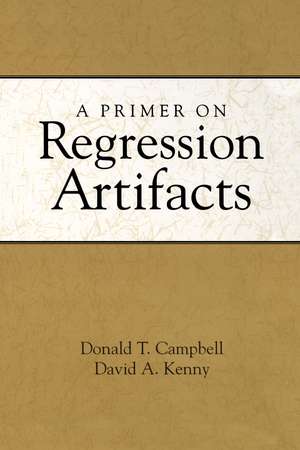
A Primer on Regression Artifacts: Methodology in the Social Sciences
Autor Donald T. Campbell, David A. Kennyen Limba Engleză Hardback – 16 sep 1999
Apreciem autoritatea incontestabilă cu care Donald T. Campbell, un pionier al validității în cercetarea socială, și David A. Kenny abordează unul dintre cele mai subtile obstacole în analiza datelor: regresia către medie. A Primer on Regression Artifacts nu este doar un manual tehnic, ci un ghid metodologic esențial care fundamentează rigoarea științifică în evaluarea intervențiilor. Autorii își folosesc experiența vastă pentru a demonstra cum cercetătorii atribuie adesea în mod eronat succesul unei terapii sau al unui program educațional unor variabile cauzale, ignorând faptul că schimbarea observată este un simplu artefact statistic.
Considerăm că structura logică a cărții facilitează o progresie clară a înțelegerii. Primele capitole introduc concepte grafice și matematice, urmate de analize specifice asupra modului în care selecția grupurilor extreme sau potrivirea subiecților pot genera distorsiuni. Lucrarea acoperă scenarii complexe, de la studii longitudinale la analize de corelație panel (cross-lagged), oferind instrumente practice precum glosare și seturi de date pentru simulări. Această abordare completează perspectiva oferită de Regression Analysis de Jeremy Arkes; în timp ce Arkes oferă o introducere practică generală în modelele de regresie, lucrarea lui Campbell și Kenny adâncește specific acele „capcane” statistice care pot compromite validitatea inferențelor cauzale.
În contextul operei lui Donald T. Campbell, acest volum rafinează temele explorate în Social Experimentation și Unobtrusive Measures. Dacă lucrările sale anterioare stabileau cadrul general al experimentării sociale, A Primer on Regression Artifacts acționează ca un instrument de precizie, concentrându-se pe mecanismele interne care pot invalida un experiment. Este o resursă indispensabilă pentru cei care doresc să evite interpretările eronate în cercetarea aplicată.
Din seria Methodology in the Social Sciences
-
 Preț: 433.26 lei
 - 8%
 Preț: 501.84 lei
 - 15%
 Preț: 618.35 lei
 - 9%
 Preț: 654.93 lei
 - 8%
 Preț: 626.26 lei
 -
 Preț: 441.14 lei
 - 8%
 Preț: 511.92 lei
 - 8%
 Preț: 475.65 lei
 - 15%
 Preț: 499.87 lei
 - 8%
 Preț: 436.19 lei
 - 15%
 Preț: 570.22 lei
 -
 Preț: 331.62 lei
 -
 Preț: 387.82 lei
 -
 Preț: 426.14 lei
 - 24%
 Preț: 358.06 lei
 - 11%
 Preț: 358.37 lei
 - 22%
 Preț: 405.79 lei
 - 11%
 Preț: 347.66 lei
 - 9%
 Preț: 506.26 lei
Preț: 515.72 lei
Carte tipărită la comandă
Livrare economică 23 noiembrie-07 decembrie
Specificații
ISBN-10: 1572304820
Pagini: 202
Ilustrații: figures, diagrams, glossaries
Dimensiuni: 152 x 229 x 23 mm
Greutate: 0.1 kg
Ediția:New.
Editura: Guilford Publications
Colecția Guilford Press
Seria Methodology in the Social Sciences
V-ar putea interesa
-
 Discovering the musical mind: A view of creativity as learningJeanne Bamberger-30%Preț: 489.05 lei695.38 lei
 -
 -21%Preț: 325.14 lei409.10 lei
 -
 -32%Preț: 1020.57 lei1495.89 lei
 -
 Preț: 91.84 lei
 -
 Preț: 254.40 lei
 -
 Multiple Pathways to the Student BrainJanet ZadinaPreț: 158.95 lei
 -
 The Nurture AssumptionJudith Rich HarrisPreț: 132.18 lei
 -
 Preț: 199.53 lei
 -
 Developmental Issues in Chinese AdolescentsDaniel T L Shek-23%Preț: 1305.94 lei1703.49 lei
 -
 -26%Preț: 186.11 lei250.88 lei
Public țintă
Postgraduate and Professional Practice & DevelopmentDe ce să citești această carte
Recomandăm această carte cercetătorilor și studenților la masterat sau doctorat care doresc să își protejeze studiile împotriva erorilor de interpretare statistică. A Primer on Regression Artifacts oferă o claritate rară asupra unui fenomen complex, ajutându-vă să distingeți între efectele reale ale unei intervenții și fluctuațiile statistice naturale. Veți câștiga rigoare metodologică prin diagrame accesibile și exemple concrete, esențiale pentru o evaluare corectă a programelor sociale sau educaționale.
Despre autor
Donald T. Campbell (1916–1996) a fost un psiholog și sociolog de renume mondial, profesor la Lehigh University și membru al Academiei Naționale de Științe din SUA. Este recunoscut pentru dezvoltarea conceptelor de validitate internă și externă și pentru promovarea cvasi-experimentării. David A. Kenny este un expert în psihologie socială și metodologie, cunoscut pentru contribuțiile sale în analiza medierii și moderării. Împreună, autorii reprezintă standardul de aur în metodologia științelor comportamentale, munca lor fiind onorată anual prin premii de excelență în cercetare.
Cuprins
1. Graphical Introduction
2. Mathematical and Special Cases
3. Regression Artifacts Due to Extreme Group Selection
4. Regression Artifacts Due to Matching
5. Regression Artifacts Due to Statistical Equating
6. Regression Artifacts in Change Scores
7. Regression Artifacts in Time-Series Studies
8. Regression Artifacts in Longitudinal Studies
9. Cross-Lagged Panel Correlation Analysis
10. Conclusion
Glossary of Terms
Glossary of Symbols
Appendix A. Dice-Rolling Program and Data Sets Used as Illustrations
Appendix B. The Computation of Autocorrelations
Notă biografică
David A. Kenny, PhD, is Professor of Social Psychology at the University of Connecticut. He has been a visiting professor at Oxford University and Arizona State University, and was a Fellow at the Center for Advanced Study in the Behavioral Sciences.
Recenzii
"Elegant and concise....If you are a novice in the topic, you will become an expert by reading A Primer on Regression Artifacts. If you are already an expert, you will learn things you will be surprised you did not already know. In either case, you will find that the authors meet you more than halfway; they guide your inquiry with ample encouragement, engaging illustrations, and good humor....It is hard to imagine a duo that is more capable of making comprehensible a challenging methodological topic." --From the Foreword by Charles S. Reichardt, PhD, University of Denver
"A Primer on Regression Artifacts is a valuable addition to the literature. The volume not only lays bare most of the secrets of regression toward the mean; it also explores correlation in general with great enthusiasm. In a most appropriate arena, this book further extends the vast legacy of the inimitable Donald T. Campbell. I will recommend it to advanced undergraduates, graduate students, and, most certainly, to my faculty colleagues in the behavioral and social sciences." --John R. Nesselroade, PhD, Hugh Scott Hamilton Professor of Psychology, University of Virginia
"This important and useful volume brings together two of our greatest methodologists to tackle one of the thorniest methodological problems in the behavioral sciences. Using interesting examples from research and everyday life, Campbell and Kenny illustrate the diverse contexts in which regression to the mean can arise, and offer suggestions for minimizing its occurrence. Graduate students will find that the book's liberal use of new graphical illustrations makes this normally difficult material wonderfully accessible; established researchers will gain a new and deeper understanding of this classic problem in the study of change." --Stephen G. West, PhD, Department of Psychology, Arizona State University, Tempe, Arizona