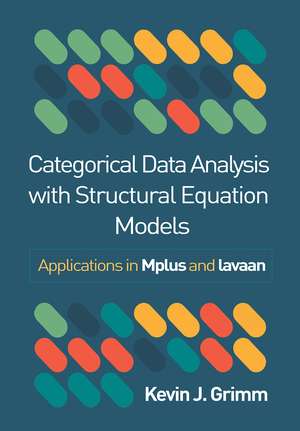
Categorical Data Analysis with Structural Equation Models: Applications in Mplus and lavaan
Autor Kevin J. Grimmen Limba Engleză Hardback – 21 noi 2025
Preț: 461.63 lei
Preț vechi: 543.09 lei
-15%
Puncte Express: 692
Carte disponibilă
Livrare economică 16-30 noiembrie
Livrare express 30 octombrie-05 noiembrie pentru 92.96 lei
Livrare prin curier în România Termenul estimat este afișat lângă disponibilitate.
Transport gratuit pentru acest produs Plată online sau ramburs, în funcție de opțiunile comenzii.
Retur gratuit în 14 zile Comandă securizată și suport în română.
Specificații
ISBN-13: 9781462558315
ISBN-10: 1462558313
Pagini: 368
Dimensiuni: 178 x 254 x 25 mm
Greutate: 0.89 kg
Ediția:1
Editura: Guilford Publications
Colecția Guilford Press
ISBN-10: 1462558313
Pagini: 368
Dimensiuni: 178 x 254 x 25 mm
Greutate: 0.89 kg
Ediția:1
Editura: Guilford Publications
Colecția Guilford Press
Notă biografică
Kevin J. Grimm, PhD, is Professor of Psychology at Arizona State University. His research interests include multivariate methods for the analysis of change, multiple group and latent class models for understanding divergent developmental processes, categorical data analysis, machine learning techniques for psychological data, and cognitive/achievement development. Dr. Grimm teaches graduate quantitative courses, including Longitudinal Growth Modeling, Machine Learning in Psychology, Structural Equation Modeling, Advanced Categorical Data Analysis, and Intermediate Statistics. He has also taught workshops sponsored by the American Psychological Association's Advanced Training Institute, Statistical Horizons, Instats, Stats Camp, and various departments and schools across the country.
Cuprins
1. Regression, Structural Equation Modeling, Mplus, and lavaan
I. Regression Analysis with Categorical Outcomes in R
2. Regression Models with Binary Outcomes in R
3. Regression Models with Ordinal Outcomes in R
4. Regression Models with Count Outcomes in R
II. Regression Analysis with Structural Equation Modeling Programs
5. Structural Equation Modeling with Categorical Outcomes in Mplus and lavaan
6. Binary Regression Models in Mplus and lavaan
7. Ordered and Nominal Regression Models in Mplus and lavaan
8. Count Regression Models in Mplus
III. Structural Equation Models and Applications
9. Path Analysis with Categorical Outcomes in Mplus and lavaan
10. Confirmatory Factor Models with Categorical Indicators in Mplus and lavaan
11. Latent Variable Path Models with Categorical Outcomes in Mplus and lavaan
IV. Advanced Structural Equation Models and Applications
12. Growth Models with Ordered Categorical Outcomes in Mplus and lavaan
13. Multiple Group Confirmatory Factor Models in Mplus and lavaan
14. Finite Mixture and Latent Class Models in Mplus
15. Zero-Inflated Count Outcomes in Mplus
16. Survival Analysis in Mplus
References
Author Index
Subject Index
About the Author
I. Regression Analysis with Categorical Outcomes in R
2. Regression Models with Binary Outcomes in R
3. Regression Models with Ordinal Outcomes in R
4. Regression Models with Count Outcomes in R
II. Regression Analysis with Structural Equation Modeling Programs
5. Structural Equation Modeling with Categorical Outcomes in Mplus and lavaan
6. Binary Regression Models in Mplus and lavaan
7. Ordered and Nominal Regression Models in Mplus and lavaan
8. Count Regression Models in Mplus
III. Structural Equation Models and Applications
9. Path Analysis with Categorical Outcomes in Mplus and lavaan
10. Confirmatory Factor Models with Categorical Indicators in Mplus and lavaan
11. Latent Variable Path Models with Categorical Outcomes in Mplus and lavaan
IV. Advanced Structural Equation Models and Applications
12. Growth Models with Ordered Categorical Outcomes in Mplus and lavaan
13. Multiple Group Confirmatory Factor Models in Mplus and lavaan
14. Finite Mixture and Latent Class Models in Mplus
15. Zero-Inflated Count Outcomes in Mplus
16. Survival Analysis in Mplus
References
Author Index
Subject Index
About the Author
Recenzii
“Grimm once again shows his knack for taking complex statistical models and ideas and expressing them in understandable terms. Categorical data come in many forms: binary, ordinal, and count variables, among others. Grimm explains modeling options for each type of analytic model, from regression models to more advanced models. Example scripts for Mplus and lavaan provide readers with clear roadmaps for conducting analyses and understanding results. This book is a ‘must read’ for anyone interested in learning about categorical data analysis in the social sciences using state-of-the-art methods.”--Keith F. Widaman, PhD, Distinguished Professor Emeritus of Education and Distinguished Professor of the Graduate Division, University of California, Riverside
"This book fills an important gap in texts on SEM. Grimm provides rigorous, in-depth coverage of regression, path models, SEM, growth models, and mixture models, combined with practical instruction on programming in Mplus and lavaan. This book is a valuable resource for researchers modeling categorical, count, and time-to-event data, frequently encountered in social science research. As a course text, this book will provide the next level of knowledge to students who have learned the basics of SEM, and it will equip them with the expertise and skills necessary to implement these sophisticated models."--Paul Sacco, PhD, School of Social Work, University of Maryland, Baltimore
“This book offers comprehensive coverage of key topics in SEM with categorical data. Chapters include practical data analysis examples using two widely adopted SEM software packages--Mplus and R (with the lavaan package)--accompanied by clear interpretations of the results. I highly recommend this book to researchers seeking to deepen their understanding of categorical data analysis in applied contexts. It also serves as an excellent text for graduate-level courses on categorical data analysis and advanced SEM.”--Myeongsun Yoon, PhD, Department of Educational Psychology, Texas A&M University
“I particularly enjoy the lavaan and Mplus code that accompanies the book, which is more detailed than in other books I have come across. The book is well written and provides excellent syntax examples. I would use it to teach categorical SEM in my graduate SEM course.”--Jam Khojasteh, PhD, Research, Evaluation, Measurement, and Statistics Program, Oklahoma State University-
"This book fills an important gap in texts on SEM. Grimm provides rigorous, in-depth coverage of regression, path models, SEM, growth models, and mixture models, combined with practical instruction on programming in Mplus and lavaan. This book is a valuable resource for researchers modeling categorical, count, and time-to-event data, frequently encountered in social science research. As a course text, this book will provide the next level of knowledge to students who have learned the basics of SEM, and it will equip them with the expertise and skills necessary to implement these sophisticated models."--Paul Sacco, PhD, School of Social Work, University of Maryland, Baltimore
“This book offers comprehensive coverage of key topics in SEM with categorical data. Chapters include practical data analysis examples using two widely adopted SEM software packages--Mplus and R (with the lavaan package)--accompanied by clear interpretations of the results. I highly recommend this book to researchers seeking to deepen their understanding of categorical data analysis in applied contexts. It also serves as an excellent text for graduate-level courses on categorical data analysis and advanced SEM.”--Myeongsun Yoon, PhD, Department of Educational Psychology, Texas A&M University
“I particularly enjoy the lavaan and Mplus code that accompanies the book, which is more detailed than in other books I have come across. The book is well written and provides excellent syntax examples. I would use it to teach categorical SEM in my graduate SEM course.”--Jam Khojasteh, PhD, Research, Evaluation, Measurement, and Statistics Program, Oklahoma State University-