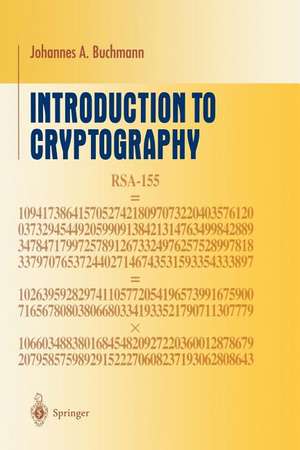
Introduction to Cryptography
Autor Johannes Buchmannen Limba Engleză Paperback – 21 ian 2012
În această a doua ediție a volumului Introduction to Cryptography, asistăm la o extindere necesară a materialului didactic pentru a reflecta evoluțiile tehnologice fundamentale de la începutul anilor 2000. Observăm introducerea unor secțiuni critice despre algoritmul de criptare AES și funcția hash SHA-1, elemente care au devenit standarde în securitatea digitală modernă. Suntem de părere că această revizuire transformă un curs universitar deja solid într-o resursă de referință pentru studiul mecanismelor de semnătură digitală și control al accesului. Structura cărții urmează o progresie logică, de la elementele de bază ale numerelor întregi și divizibilității, până la structuri algebrice complexe precum inelele de reziduuri și corpurile finite. Fiecare capitol este însoțit de exerciții practice, facilitând tranziția de la teoria abstractă la estimarea eficienței și securității algoritmilor. Comparabil cu Introduction to Cryptography with Coding Theory de Wade Trappe în ceea ce privește rigurozitatea, volumul lui Johannes Buchmann se distinge prin accentul pus pe fundamentul matematic pur, fiind adaptat pentru un nivel de studiu avansat (graduate). Poziționată în contextul operei autorului, această lucrare servește drept fundament teoretic pentru cercetările sale ulterioare, cum este volumul Post-Quantum Cryptography. Dacă lucrările sale mai recente explorează rezistența sistemelor în fața calculului cuantic, acest titlu rămâne pilonul central pentru înțelegerea criptografiei clasice și moderne. Descoperim aici rigoarea unui laureat al premiului Leibniz, transpusă într-un limbaj accesibil celor care posedă cunoștințe matematice de bază, dar doresc să înțeleagă mecanismele interne ale sistemelor de chei electronice.
Preț: 389.70 lei
Carte disponibilă
Livrare economică 12-26 octombrie
Specificații
ISBN-10: 1468404989
Pagini: 281
Ilustrații: XI, 281 p.
Dimensiuni: 155 x 235 x 17 mm
Greutate: 0.42 kg
Ediția:Softcover Reprint of the Original 1st 2001 edition
Editura: Springer
Locul publicării:New York, NY, United States
V-ar putea interesa
-
 p-Adic Methods and Their ApplicationsAndrew J. Baker-31%Preț: 557.21 lei807.57 lei
 -
 Numbers: A Very Short IntroductionPeter M. Higgins-20%Preț: 55.78 lei69.86 lei
 -
 A First Course in Modular FormsFred Diamond-15%Preț: 402.72 lei473.78 lei
 -
 The Riemann HypothesisPeter Borwein-18%Preț: 1052.65 lei1283.72 lei
 -
 Multiplicative Number TheoryHarold Davenport-15%Preț: 472.85 lei556.29 lei
 -
 Topics in the Theory of NumbersJanos Suranyi-15%Preț: 508.58 lei598.32 lei
 -
 A Classical Introduction to Modern Number TheoryKenneth Ireland-17%Preț: 472.44 lei569.21 lei
 -
 The Book of NumbersJohn H. Conway-17%Preț: 393.37 lei473.95 lei
 -
 Advanced Topics in Computational Number TheoryHenri Cohen-15%Preț: 608.92 lei716.38 lei
 -
 Elementary Methods in Number TheoryMelvyn B. Nathanson-15%Preț: 596.08 lei701.28 lei
 -
 Modular Forms and Fermat's Last TheoremGary Cornell-15%Preț: 660.14 lei776.63 lei
 -
 Fibonacci and Catalan NumbersGrimaldi-9%Preț: 733.64 lei806.20 lei
 -
 Number Theory PBorwein-9%Preț: 1161.44 lei1276.30 lei
 -
 An Introduction to the Theory of NumbersIvan Morton Niven-27%Preț: 1438.49 lei1970.54 lei
 -
 Essays on the Theory of NumbersRichard DedekindPreț: 53.52 lei
 -
 -24%Preț: 144.33 lei189.62 lei
 -
 Number TheoryTitu Andreescu-15%Preț: 591.35 lei695.71 lei
 -
 One, Two, ThreeDavid BerlinskiPreț: 104.36 lei
 -
 Problem-Solving and Selected Topics in Number TheoryMichael Th Rassias-15%Preț: 537.34 lei632.17 lei
 -
 A Classical Introduction to Modern Number TheoryKenneth Ireland-15%Preț: 536.60 lei631.29 lei
 -
 Fermat's Last TheoremSimon SinghPreț: 78.31 lei
 -
 Elementary Number TheoryGareth A. JonesPreț: 266.17 lei
 -
 Intersections of Hirzebruch-Zagier Divisors and CM CyclesBenjamin HowardPreț: 348.48 lei
Public țintă
GraduateDe ce să citești această carte
Recomandăm această carte studenților și specialiștilor care doresc să depășească etapa de simpli utilizatori ai algoritmilor de criptare. Veți câștiga o înțelegere profundă a matematicii din spatele SHA-1 și AES, învățând nu doar cum să aplicați aceste tehnici, ci și cum să le evaluați critic securitatea. Este resursa ideală pentru a construi o bază solidă în teoria numerelor aplicată în securitatea informației.
Despre autor
Johannes Buchmann este profesor de informatică și matematică la Universitatea Tehnică din Darmstadt și o figură proeminentă în comunitatea academică globală. Recunoscut pentru contribuțiile sale de excepție, a primit Premiul Leibniz, cea mai înaltă distincție științifică din Germania. Expertiza sa este vastă, activând ca editor asociat pentru Journal of Cryptology și publicând lucrări de referință care variază de la fundamentele algebrice la securitatea post-cuantică. Experiența sa didactică se reflectă în claritatea cu care expune algoritmi complecși în acest manual de referință.
Cuprins
Textul de pe ultima copertă
Johannes A. Buchmann is a Professor of Computer Science and Mathematics at the Technical University of Darmstadt, and the Associate Editor of the Journal of Cryptology. In 1985, he received the Feodor Lynen Fellowship of the Alexander von Humboldt Foundation. Furthermore, he has received the most prestigious award in science in Germany, the Leibniz Award of the German Science Foundation.
About the first edition:
It is amazing how much Buchmann is able to do in under 300 pages: self-contained explanations of the relevant mathematics (with proofs); a systematic introduction to symmetric cryptosystems, including a detailed description and discussion of DES; a good treatment of primality testing, integer factorization, and algorithms for discrete logarithms; clearly written sections describing most of the major types of cryptosystems....This book is an excellent reference, and I believe it would also be a good textbook for a course for mathematics or computer science majors..."
-Neal Koblitz, The American Mathematical Monthly
Descriere scurtă
Recenzii
Zentralblatt Math
"[......] Of the three books under review, Buchmann's is by far the most sophisticated, complete and up-to-date. It was written for computer-science majors - German ones at that - and might be rough going for all but the best American undergraduates. It is amazing how much Buchmann is able to do in under 300 pages: self-contained explanations of the relevant mathematics (with proofs); a systematic introduction to symmetric cryptosystems, including a detailed description and discussion of DES; a good treatment of primality testing, integer factorization, and algorithms for discrete logarithms, clearly written sections describing most of the major types of cryptosystems, and explanations of basic concepts of practical cryptography such as hash functions, message authentication codes, signatures, passwords, certification authorities, and certificate chains. This book is an excellent reference, and I believe that it would also be a good textbook for a course for mathematics or computer science majors, provided that the instructor is prepared to supplement it with more leisurely treatments of some of the topics."
N. Koblitz (Seattle, WA) - American Math. Society Monthly.
J.A. Buchmann
Introduction to Cryptography
"It gives a clear and systematic introduction into the subject whose popularity is ever increasing, and can be recommended to all who would like to learn about cryptography. The book contains many exercises and examples. It can be used as a textbook and is likely to become popular among students. The necessary definitions and concepts from algebra, number theory and probability theory are formulated, illustrated by examples and applied to cryptography." —ZENTRALBLATT MATH
"For those of use who wish to learn more about cryptography and/or to teach it, Johannes Buchmann has written this book. … The book is mathematicallycomplete and a satisfying read. There are plenty of homework exercises … . This is a good book for upperclassmen, graduate students, and faculty. … This book makes a superior reference and a fine textbook." (Robert W. Vallin, MathDL, January, 2001)
"Buchmann’s book is a text on cryptography intended to be used at the undergraduate level. … the intended audiences of this book are ‘readers who want to learn about modern cryptographic algorithms and their mathematical foundations … . I enjoy reading this book. … Readers will find a good exposition of the techniques used in developing and analyzing these algorithms. … These make Buchmann’s text an excellent choice for self study or as a text for students … in elementary number theory and algebra." (Andrew C. Lee, SIGACT News, Vol. 34 (4), 2003)
From the reviews of the second edition:
"This is the english translation of the second edition of the author’s prominent german textbook ‘Einführung in die Kryptographie’. The original text grew out of several courses on cryptography given by the author at the Technical University Darmstadt; it is aimed at readers who want to learn about modern cryptographic techniques and its mathematical foundations … . As compared with the first edition the number of exercises has almost been doubled and some material … has been added." (R. Steinbauer, Monatshefte für Mathematik, Vol. 150 (4), 2007)