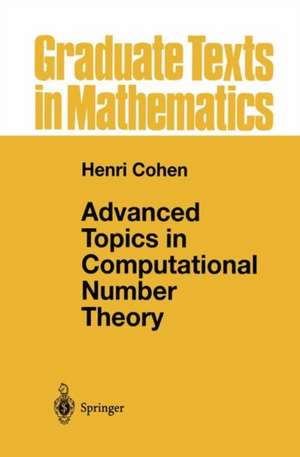
Advanced Topics in Computational Number Theory: Graduate Texts in Mathematics, cartea 193
Autor Henri Cohenen Limba Engleză Hardback – 30 noi 1999
Destinată studenților la nivel de masterat sau doctorat și cercetătorilor în matematică pură, Advanced Topics in Computational Number Theory oferă instrumentele necesare pentru a aborda probleme complexe de calcul în teoria numerelor algebrice. Credem că această lucrare este esențială pentru cei care doresc să depășească limitele algoritmilor standard, oferind o bază teoretică și practică solidă pentru utilizarea sistemelor de algebră computațională precum Magma sau Pari/GP. Notăm cu interes modul în care Henri Cohen își extinde contribuțiile anterioare. Dacă în lucrarea sa de referință, A Course in Computational Algebraic Number Theory, autorul se concentra pe fundamentele corpurilor numerice, prezentul volum generalizează aceste concepte către extensiile relative, un pas necesar pentru rezolvarea ecuațiilor diofantiene complexe. Cartea extinde, de asemenea, cadrul propus de Computational Algebraic Number Theory de M. E. Pohst prin integrarea unor date noi privind domeniile Dedekind și algoritmii de tip Round 2 pentru extensii relative. Structura volumului este riguroasă, debutând cu studiul modulelor finit generate și algoritmilor pentru formele normale Hermite și Smith. Progresia narativă continuă logic spre aritmetica extensiilor relative și culminează cu o tratare detaliată a teoriei corpurilor de clase. Găsim în această carte o metodologie clară de transformare a teoremelor abstracte în proceduri computaționale eficiente, reflectând experiența autorului în dezvoltarea de software matematic, vizibilă și în seria sa în două volume Number Theory.
Din seria Graduate Texts in Mathematics
- 13%
 Preț: 407.97 lei
 -
 Preț: 526.10 lei
 - 15%
 Preț: 414.37 lei
 - 15%
 Preț: 403.03 lei
 - 15%
 Preț: 413.96 lei
 - 15%
 Preț: 530.03 lei
 - 15%
 Preț: 449.14 lei
 - 15%
 Preț: 532.83 lei
 - 15%
 Preț: 530.66 lei
 - 15%
 Preț: 501.17 lei
 - 15%
 Preț: 543.00 lei
 - 13%
 Preț: 406.00 lei
 -
 Preț: 446.38 lei
 - 15%
 Preț: 579.99 lei
 -
 Preț: 381.34 lei
 - 15%
 Preț: 455.36 lei
 - 15%
 Preț: 560.82 lei
 - 17%
 Preț: 453.24 lei
 - 15%
 Preț: 590.39 lei
 -
 Preț: 500.30 lei
 -
 Preț: 451.05 lei
 -
 Preț: 386.90 lei
 - 15%
 Preț: 614.52 lei
 - 15%
 Preț: 477.57 lei
 -
 Preț: 460.05 lei
 - 15%
 Preț: 498.36 lei
 -
 Preț: 504.56 lei
 - 18%
 Preț: 808.24 lei
 -
 Preț: 472.04 lei
 - 15%
 Preț: 621.81 lei
 -
 Preț: 398.40 lei
 - 15%
 Preț: 656.51 lei
 - 15%
 Preț: 602.39 lei
 - 15%
 Preț: 531.78 lei
 -
 Preț: 405.89 lei
Preț: 677.01 lei
Preț vechi: 796.48 lei
-15%
Carte tipărită la comandă
Livrare economică 05-19 decembrie
Specificații
ISBN-10: 0387987274
Pagini: 600
Ilustrații: XV, 581 p.
Dimensiuni: 160 x 241 x 37 mm
Greutate: 1.01 kg
Ediția:2000
Editura: Springer
Colecția Graduate Texts in Mathematics
Seria Graduate Texts in Mathematics
Locul publicării:New York, NY, United States
V-ar putea interesa
-
 A Course in Number TheoryH. E. Rose-30%Preț: 578.84 lei823.54 lei
 -
 -28%Preț: 419.81 lei585.35 lei
 -
 Number Theory, Volume 2Henri CohenPreț: 495.68 lei
 -
 Multiplicative Number TheoryHarold Davenport-15%Preț: 485.99 lei571.75 lei
 -
 Topics in the Theory of NumbersJanos Suranyi-15%Preț: 525.87 lei618.67 lei
 -
 A Classical Introduction to Modern Number TheoryKenneth Ireland-17%Preț: 481.23 lei579.80 lei
 -
 Elementary Methods in Number TheoryMelvyn B. Nathanson-15%Preț: 618.64 lei727.80 lei
 -
 Modular Forms and Fermat's Last TheoremGary Cornell-15%Preț: 660.14 lei776.63 lei
 -
 Edouard Lucas and Primality TestingHugh C Williams-9%Preț: 1381.52 lei1518.15 lei
 -
 Essays on the Theory of NumbersRichard DedekindPreț: 55.02 lei
 -
 -24%Preț: 146.90 lei192.22 lei
 -
 Number TheoryAndré Weil-18%Preț: 760.75 lei927.74 lei
 -
 Discrete Harmonic AnalysisTullio Ceccherini-Silberstein-14%Preț: 709.49 lei824.99 lei
 -
 Galois Representations and (Phi, Gamma)-ModulesPeter Schneider-11%Preț: 458.32 lei514.96 lei
 -
 Dynamics and Analytic Number TheoryDzmitry Badziahin-11%Preț: 496.98 lei558.41 lei
 -
 -14%Preț: 866.61 lei1007.68 lei
 -
 -18%Preț: 783.70 lei955.73 lei
 -
 A Classical Introduction to Modern Number TheoryKenneth Ireland-15%Preț: 536.60 lei631.29 lei
 -
 Group Theory in Particle, Nuclear, and Hadron PhysicsSyed Afsar Abbas-18%Preț: 1610.47 lei1963.98 lei
 -
 Infinite Ergodic Theory of NumbersMarc Kesseböhmer-8%Preț: 459.13 lei499.06 lei
 -
 Fractal Zeta Functions and Fractal DrumsMichel L. Lapidus-18%Preț: 1006.23 lei1227.11 lei
 -
 Sequential Experiments with PrimesMihai Caragiu-15%Preț: 520.88 lei612.80 lei
 -
 Summability CalculusIbrahim M. Alabdulmohsin-15%Preț: 597.04 lei702.40 lei
 -
 -15%Preț: 620.67 lei730.20 lei
 -
 Intersections of Hirzebruch-Zagier Divisors and CM CyclesBenjamin HowardPreț: 348.48 lei
 -
 P-ADIC ASPECTS OF MODULAR FORMSHida Haruzo-18%Preț: 728.25 lei888.11 lei
 -
 The Book on NumbersTianxin CaiPreț: 422.68 lei
Public țintă
GraduateDe ce să citești această carte
Pentru un practician în algebra computațională, această carte reprezintă tranziția de la algoritmi de bază la cercetare avansată. Cititorul câștigă acces la tehnici matematice de vârf pentru calculul invarianților corpurilor numerice, esențiale în criptografie și teoria numerelor. Este resursa definitivă pentru implementarea programului Dedekind în sisteme moderne, oferind atât demonstrații riguroase, cât și exerciții aplicate la finalul fiecărui capitol.