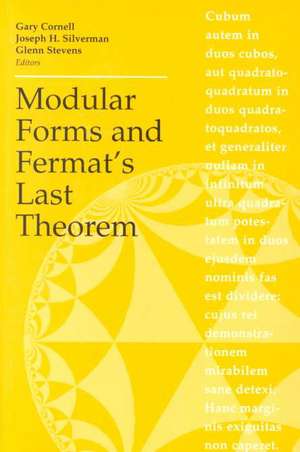
Modular Forms and Fermat's Last Theorem
Editat de Gary Cornell, Joseph H. Silverman, Glenn Stevensen Limba Engleză Paperback – 14 ian 2000
Subliniem faptul că volumul Modular Forms and Fermat’s Last Theorem nu este o simplă monografie, ci o resursă pedagogică avansată, structurată pentru a ghida cercetătorul prin arhitectura complexă a demonstrației lui Andrew Wiles. Organizarea materialului reflectă o metodologie progresivă: se începe cu o privire de ansamblu asupra întregii demonstrații, urmată de capitole introductive care pun bazele necesare în teoria aritmetică a curbelor eliptice, funcțiilor modulare și coomologiei Galois. Această abordare este esențială, deoarece permite cititorului să înțeleagă contextul teoretic înainte de a aborda nucleul dur al demonstrației — reprezentările automorfe și teoria deformării. Suntem de părere că forța acestui volum rezidă în capacitatea de a sintetiza contribuțiile fundamentale ale mai multor matematicieni. Autorii explică modul în care rezultatul lui Wiles se combină cu teorema lui Ribet și intuițiile lui Frey și Serre. Cititorii familiarizați cu Modular Forms and Galois Cohomology de Haruzo Hida vor aprecia în acest volum focalizarea pe aspectul instrucțional și claritatea cu care sunt prezentate inelele de deformare universală și proprietatea Gorenstein a algebrelor Hecke. În timp ce alte lucrări se concentrează pe simplificări tehnice, volumul editat de Gary Cornell, Joseph H. Silverman și Glenn Stevens păstrează rigoarea necesară nivelului de cercetare, oferind în același timp o perspectivă istorică asupra problemei. Deși Gary Cornell este cunoscut în alte contexte pentru lucrări tehnice de programare, precum Visual Basic 6 from the Ground Up, implicarea sa editorială aici vizează rigoarea academică specifică editurii Springer. Structura cărții, care culminează cu discuții despre intersecții complete și deformări p-adice, transformă acest text într-un instrument de lucru indispensabil pentru orice matematician care dorește să stăpânească tehnicile ce au dus la rezolvarea celei mai faimoase probleme din istoria matematicii.
Preț: 660.14 lei
Preț vechi: 776.63 lei
-15%
Carte tipărită la comandă
Livrare economică 07-21 decembrie
Specificații
ISBN-10: 0387989986
Pagini: 608
Ilustrații: XIX, 582 p.
Dimensiuni: 155 x 235 x 33 mm
Greutate: 0.91 kg
Ediția:1st ed. 1997. 3rd printing 2000
Editura: Springer
Locul publicării:New York, NY, United States
V-ar putea interesa
-
 Numbers: A Very Short IntroductionPeter M. Higgins-19%Preț: 57.46 lei71.12 lei
 -
 P-Adic Automorphic Forms on Shimura VarietiesHaruzo Hida-18%Preț: 1272.44 lei1551.76 lei
 -
 Number Theory, Volume 2Henri CohenPreț: 495.68 lei
 -
 Fibonacci and Catalan NumbersGrimaldi-9%Preț: 758.66 lei833.70 lei
 -
 Elementary Number TheoryUnderwood DudleyPreț: 112.31 lei
 -
 -23%Preț: 604.86 lei785.54 lei
 -
 One, Two, ThreeDavid BerlinskiPreț: 104.36 lei
 -
 Problem-Solving and Selected Topics in Number TheoryMichael Th Rassias-15%Preț: 537.34 lei632.17 lei
 -
 Preț: 403.57 lei
 -
 Advanced Topics in Computational Number TheoryHenri CohenPreț: 509.76 lei
 -
 Introduction to MapleAndre HeckPreț: 480.37 lei
 -
 Introduction to Cyclotomic FieldsLawrence C. Washington-15%Preț: 559.70 lei658.46 lei
 -
 Probabilistic Number Theory IIP.D.T.A. Elliott-15%Preț: 622.13 lei731.92 lei
 -
 Ramanujan's Lost Notebook: Part IIIGeorge E. Andrews-18%Preț: 954.47 lei1163.98 lei
 -
 Analytic Number Theory, Approximation Theory, and Special FunctionsGradimir V. Milovanovi¿-18%Preț: 1012.19 lei1234.38 lei
 -
 Transcendental NumbersM. Ram Murty-15%Preț: 470.47 lei553.50 lei
 -
 An Introduction to Mathematical CryptographyJeffrey Hoffstein-15%Preț: 474.43 lei558.14 lei
 -
 Right-Brained Addition & SubtractionSarah MajorPreț: 291.00 lei
 -
 The Problem of CatalanYuri F. BiluPreț: 406.64 lei
 -
 Probabilistic Diophantine ApproximationJózsef Beck-15%Preț: 680.99 lei801.16 lei
 -
 Preț: 299.82 lei
 -
 Rational Points on Elliptic CurvesJoseph H. SilvermanPreț: 394.72 lei
Public țintă
ResearchDe ce să citești această carte
Această carte este recomandată cercetătorilor și studenților la doctorat care doresc să înțeleagă detaliile tehnice ale demonstrației Marii Teoreme a lui Fermat. Cititorul câștigă o viziune unitară asupra matematicii moderne, de la curbe eliptice la forme modulare și reprezentări Galois. Este resursa definitivă care explică pas cu pas cum au fost îmbinate teoriile lui Wiles, Ribet și Serre pentru a închide un capitol istoric de peste 350 de ani.
Despre autor
Editorii acestui volum sunt figuri proeminente în comunitatea științifică și tehnică. Gary Cornell este un autor versatil, cunoscut atât pentru contribuțiile sale editoriale în matematică, cât și pentru manualele de referință în informatică publicate la McGraw-Hill și Apress. Joseph H. Silverman este un specialist renumit în teoria numerelor și geometria aritmetică, autor al unor texte fundamentale despre curbele eliptice. Glenn Stevens este profesor de matematică la Boston University, specializat în forme automorfe și teoria numerelor. Împreună, aceștia au coordonat conferința istorică din 1995 care a stat la baza acestui volum de referință pentru matematica contemporană.
Descriere scurtă
Cuprins
Recenzii
The purpose of the book under review is to highlight and amplify these developments. As such, the book is indispensable to any student wanting to learn the finer details of the proof or any researcher wanting to extend the subject in a higher direction. Indeed, the subject is already expanding with the recent researches of Conrad, Darmon, Diamond, Skinner and others. ...
FLT deserves a special place in the history of civilization. Because of its simplicity, it has tantalized amateurs and professionalsalike, and its remarkable fecundity has led to the development of large areas of mathematics such as, in the last century, algebraic number theory, ring theory, algebraic geometry, and in this century, the theory of elliptic curves, representation theory, Iwasawa theory, formal groups, finite flat group schemes and deformation theory of Galois representations, to mention a few. It is as if some supermind planned it all and over the centuries had been developing diverse streams of thought only to have them fuse in a spectacular synthesis to resolve FLT. No single brain can claim expertise in all of the ideas that have gone into this "marvelous proof". In this age of specialization, where "each one of us knows more and more about less and less", it is vital for us to have an overview of the masterpiece such as the one provided by this book." (M. Ram Murty, Mathematical Reviews)