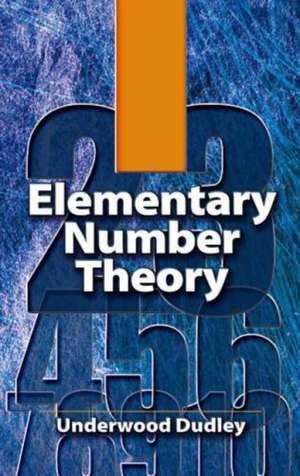
Elementary Number Theory
Autor Underwood Dudleyen Limba Engleză Paperback – 26 dec 2008
Această a doua ediție a lucrării Elementary Number Theory aduce o rafinare a metodologiei didactice, punând accent pe rezolvarea activă a problemelor ca vehicul principal pentru învățare. Ne-a atras atenția modul în care Underwood Dudley reușește să demistifice concepte complexe, transformând un curs introductiv într-o experiență interactivă. Spre deosebire de alte manuale care prioritizează demonstrațiile teoretice abstracte, acest volum propune aproape 1.000 de exerciții, oferind cititorului instrumentele necesare pentru a „face” matematică, nu doar pentru a o citi. Structura narativă a cursului este logică și progresivă: începe cu bazele numerelor întregi și ale congruențelor, avansând spre demonstrații ale teoremelor lui Fermat și Wilson, pentru ca ulterior să exploreze reciprocitatea quadratică. Apreciem independența secțiunilor finale dedicate ecuațiilor diofantiene și numerelor prime, ceea ce oferă flexibilitate în parcurgerea materialului. Comparabil cu Number Theory de Titu Andreescu în ceea ce privește rigoarea și abordarea bazată pe probleme, volumul lui Dudley se distinge prin accesibilitate, fiind calibrat special pentru studenții care au doar un fundament de algebră de liceu. În contextul operei autorului, lucrarea se poziționează la intersecția dintre rigoarea academică din Number Systems and the Foundations of Analysis și stilul ludic, dar precis, din volumele sale despre curiozități matematice, precum A Budget of Trisections. Elementary Number Theory rămâne o resursă stabilă în curriculumul universitar, reușind să echilibreze problemele computaționale cu cele teoretice, totul într-un format compact de tip paperback publicat de Dover Publications Inc..
Preț: 112.31 lei
Carte disponibilă
Livrare economică 17 noiembrie-01 decembrie
Livrare express 31 octombrie-06 noiembrie pentru 33.30 lei
Specificații
ISBN-10: 048646931X
Pagini: 272
Dimensiuni: 136 x 219 x 17 mm
Greutate: 0.3 kg
Ediția:2nd edition
Editura: Dover Publications Inc.
V-ar putea interesa
-
 Preț: 79.30 lei
 -
 Oxford English Grammar Course: Intermediate: with Answers CD-ROM PackMichael Lovat SwanPreț: 79.30 lei
 -
 Discrete MathematicsNorman L. Biggs-20%Preț: 520.25 lei651.10 lei
 -
 An Introduction to the Theory of NumbersG. H. Hardy-19%Preț: 445.15 lei548.81 lei
 -
 An Introduction to Discrete MathematicsVidyadhar Kulkarni-34%Preț: 525.40 lei798.57 lei
 -
 History Mathematics 3eCarl B. BoyerPreț: 263.04 lei
 -
 How to Calculate QuicklyHenry StickerPreț: 73.82 lei
 -
 The USSR Olympiad Problem BookD. O. ShklarskyPreț: 191.64 lei
 -
 Book of Abstract AlgebraCharles C. Pinter-24%Preț: 145.43 lei191.28 lei
 -
 A First Course in Graph TheoryGary Chartrand-24%Preț: 147.14 lei192.83 lei
 -
 Preț: 142.41 lei
 -
 -24%Preț: 146.90 lei192.22 lei
 -
 Number TheoryGeorge E. Andrews-17%Preț: 86.86 lei104.94 lei
 -
 Preț: 105.05 lei
 -
 Bobby Fischer Teaches ChessBobby Fischer-18%Preț: 53.04 lei64.64 lei
 -
 Introduction to Number TheoryAnthony Vazzana-8%Preț: 510.34 lei554.72 lei
 -
 Friendly Introduction to Number Theory, AJoseph Silverman-9%Preț: 606.73 lei666.73 lei
 -
 Elementary Number TheoryKenneth Rosen-13%Preț: 627.61 lei721.39 lei
 -
 First Aid in Mathematics Colour EditionRobert Sulley-21%Preț: 97.17 lei123.35 lei
 -
 -24%Preț: 82.47 lei109.09 lei
 -
 Number Theory with ComputationsPeter ShiuPreț: 404.72 lei
 -
 Number TheoryBenjamin Fine-19%Preț: 456.72 lei563.85 lei
De ce să citești această carte
Recomandăm această carte oricărui student la matematică sau pasionat care dorește o introducere clară în teoria numerelor. Câștigul principal este dezvoltarea intuiției matematice prin practică directă, grație celor peste 1.000 de probleme incluse. Este un punct de plecare ideal deoarece nu presupune cunoștințe avansate de analiză, oferind totodată soluții și apendice utile pentru studiu individual.
Despre autor
Underwood Dudley (n. 1937, New York) este un matematician american renumit, specializat în teoria numerelor, domeniu în care și-a obținut doctoratul la University of Michigan în 1965. Cu o carieră didactică îndelungată la Ohio State University și DePauw University, Dudley este cunoscut nu doar pentru textele sale academice, ci și pentru interesul său față de pseudomatematică și curiozități numerice. A editat publicații prestigioase precum College Mathematics Journal și a scris lucrări de referință care combat miturile matematice, aplicând aceeași claritate logică pe care o regăsim și în Elementary Number Theory.
Descriere scurtă
The opening chapters offer sound explanations of the basics of elementary number theory anddevelop the fundamental properties of integers and congruences. Subsequent chapters present proofs of Fermat's and Wilson's theorems, introduce number theoretic functions, and explore the quadratic reciprocity theorem. Three independent sections follow, with examinations of the representation of numbers, diophantine equations, and primes. The text concludes with 260 additional problems, three helpful appendixes, and answers to selected exercises and problems."