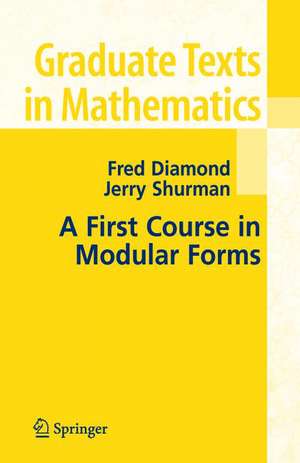
A First Course in Modular Forms
Autor Fred Diamond, Jerry Shurmanen Limba Engleză Hardback – 19 ian 2005
Descoperim în A First Course in Modular Forms o lucrare semnată de Fred Diamond și Jerry Shurman, doi matematicieni a căror autoritate este ancorată în colaborarea directă cu figurile legendare ale teoriei numerelor moderne. Având în vedere că Diamond și-a obținut doctoratul sub îndrumarea lui Andrew Wiles, autorul a scris acest curs cu scopul de a face accesibilă Teorema de Modularitate — pilonul central care a dus la rezolvarea Ultimei Teoreme a lui Fermat. Găsim aici o abordare didactică ce prioritizează claritatea, fiind concepută special pentru a ghida cititorul prin concepte complexe fără a impune bariere de intrare precum geometria algebrică avansată.
Complementar volumului Introduction to Modular Forms de Serge Lang, acest volum adaugă o perspectivă modernă și o structură pedagogică ce pune accent pe legătura dintre curbele eliptice și formele modulare, oferind demonstrații detaliate acolo unde alte texte sunt adesea eliptice. În contextul operei lui Diamond, care include contribuții la Automorphic Forms and Galois Representations: Volume 1, această carte servește drept fundament teoretic indispensabil, pregătind terenul pentru studiul reprezentărilor Galois și al varietăților abeliene.
Structura este una progresivă, debutând cu definițiile clasice ale formelor modulare și curbelor eliptice privite ca toruri complexe, pentru ca ulterior să introducă operatorii Hecke și curbele modulare ca suprafețe Riemann. Considerăm că tranziția către curbele modulare ca obiecte algebrice și explorarea relației Eichler-Shimura oferă o acoperire exhaustivă a subiectului, transformând o temă abstractă într-un parcurs logic și inteligibil.
Preț: 402.72 lei
Preț vechi: 473.78 lei
-15%
Carte disponibilă
Livrare economică 15-29 iulie
Livrare express 30 iunie-04 iulie pentru 54.60 lei
Specificații
ISBN-10: 038723229X
Pagini: 472
Ilustrații: XVI, 450 p. 57 illus.
Dimensiuni: 160 x 241 x 30 mm
Greutate: 0.96 kg
Ediția:2005
Editura: Springer
Locul publicării:New York, NY, United States
V-ar putea interesa
-
 Additive Number Theory: Inverse Problems and the Geometry of SumsetsMelvyn B. Nathanson-15%Preț: 571.23 lei672.03 lei
 -
 Additive Number Theory The Classical BasesMelvyn B. Nathanson-18%Preț: 810.98 lei989.00 lei
 -
 Binary Quadratic Forms: Classical Theory and Modern ComputationsDuncan A. Buell-18%Preț: 913.45 lei1113.96 lei
 -
 -15%Preț: 442.80 lei520.95 lei
 -
 Torsors, Étale Homotopy and Applications to Rational PointsAlexei Skorobogatov-11%Preț: 447.00 lei502.24 lei
 -
 -11%Preț: 515.79 lei579.54 lei
 -
 Automorphic Forms and Galois RepresentationsFred Diamond-11%Preț: 486.19 lei546.29 lei
 -
 Preț: 377.12 lei
 -
 Introduction to Programming LanguagesArvind Kumar Bansal-18%Preț: 722.21 lei880.74 lei
 -
 Adeles and Algebraic GroupsA. Weil-15%Preț: 608.28 lei715.63 lei
 -
 Additive Number TheoryDavid Chudnovsky-15%Preț: 623.33 lei733.33 lei
 -
 Fractal Geometry, Complex Dimensions and Zeta FunctionsMichel L. Lapidus-18%Preț: 866.37 lei1056.54 lei
 -
 Elliptic Curves and Arithmetic InvariantsHaruzo Hida-18%Preț: 860.15 lei1048.96 lei
 -
 Analytic Number Theory, Approximation Theory, and Special FunctionsGradimir V. Milovanovi¿-18%Preț: 934.15 lei1139.22 lei
 -
 Transcendental NumbersM. Ram Murty-15%Preț: 452.70 lei532.59 lei
 -
 An Introduction to Mathematical CryptographyJeffrey Hoffstein-15%Preț: 467.64 lei550.17 lei
 -
 -30%Preț: 976.52 lei1398.58 lei
 -
 Study of Analytic Number TheoryLukasz Andrzej GlinkaPreț: 281.58 lei
 -
 Preț: 273.66 lei
 -
 Calculus and Analysis in Euclidean SpaceJerry ShurmanPreț: 386.76 lei
 -
 Elementare ZahlentheorieJochen ZiegenbalgPreț: 219.74 lei
Public țintă
GraduateDe ce să citești această carte
Pentru studenții la matematică și cercetătorii care doresc să înțeleagă fundamentul Teoremei de Modularitate fără a se pierde în formalismul excesiv al geometriei algebrice. Veți câștiga o bază solidă în teoria formelor modulare și a reprezentărilor Galois, beneficiind de exerciții practice și de claritatea unor autori care au lucrat direct la frontierele acestui domeniu.
Despre autor
Fred Diamond este profesor la King's College London, fiind un expert recunoscut în teoria numerelor. Și-a obținut doctoratul la Princeton în 1988, sub coordonarea lui Andrew Wiles, și a jucat un rol esențial în rafinarea demonstrației acestuia pentru Ultima Teoremă a lui Fermat. Jerry Shurman, coautorul său, și-a obținut doctoratul în același an la Princeton sub îndrumarea lui Goro Shimura, fiind în prezent profesor la Reed College. Împreună, cei doi combină rigoarea academică de la Princeton cu o experiență vastă în predarea matematicii avansate.
Descriere scurtă
Cuprins
Recenzii
“The textbook under review provides a modern introduction to the theory of modular forms, with the aim to explain the modularity theorem to beginning graduate students and advanced undergraduates. … Written in a very comprehensible, detailed, lucid and instructive manner, this unique textbook is widely self-contained and perfectly suitable for self-study by beginners. … an excellent guide to the relevant research literature … . experts and teachers will get a lot of methodological inspiration from the authors’ approach, and many useful ideas for efficient teaching.” (Philosophy, Religion and Science Book Reviews, bookinspections.wordpress.com, June, 2013)
"It has always been difficult to start learning about modular forms. … we were still lacking a textbook that could be honestly described as both comprehensive and accessible. Diamond and Shurman’s First Course is a largely successful attempt to provide just such a book. … A First Course in Modular Forms is a success. … a course taught from this text would be a very good way to lead students into the area. … I expect that Diamond and Shurman’s book would serve very well." (Fernando Q. Gouvêa, MathDL, February, 2007)
"An essentially self-contained treatment that readers will find valuable both as a reference and a pedagogical text. ... The authors of FCMF are to be commended for producing a valuable addition to the literature which belongs on the shelf of all scholars with an interest in modular forms, modular curves and their arithmetic applications." (Henri Darmon, Mathematical Reviews, Issue 2006 f)
"The aim of this book is to introduce the reader to the modularity theorem. … This book can be recommended to everyone wishing to learn about modular forms and their connections to number theory." (J. Mahnkopf, Monatshefte für Mathematik, Vol. 146 (4), 2006)
"The … goal of Diamond (Brandeis Univ.) and Shurman (Reed College) is … to state the modularity conjecture insome of its many forms. … readers wishing eventually to read Wiles could hardly find a better place to start than this. … Summing Up: Highly recommended. General readers; upper-division undergraduates through professionals." (D. V. Feldman, CHOICE, Vol. 43 (1), September, 2005)
"The textbook under review provides a modern introduction to the theory of modular forms … . This ambitious program … is carried out in as down-to-earth a way as possible. … this is the first comprehensive introduction to the recent modularity theorem … . Written in a very comprehensible, detailed, lucid and instructive manner, this unique textbook is widely self-contained and perfectly suitable for self-study by beginners. Moreover, this book is an excellent guide to the relevant research literature … ." (Werner Kleinert, Zentralblatt MATH, Vol. 1062 (13), 2005)
"While there are many books on modular forms and elliptic curves, and some of them discuss the Eicheler-Shimura theory, most that describeit do not go deeply into the proofs. … The book of Diamond and Shurman addresses this need. … it is clearly directed to the serious student and it will unquestionably be a useful book even to experts. … this is a very unique and valuable book, and one that I would recommend to anyone wishing to learn about modular forms … ." (Daniel Bump, SIAM Review, Vol. 47 (4), 2005)
"This introduction to modular forms is aimed at students with only a basic knowledge of complex function theory. … A useful and up-to-date exposition of topics scattered throughout the literature, aided by exercises with answers." (Mathematika, Vol. 52, 2005)