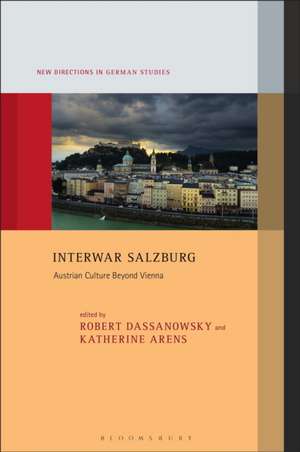
Interwar Salzburg: Austrian Culture Beyond Vienna: New Directions in German Studies
Editat de Professor or Dr. Robert von Dassanowsky, Professor Katherine Arens Prof Imke Meyeren Limba Engleză Paperback – 21 aug 2025
For over 300 years, Salzburg had its own legacy as a city-state at an international crossroads, less stratified than Europe's colonial capitals and seeking a political identity based in civic participation with its own economy and politics. After World War I, Salzburg became a refuge. Its urban and bucolic spaces staged encounters that had been brutally cut apart by the war; its deep-seated traditions of citizenship, art, and education guided its path.
In Interwar Salzburg, contributors from around the globe recover an evolving but now lost vanguard of European culture, fostering not only new identities in visual and performing arts, film, music, and literature, but also a festival culture aimed at cultivating an inclusive public (not an international elite) and a civic culture sharing public institutions, sports, tourism, and a diverse spectrum of cultural identities serving a new European ideal.
Din seria New Directions in German Studies
- 12%
 Preț: 141.69 lei
 - 26%
 Preț: 203.69 lei
 - 26%
 Preț: 232.71 lei
 - 28%
 Preț: 225.79 lei
 -
 Preț: 105.93 lei
 - 26%
 Preț: 263.68 lei
 - 34%
 Preț: 584.96 lei
 - 18%
 Preț: 192.42 lei
 - 32%
 Preț: 202.86 lei
 -
 Preț: 239.06 lei
 - 25%
 Preț: 221.12 lei
 - 25%
 Preț: 241.46 lei
 - 24%
 Preț: 232.25 lei
 - 26%
 Preț: 244.93 lei
 - 26%
 Preț: 229.03 lei
 - 18%
 Preț: 190.53 lei
 - 24%
 Preț: 225.52 lei
 - 15%
 Preț: 225.02 lei
 - 34%
 Preț: 608.46 lei
 - 25%
 Preț: 234.00 lei
 - 26%
 Preț: 237.02 lei
 - 24%
 Preț: 226.35 lei
 - 26%
 Preț: 265.01 lei
 - 21%
 Preț: 195.74 lei
 - 17%
 Preț: 262.84 lei
 - 37%
 Preț: 588.11 lei
 - 18%
 Preț: 197.99 lei
 -
 Preț: 288.32 lei
 -
 Preț: 187.76 lei
 - 39%
 Preț: 822.42 lei
 - 17%
 Preț: 265.59 lei
 - 26%
 Preț: 188.69 lei
 - 17%
 Preț: 198.48 lei
Preț: 198.82 lei
Preț vechi: 270.86 lei
-27%
Puncte Express: 298
Carte tipărită la comandă
Livrare economică 12-26 august
Livrare prin curier în România Termenul estimat este afișat lângă disponibilitate.
Transport gratuit de la 400.00 lei Plată online sau ramburs, în funcție de opțiunile comenzii.
Retur gratuit în 14 zile Comandă securizată și suport în română.
Specificații
ISBN-13: 9798765112571
Pagini: 358
Ilustrații: 5 b&w illustrations
Dimensiuni: 136 x 214 x 24 mm
Greutate: 0.44 kg
Editura: Bloomsbury Publishing
Colecția Bloomsbury Academic
Seria New Directions in German Studies
Locul publicării:New York, United States
Pagini: 358
Ilustrații: 5 b&w illustrations
Dimensiuni: 136 x 214 x 24 mm
Greutate: 0.44 kg
Editura: Bloomsbury Publishing
Colecția Bloomsbury Academic
Seria New Directions in German Studies
Locul publicării:New York, United States
Cuprins
Introduction
Robert Dassanowsky (University of Colorado, USA) and Katherine Arens (University of Texas at Austin, USA)
Prologue: The Capital of Europe. A Fantasy in Salzburg, 1900
Hermann Bahr; translated by Vincent Kling (La Salle University, USA)
I. Dreaming Salzburg: Hoping for hope, grasping at what it was and might have been . . .
1. Fantasy as Parody?: Hermann Bahr's Salzburg Dialogue
Vincent Kling (La Salle University, USA)
2. Salzburg's Age of Aquarius: Der Wassermann as an Austrian Sonderweg in the European Arts
Katherine Arens (University of Texas at Austin, USA)
II. Choosing Salzburg: Cosmopolitan Refuge and the Search for a Third Way
3. On Film in Salzburg
Robert Dassanowsky (University University of Colorado, Colorado Springs, USA)
4. The "World of Doomed Enchantment": Carl Zuckmayer and the 'Henndorf Circle'
Christopher Dietz (Independent Scholar, Austria)
III. Being Salzburg: Cultures Found and Lost
5. In the Shadow of the Salzburg Festival?: The Mozarteum Foundation and Conservatory as Protagonists in Salzburg Music Culture Between the Wars
Julia Hinterberger (University of Salzburg, Austria)
6. Sports Culture Between State and Dictatorship
Andreas Praher (University of Salzburg, Austria)
7. Everyman and the New Man: Festival Culture in Interwar Austria
Alys X. George (Stanford University, USA)
8. Shadow Sides of Modernism: Poldi Wojtek's Designs for the Salzburg Festival and Austria's Conservative Modernity
Julia Secklehner (Masaryk University, Czech Republic)
IV. Eyes on Salzburg: Salzburg Trapped and the Costs It Imposed
9. Jewish Identities and Antisemitism in Salzburg after 1918
Helga Embacher (University of Salzburg, Vienna)
10. Hungarian Salzburgs: Salzburg and the Salzburg Idea as Inspiration for Cultural Policy Initiatives and Urban Tourism Development in Interwar Hungary
Alexander Vari (Marywood University, USA)
Afterword
Bibliography
Index
Robert Dassanowsky (University of Colorado, USA) and Katherine Arens (University of Texas at Austin, USA)
Prologue: The Capital of Europe. A Fantasy in Salzburg, 1900
Hermann Bahr; translated by Vincent Kling (La Salle University, USA)
I. Dreaming Salzburg: Hoping for hope, grasping at what it was and might have been . . .
1. Fantasy as Parody?: Hermann Bahr's Salzburg Dialogue
Vincent Kling (La Salle University, USA)
2. Salzburg's Age of Aquarius: Der Wassermann as an Austrian Sonderweg in the European Arts
Katherine Arens (University of Texas at Austin, USA)
II. Choosing Salzburg: Cosmopolitan Refuge and the Search for a Third Way
3. On Film in Salzburg
Robert Dassanowsky (University University of Colorado, Colorado Springs, USA)
4. The "World of Doomed Enchantment": Carl Zuckmayer and the 'Henndorf Circle'
Christopher Dietz (Independent Scholar, Austria)
III. Being Salzburg: Cultures Found and Lost
5. In the Shadow of the Salzburg Festival?: The Mozarteum Foundation and Conservatory as Protagonists in Salzburg Music Culture Between the Wars
Julia Hinterberger (University of Salzburg, Austria)
6. Sports Culture Between State and Dictatorship
Andreas Praher (University of Salzburg, Austria)
7. Everyman and the New Man: Festival Culture in Interwar Austria
Alys X. George (Stanford University, USA)
8. Shadow Sides of Modernism: Poldi Wojtek's Designs for the Salzburg Festival and Austria's Conservative Modernity
Julia Secklehner (Masaryk University, Czech Republic)
IV. Eyes on Salzburg: Salzburg Trapped and the Costs It Imposed
9. Jewish Identities and Antisemitism in Salzburg after 1918
Helga Embacher (University of Salzburg, Vienna)
10. Hungarian Salzburgs: Salzburg and the Salzburg Idea as Inspiration for Cultural Policy Initiatives and Urban Tourism Development in Interwar Hungary
Alexander Vari (Marywood University, USA)
Afterword
Bibliography
Index
Recenzii
Interwar Salzburg is a beautiful volume on a neglected and fascinating subject. Dassanowsky and Arens are just the right people to bring this world to light, and their introduction is elegantly written to draw interwar Salzburg 'out of the shadows of the wreck of the Empire.' The essays collected here provide an impressive array of thoughtful understandings of this small city that was hard to see from Vienna-as it still is a century later. They aim at alternative historical narratives of Austria and Europe, in an effort to restore Europe's peripheries to national narratives and European histories.
Interwar Salzburg makes a case for Austria's 'second city' as a dynamic cultural space that worked to forge a modern, post-Habsburg Austrian and European identity after the upheavals of the First World War. This volume assembles an impressively interdisciplinary team of leading scholars who provide diverse perspectives on what it meant to be in, of, and from Salzburg between the wars. The essays
collected here offer compelling models of local and regional history that insist we think beyond national histories and the political and financial metropolises that that typically dominate those histories.
Interwar Salzburg makes a case for Austria's 'second city' as a dynamic cultural space that worked to forge a modern, post-Habsburg Austrian and European identity after the upheavals of the First World War. This volume assembles an impressively interdisciplinary team of leading scholars who provide diverse perspectives on what it meant to be in, of, and from Salzburg between the wars. The essays
collected here offer compelling models of local and regional history that insist we think beyond national histories and the political and financial metropolises that that typically dominate those histories.