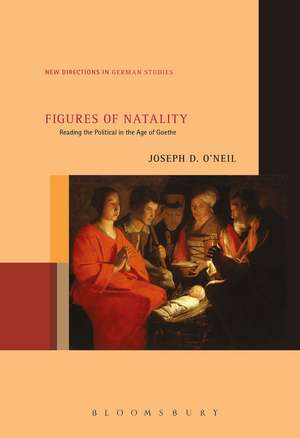
Figures of Natality: Reading the Political in the Age of Goethe: New Directions in German Studies
Autor Dr. Joseph D. O’Neilen Limba Engleză Paperback – 26 iul 2018
Alongside this geopolitical evolution, the ways of representing the political change, too, moving from the new as revolutionary eruption to economic metaphors of birth. More pressing still is the question of revolutionary subjectivity and political agency, and Lessing, Goethe, and Kleist have an answer that is remarkably close to that of Walter Benjamin, as that "secret index" through which each past age is "pointed toward redemption." Figures of Natality uncovers this index at the heart of scenes and products of birth in the age of Goethe.
Din seria New Directions in German Studies
- 26%
 Preț: 197.58 lei
 - 12%
 Preț: 137.43 lei
 - nou
 Preț: 200.29 lei
 - 26%
 Preț: 232.71 lei
 -
 Preț: 105.93 lei
 - 26%
 Preț: 263.68 lei
 - 18%
 Preț: 192.42 lei
 - 34%
 Preț: 584.96 lei
 - 28%
 Preț: 225.79 lei
 - 32%
 Preț: 202.86 lei
 - 25%
 Preț: 221.12 lei
 - 25%
 Preț: 241.46 lei
 - 24%
 Preț: 232.25 lei
 - 26%
 Preț: 229.03 lei
 - 18%
 Preț: 190.53 lei
 - 24%
 Preț: 225.52 lei
 - 15%
 Preț: 225.02 lei
 - 34%
 Preț: 590.34 lei
 -
 Preț: 239.06 lei
 - 26%
 Preț: 237.02 lei
 - 25%
 Preț: 234.00 lei
 - 24%
 Preț: 226.35 lei
 - 26%
 Preț: 265.01 lei
 - 21%
 Preț: 195.74 lei
 - 17%
 Preț: 262.84 lei
 - 37%
 Preț: 588.11 lei
 - 18%
 Preț: 197.99 lei
 -
 Preț: 288.32 lei
 -
 Preț: 187.76 lei
 - 39%
 Preț: 793.78 lei
 - 17%
 Preț: 265.59 lei
 - 26%
 Preț: 188.69 lei
Preț: 244.93 lei
Preț vechi: 330.95 lei
-26%
Puncte Express: 367
Carte tipărită la comandă
Livrare economică 08-22 iunie
Specificații
ISBN-13: 9781501343728
ISBN-10: 1501343726
Pagini: 320
Dimensiuni: 140 x 216 x 25 mm
Greutate: 0.38 kg
Ediția:NIPPOD
Editura: Bloomsbury Publishing
Colecția Bloomsbury Academic
Seria New Directions in German Studies
Locul publicării:New York, United States
ISBN-10: 1501343726
Pagini: 320
Dimensiuni: 140 x 216 x 25 mm
Greutate: 0.38 kg
Ediția:NIPPOD
Editura: Bloomsbury Publishing
Colecția Bloomsbury Academic
Seria New Directions in German Studies
Locul publicării:New York, United States
V-ar putea interesa
-
 DiaryWitold GombrowiczPreț: 115.15 lei
 -
 Bring on the Books for EverybodyJim CollinsPreț: 241.90 lei
 -
 -39%Preț: 78.65 lei128.30 lei
 -
 Jonathan Franzen: The Comedy of RageProfessor Philip Weinstein-45%Preț: 88.58 lei159.61 lei
 -
 National PlotsAndrea CabajskyPreț: 333.18 lei
 -
 The Sherlock Holmes HandbookRansom RiggsPreț: 110.07 lei
 -
 The Yellow Wallpaper And Selected WritingsCharlotte Perkins Gilman-26%Preț: 56.28 lei76.39 lei
 -
 Henry DunbarMary Elizabeth BraddonPreț: 135.61 lei
 -
 Dame Agatha's ShortsElena SantangeloPreț: 72.71 lei
Cuprins
Acknowledgements
Chapter 1: Lyric Births: Poetic Revolution and Maieutic Technique
Chapter 2: Genre, Generation, and the Retreat of the Political
Chapter 3: Ghostly Births: The Specter of Romanticism and the Maieutics of the Medium
Chapter 4: "Not as in a mirror": Wilhelm Meister and the Haunting of Sovereignty
Chapter 5: Kleist's Machiavellian Mothers: Institution, Relation, Distribution
Conclusion: Split Summits and Bifurcated Maieutics: The Political Difference and the Future of Democracy
Bibliography
Chapter 1: Lyric Births: Poetic Revolution and Maieutic Technique
Chapter 2: Genre, Generation, and the Retreat of the Political
Chapter 3: Ghostly Births: The Specter of Romanticism and the Maieutics of the Medium
Chapter 4: "Not as in a mirror": Wilhelm Meister and the Haunting of Sovereignty
Chapter 5: Kleist's Machiavellian Mothers: Institution, Relation, Distribution
Conclusion: Split Summits and Bifurcated Maieutics: The Political Difference and the Future of Democracy
Bibliography
Recenzii
At the core of this project is the question of how political action is possible without relying on essentialism. We do not need to be reminded of current discussions to understand that this is a timely project. O'Neil offers a sophisticated account of the concepts behind these debates which delivers to the reader both a panoramic display of political theory and a careful consideration of literary texts . The study brings a number of discourses into relation (biology, selfhood, economic etc.), arguing that they all follow a shared model of autopoiesis (or its rupture) around 1800. Considering the metaphor of birth at the study's center, it is not surprising that the author aims to establish a connection between models of life's origin and the political . Ultimately, however, for O'Neil the question is not only what happens in literature, but what we gain when engaging with it. O'Neil's work is driven by the desire to open spaces for contingency in action in a world that is increasingly defined by automatization and repetition. In opening these spaces, literature plays a prominent role "as that which breaks with. social and cognitive routines" (21) . O'Neil's engagement with Arendt's concept of natality proves an impressively productive venue for, as the title states, Reading the Political in the Age of Goethe. It is also a powerful reminder that the end of politics might not deliver the best of possible worlds.
Joseph O'Neil's Figures of Natality offers an insightful and conceptually bold rethinking of the political as it is worked through in literary texts in the age of Goethe . This task is both worthwhile and timely, and the readings it produces are genuinely novel and interesting.
O'Neil connects Hannah Arendt's concept of natality as the birth of the new and Carl Schmitt's understanding of the sovereign decision as a basis for social organization in order to explore the nature of 'the political.' By focusing on natality, he can both use and challenge Arendt's and Schmitt's approaches, because natality points to the paradoxical conjoining of the reproductive and productive, or, in O'Neil's version, the economic and the political. In his reading of major texts from German literature spanning the decades around 1800 that embrace this conjoining, O'Neil makes the deployment of a discourse and metaphors around birth fruitful for us today.
O'Neil's is a dynamic, ingeniously crafted tour de force, which, by virtue of its range and diversity, succeeds in generating a web of hitherto unnoticed contextualizations. Its appeal will not be restricted to specialists already attuned to the intricacies of post-foundational discourse.
In Figures of Natality, O'Neil has provided a fascinating and lucid reflection on inception within the political, and hence on the relationship of birth to the state in literature and in theory. Scholars of the Age of Goethe and political theorists alike will benefit from this study of spontaneity, will, and life processes as crucial to understanding the political across an arc of two centuries. Highly recommended!
Joseph O'Neil provides an original and surprising insight into the poetics and politics of life around 1800.
Joseph O'Neil's Figures of Natality offers an insightful and conceptually bold rethinking of the political as it is worked through in literary texts in the age of Goethe . This task is both worthwhile and timely, and the readings it produces are genuinely novel and interesting.
O'Neil connects Hannah Arendt's concept of natality as the birth of the new and Carl Schmitt's understanding of the sovereign decision as a basis for social organization in order to explore the nature of 'the political.' By focusing on natality, he can both use and challenge Arendt's and Schmitt's approaches, because natality points to the paradoxical conjoining of the reproductive and productive, or, in O'Neil's version, the economic and the political. In his reading of major texts from German literature spanning the decades around 1800 that embrace this conjoining, O'Neil makes the deployment of a discourse and metaphors around birth fruitful for us today.
O'Neil's is a dynamic, ingeniously crafted tour de force, which, by virtue of its range and diversity, succeeds in generating a web of hitherto unnoticed contextualizations. Its appeal will not be restricted to specialists already attuned to the intricacies of post-foundational discourse.
In Figures of Natality, O'Neil has provided a fascinating and lucid reflection on inception within the political, and hence on the relationship of birth to the state in literature and in theory. Scholars of the Age of Goethe and political theorists alike will benefit from this study of spontaneity, will, and life processes as crucial to understanding the political across an arc of two centuries. Highly recommended!
Joseph O'Neil provides an original and surprising insight into the poetics and politics of life around 1800.