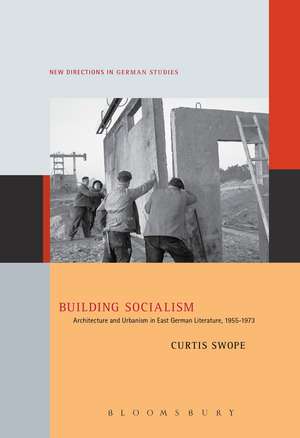
Building Socialism: Architecture and Urbanism in East German Literature, 1955-1973: New Directions in German Studies
Autor Dr. Curtis Swopeen Limba Engleză Paperback – 27 dec 2018
Design and construction were a central part of politics and everyday life in East Germany during this time as buildings old and new were asked to bear heavy ideological and social burdens. In their novels, stories, and plays, Heiner Müller, Christa Wolf, Günter Kunert, Volker Braun, Günter de Bruyn, and Brigitte Reimann responded to enormous new factory complexes, experimental new towns, the demolition of Berlin's tenements, and the propagation of a pared-down modernist aesthetic in interior design. Writers' representation of the design, construction, and use of architecture formed part of a turn to modernist literary devices, including montage, metaphor, and shifting narrative perspectives. East Germany's literary architecture also represents a sophisticated theoretical reflection on the intractable problems of East Germany's socialist modernity, including the alliance between state socialism and technological modernization, competing commitments to working-class self-organization and the power of specialist planners and designers, and the attempt to create an alternative to fascism.
Din seria New Directions in German Studies
- 15%
 Preț: 143.53 lei
 - 25%
 Preț: 209.71 lei
 - 24%
 Preț: 244.30 lei
 - 27%
 Preț: 235.82 lei
 -
 Preț: 109.15 lei
 - 25%
 Preț: 277.39 lei
 - 33%
 Preț: 613.84 lei
 - 16%
 Preț: 202.00 lei
 - 31%
 Preț: 212.98 lei
 -
 Preț: 250.42 lei
 - 24%
 Preț: 232.13 lei
 - 24%
 Preț: 253.50 lei
 - 24%
 Preț: 242.55 lei
 - 25%
 Preț: 257.03 lei
 - 25%
 Preț: 240.44 lei
 - 17%
 Preț: 200.01 lei
 - 23%
 Preț: 235.90 lei
 - 14%
 Preț: 235.44 lei
 - 33%
 Preț: 616.33 lei
 - 24%
 Preț: 244.99 lei
 - 23%
 Preț: 236.40 lei
 - 25%
 Preț: 276.77 lei
 - 20%
 Preț: 205.33 lei
 - 16%
 Preț: 275.60 lei
 - 37%
 Preț: 608.59 lei
 - 17%
 Preț: 207.84 lei
 -
 Preț: 297.74 lei
 -
 Preț: 197.10 lei
 - 38%
 Preț: 833.07 lei
 - 16%
 Preț: 278.18 lei
 - 25%
 Preț: 197.75 lei
 - 15%
 Preț: 208.34 lei
Preț: 248.75 lei
Preț vechi: 331.21 lei
-25%
Puncte Express: 373
Carte tipărită la comandă
Livrare economică 18 noiembrie-02 decembrie
Livrare prin curier în România Termenul estimat este afișat lângă disponibilitate.
Transport gratuit de la 400.00 lei Plată online sau ramburs, în funcție de opțiunile comenzii.
Retur gratuit în 14 zile Comandă securizată și suport în română.
Specificații
ISBN-13: 9781501351778
ISBN-10: 150135177X
Pagini: 272
Ilustrații: 14 b/w illustrations
Dimensiuni: 140 x 216 mm
Greutate: 0.32 kg
Editura: Bloomsbury Publishing
Colecția Bloomsbury Academic
Seria New Directions in German Studies
Locul publicării:New York, United States
ISBN-10: 150135177X
Pagini: 272
Ilustrații: 14 b/w illustrations
Dimensiuni: 140 x 216 mm
Greutate: 0.32 kg
Editura: Bloomsbury Publishing
Colecția Bloomsbury Academic
Seria New Directions in German Studies
Locul publicării:New York, United States
Cuprins
Acknowledgments
I: Framing East Germany: Marxism, Architecture, and Literature
Introduction
1. Socialist Writers and Modern Architecture
II. Architecture, Theater, and the Early Years of the Scientific-Technological Revolution
2. Confronting the Construction Site: Heiner Müller from Operativity to Metaphor
3. Towards a Bourgeois Architecture: Helmut Baierl's Frau Flinz and the Space of the Class Enemy
III. Artchitecture and Modernity in the Prose of the 1960s
4. Time at Home: The Domestic Interior in Günter de Bruyn, Irmtraud Morgner, Brigitte Reimann, Christa Wolf, and Gerhard Wolf
5. Literary Responses to East German Urbanism
Conclusion
Bibliography
Index
I: Framing East Germany: Marxism, Architecture, and Literature
Introduction
1. Socialist Writers and Modern Architecture
II. Architecture, Theater, and the Early Years of the Scientific-Technological Revolution
2. Confronting the Construction Site: Heiner Müller from Operativity to Metaphor
3. Towards a Bourgeois Architecture: Helmut Baierl's Frau Flinz and the Space of the Class Enemy
III. Artchitecture and Modernity in the Prose of the 1960s
4. Time at Home: The Domestic Interior in Günter de Bruyn, Irmtraud Morgner, Brigitte Reimann, Christa Wolf, and Gerhard Wolf
5. Literary Responses to East German Urbanism
Conclusion
Bibliography
Index
Recenzii
Though Swope's book is not the first study of literature and architecture in the GDR, it is the most thoroughly researched and far reaching published to date and breaks new ground on the topic of built space in the GDR. Summing Up: Highly recommended.
A stimulating, lucid, and well-researched study that makes for a crucial and timely contribution to the Marxist discourse on built space-especially the research of the various authors' personal libraries-the architectural heritage of the GDR in the cultural imaginary, and the still often underappreciated quality of the literary and theatrical works of the East German state.
How do writers imagine buildings and their interior design? How do politics shape architectural debates and how do those make poetry and prose? In answer to these kinds of questions, Curtis Swope offers intriguing close readings of the GDR's literary imagination of architecture based on rich sources with an international scope. This book will shape the study of the GDR-I was unable to put it down until I had read the last page.
Thanks to Curtis Swope's thoughtful research into previously unexplored territories, this book for the first time illuminates the architectural spaces that frame socialist approaches to modernity and East German literature-thus extending a spatial trajectory in modern literature that reaches back to Dickens, Balzac, and Tolstoy.
A stimulating, lucid, and well-researched study that makes for a crucial and timely contribution to the Marxist discourse on built space-especially the research of the various authors' personal libraries-the architectural heritage of the GDR in the cultural imaginary, and the still often underappreciated quality of the literary and theatrical works of the East German state.
How do writers imagine buildings and their interior design? How do politics shape architectural debates and how do those make poetry and prose? In answer to these kinds of questions, Curtis Swope offers intriguing close readings of the GDR's literary imagination of architecture based on rich sources with an international scope. This book will shape the study of the GDR-I was unable to put it down until I had read the last page.
Thanks to Curtis Swope's thoughtful research into previously unexplored territories, this book for the first time illuminates the architectural spaces that frame socialist approaches to modernity and East German literature-thus extending a spatial trajectory in modern literature that reaches back to Dickens, Balzac, and Tolstoy.