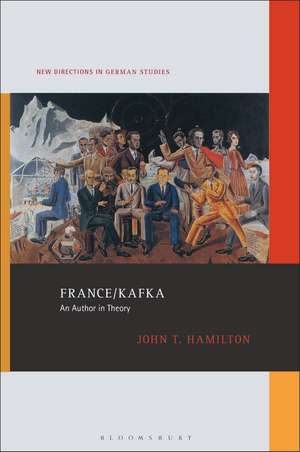
France/Kafka: An Author in Theory: New Directions in German Studies
Autor John T. Hamiltonen Limba Engleză Paperback – 23 mar 2023
Considerăm France/Kafka o resursă esențială pentru nivelul de licență avansată și cercetare academică, oferind o perspectivă riguroasă asupra modului în care un scriitor evreu de limbă germană din Praga a devenit fundamentul teoriei critice franceze. John T. Hamilton nu se limitează la o analiză literară tradițională, ci reconstruiește contextul istoric tensionat al Ocupației și Rezistenței, perioadă în care opera lui Kafka a început să fie citită ca o profeție a birocrației totalitare și a absurdului secolului XX.
Remarcăm structura progresivă a volumului, care debutează cu „naturalizarea” simbolică a lui Kafka în spațiul parizian și culminează cu explorarea „labirinturilor” teoretice post-structurale. Dacă The Cambridge Companion to Kafka de Julian Preece oferă o privire de ansamblu comprehensivă asupra vieții și operei scriitorului în context european, lucrarea de față are o abordare mult mai specifică și interdisciplinară. Ea se concentrează strict pe „viața de după moarte” a textelor kaffkiene în Franța, demonstrând cum acestea au catalizat gândirea unor intelectuali de marcă și au modelat mișcări precum existențialismul sau deconstrucția.
Subliniem continuitatea preocupărilor lui John T. Hamilton pentru teme complexe; dacă în Complacency acesta analiza declinul studiilor clasice, iar în Security explora ambiguitatea unui termen politic omniprezent, în France/Kafka el aplică aceeași rigoare filologică pentru a explica transformarea unui autor în „teorie”. Este o analiză densă a modului în care traducerile și interpretările franceze au creat un Kafka universal, detașat de originile sale geografice, dar profund ancorat în crizele ontologice ale modernității.
Din seria New Directions in German Studies
- 25%
 Preț: 209.71 lei
 - 24%
 Preț: 244.30 lei
 - 27%
 Preț: 235.82 lei
 -
 Preț: 109.15 lei
 - 25%
 Preț: 277.39 lei
 - 33%
 Preț: 613.84 lei
 - 16%
 Preț: 202.00 lei
 - 31%
 Preț: 212.98 lei
 -
 Preț: 250.42 lei
 - 24%
 Preț: 232.13 lei
 - 24%
 Preț: 253.50 lei
 - 24%
 Preț: 242.55 lei
 - 25%
 Preț: 257.03 lei
 - 25%
 Preț: 240.44 lei
 - 17%
 Preț: 200.01 lei
 - 23%
 Preț: 235.90 lei
 - 14%
 Preț: 235.44 lei
 - 33%
 Preț: 616.33 lei
 - 24%
 Preț: 244.99 lei
 - 25%
 Preț: 248.75 lei
 - 23%
 Preț: 236.40 lei
 - 25%
 Preț: 276.77 lei
 - 20%
 Preț: 205.33 lei
 - 16%
 Preț: 275.60 lei
 - 37%
 Preț: 608.59 lei
 - 17%
 Preț: 207.84 lei
 -
 Preț: 297.74 lei
 -
 Preț: 197.10 lei
 - 38%
 Preț: 833.07 lei
 - 16%
 Preț: 278.18 lei
 - 25%
 Preț: 197.75 lei
 - 15%
 Preț: 208.34 lei
Preț: 143.53 lei
Preț vechi: 169.19 lei
-15%
Carte disponibilă
Livrare economică 28 octombrie-11 noiembrie
Livrare express 13-17 octombrie pentru 48.53 lei
Specificații
Pagini: 200
Dimensiuni: 138 x 214 x 16 mm
Greutate: 0.28 kg
Editura: Bloomsbury Publishing
Colecția Bloomsbury Academic
Seria New Directions in German Studies
Locul publicării:New York, United States
De ce să citești această carte
Această lucrare este recomandată studenților și specialiștilor în literatură comparată și teorie critică. Cititorul va înțelege cum mecanismele de recepție culturală pot transforma un autor obscur într-un canon global. Este o oportunitate rară de a vedea legătura directă între traumele politice ale Franței postbelice și nașterea unor concepte filozofice fundamentale, oferind o hartă clară a influenței lui Kafka asupra gândirii contemporane.
Despre autor
John T. Hamilton este profesor de literatură comparată și limbi germanice la Universitatea Harvard, fiind o voce autoritară în studiul relației dintre filologie, filozofie și muzică. Cu o carieră academică marcată de explorarea tradițiilor clasice și a transformărilor acestora în modernitate, Hamilton a publicat lucrări de referință precum „Music, Madness, and the Unworking of Language” și „Soliciting Darkness”. În calitatea sa de profesor „William R. Kenan”, abordările sale se disting printr-o erudiție vastă, integrând analiza literară cu istoria ideilor, fapt ce îi permite să plaseze figuri precum Franz Kafka într-un context intelectual global.
Descriere
Hamilton also considers how Kafka's unique literary corpus came to stimulate reflection in diverse movements, critical approaches, and philosophical schools, from surrealism and existentialism through psychoanalysis, phenomenology, and structuralism to Marxism, deconstruction, and feminism. The story of Kafka's afterlife in Paris thus furnishes a key chapter in the unfolding of French theory, which continues to guide how we read literature and understand its relationship to the world.
Cuprins
I. Gradus ad Parnassum
The Writer and the Author in Theory · Through a Glass, darkly · From the Louvre to the Louvre · An Improbable Apparition · A Second Life
II. Metamorphoses
Naturalization Papers · Amid Intimacy and Exoticism · Universal Man · Dreams, Rivers, Snow · Translative Decisions · Bifurcations
III. Trials
Paratexts · The Adventurer · The Saint · A Certain Plume · Extremism · Non liquet
IV. Contingencies
Preoccupations · Nothing but Nothing · Seasickness on Land · Phantom War · Homo absurdus · Impossible Hope · Objective Style
V. Judgments
Upside Down, Right Side Up · Disengagement · Incendiaries · The Child · The Author in Theater
VI. Labyrinths
Signs of Change · The New New · Rhizomes · Primal Scenes · Derrida's Pharmacy
Bibliography
Index
Recenzii
A beautifully multilayered take on the interrelations between Kafka's works and the French theorists of the twentieth century who studied them. ... [France/Kafka] lends itself as a textbook for courses on literary theory and as an introduction to critical methodologies. And lastly, it is a pleasure to follow John Hamilton's expert guidance across time, languages, and cultures to learn about the chiastic, but intimate relation between Franz and France.
What makes France/Kafka so compelling is precisely its refusal to resolve Kafka into coherence. Instead, Hamilton allows us to see how French readings of Kafka's textual strategies become tools for thinking in conditions of social crisis . In France/Kafka readers will find an important study of reception, as well as a careful consideration of the meaning of literature itself.
Kafka lovers who are inclined to emulate their hero had better be en garde while opening this book: Kafka wrote, 'There is no having, only a being, only a state of being that craves the last breath.' John Hamilton's France/Kafka is literally breathtaking in its historical sense, theoretical finesse, and visual intelligence, observant of the finest telling detail. I risked danger and read France/Kafka in one go and with unstinting joy: there is no finer critic-close reader and philosopher-than John Hamilton, who, in Kafka and France, has found his predestined subject.
France/Kafka: An Author in Theory shows John T. Hamilton at a new peak of his scholarly powers and demonstrates what Comparative Literature can accomplish today. An elegant dance in French, German, and English, Hamilton's book provides a comprehensive reconstruction of Kafka's aerolithic impact within the French intellectual context from surrealism and existentialism to feminism and deconstruction. Kafka, who considered himself a spiritual son of Gustave Flaubert, turns out to be the elusive godfather of French theory. While unfolding an erudite dossier of a century of cultural history, France/Kafka discreetly designs its own literary theory, revealing all reading as Übersetzung. Franz Kafka is an author in continued translation: John T. Hamilton passes on the Imperial Message for the 21st century.
Indispensable for the study of Kafka's French reception.
The book is resoundingly successful [...] There are many chestnuts and flourishes of erudition that deepen each subsequent writer in Hamilton's genealogy, none of which can easily be synthesized down to the framework of a review. Perhaps the most impressive part of the book is that, in the end, the slash itself, so vital to the logic of the book, falls away. It disappears not merely between France/Kafka,
but inevitably between theory/practice as well. The book becomes an act of beholding, which Hamilton reminds us is the true root of theory
Hamilton is very good at reconstructing how various critical approaches were affected by the historical and political contexts of the occupation, resistance, and liberation in the wake of World War II.