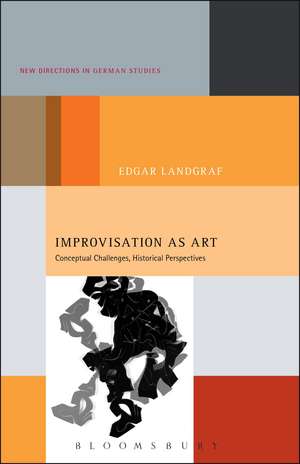
Improvisation as Art: Conceptual Challenges, Historical Perspectives: New Directions in German Studies
Autor Dr. Edgar Landgrafen Limba Engleză Paperback – 29 mai 2014
After an in-depth exploration of contemporary theoretical contentions surrounding improvisation, Landgraf examines how the new emphasis on inventiveness affects the understanding of improvisation in the emerging aesthetic and anthropological discourses of the late 18th and early 19th centuries. He first focuses on accounts of improvisational performances by Moritz, Goethe, and Fernow and reads them alongside the aesthetics of autonomy as it develops at the same time. In its second half, the book investigates how the problem of "planning" art receives a different treatment in German Romanticism. The final chapter focuses on the writings of Heinrich von Kleist where improvisation presents a central aesthetic principle. Kleist's figurations of improvisation recognize the anthropological predicament of the self in modern society and the social constraints that invite and often force individuals to improvise.
Din seria New Directions in German Studies
- 14%
 Preț: 148.41 lei
 - 24%
 Preț: 211.29 lei
 - 23%
 Preț: 251.77 lei
 - 26%
 Preț: 241.59 lei
 -
 Preț: 109.15 lei
 - 25%
 Preț: 277.39 lei
 - 33%
 Preț: 613.84 lei
 - 16%
 Preț: 206.27 lei
 - 31%
 Preț: 212.98 lei
 -
 Preț: 250.42 lei
 - 24%
 Preț: 232.13 lei
 - 24%
 Preț: 253.50 lei
 - 24%
 Preț: 242.55 lei
 - 24%
 Preț: 264.85 lei
 - 25%
 Preț: 240.44 lei
 - 16%
 Preț: 204.94 lei
 - 23%
 Preț: 235.90 lei
 - 14%
 Preț: 235.44 lei
 - 33%
 Preț: 616.33 lei
 - 24%
 Preț: 244.99 lei
 - 25%
 Preț: 248.75 lei
 - 23%
 Preț: 236.40 lei
 - 25%
 Preț: 276.77 lei
 - 19%
 Preț: 210.38 lei
 - 16%
 Preț: 275.60 lei
 - 37%
 Preț: 608.59 lei
 - 17%
 Preț: 207.84 lei
 -
 Preț: 297.74 lei
 -
 Preț: 197.10 lei
 - 38%
 Preț: 833.07 lei
 - 16%
 Preț: 278.18 lei
 - 15%
 Preț: 213.48 lei
Preț: 197.75 lei
Preț vechi: 265.20 lei
-25%
Puncte Express: 297
Carte tipărită la comandă
Livrare economică 05-19 decembrie
Livrare prin curier în România Termenul estimat este afișat lângă disponibilitate.
Transport gratuit de la 400.00 lei Plată online sau ramburs, în funcție de opțiunile comenzii.
Retur gratuit în 14 zile Comandă securizată și suport în română.
Specificații
ISBN-13: 9781628929577
ISBN-10: 162892957X
Pagini: 176
Dimensiuni: 136 x 214 x 12 mm
Greutate: 0.24 kg
Editura: Bloomsbury Publishing
Colecția Bloomsbury Academic
Seria New Directions in German Studies
Locul publicării:New York, United States
ISBN-10: 162892957X
Pagini: 176
Dimensiuni: 136 x 214 x 12 mm
Greutate: 0.24 kg
Editura: Bloomsbury Publishing
Colecția Bloomsbury Academic
Seria New Directions in German Studies
Locul publicării:New York, United States
V-ar putea interesa
-
 An Anthology of Elizabethan Prose FictionPaul Salzman-17%Preț: 72.39 lei87.36 lei
 -
 Arabian Nights' EntertainmentsRobert L. Mack-16%Preț: 100.54 lei119.18 lei
 -
 Mock-Epic Poetry from Pope to HeineRitchie Robertson-31%Preț: 576.89 lei830.38 lei
 -
 -22%Preț: 422.12 lei543.26 lei
 -
 -12%Preț: 303.17 lei345.27 lei
 -
 -30%Preț: 684.27 lei977.72 lei
 -
 -27%Preț: 524.70 lei719.87 lei
 -
 -15%Preț: 665.66 lei783.13 lei
 -
 The Interpretation of Samuel JohnsonJ. ClarkPreț: 405.27 lei
 -
 Preț: 268.72 lei
 -
 Preț: 301.91 lei
 -
 GrillparzerW. E. YatesPreț: 299.96 lei
 -
 Preț: 245.24 lei
 -
 The Shakespeare HandbookDr Andrew Hiscock-16%Preț: 216.07 lei257.82 lei
 -
 Acting Companies and their Plays in Shakespeare’s LondonDr. Siobhan Keenan-17%Preț: 208.04 lei249.44 lei
 -
 Preț: 64.09 lei
 -
 The Jew of Malta: A Critical ReaderProfessor Robert A. Logan-25%Preț: 183.03 lei242.88 lei
 -
 Shakespeare's Theatres and the Effects of PerformanceDr. Farah Karim Cooper-23%Preț: 240.19 lei312.80 lei
 -
 The RenegadoPhilip Massinger-16%Preț: 122.23 lei145.98 lei
Cuprins
Acknowledgments
Introduction: On Conceptualizing Improvisation
1. Performance, Inventiveness and Improvisation: Theoretical Contentions
1.1 Derrida's Inventiveness
1.2 Calculating Incalculability: The Neocybernetic Alternative
1.3 From Iteration to Improvisation
2. Indescribability, Perfection, Unpredictability: Improvisation and Aesthetic Autonomy
2.1 Instrumentalizing Improvisation? Johann Wolfgang von Goethe
2.2 Improvisation and Aesthetic Autonomy
2.3 Improvisation and Aesthetic Perfection: Karl Philipp Moritz
2.4 Improvisation and the Artist-Genius
3. Staged Improvisation: The Generative Principles of Romantic Irony
3.1 Reframing the Space of the Theater
3.2 Staged Improvisation
3.3 Romantic Principles of Artistic Production
3.4 Social Bearings
4. Improvisation, Agency, Autonomy. Heinrich von Kleist and the Modern Predicament
4.1 Facilitating Prohibitions
4.2 Improvisation as Political Practice
4.3 The Incalculability of Calculation
4.4 Kleist's Pedagogical Program
Conclusion: Experiencing Improvisation as Art
Works Cited
Introduction: On Conceptualizing Improvisation
1. Performance, Inventiveness and Improvisation: Theoretical Contentions
1.1 Derrida's Inventiveness
1.2 Calculating Incalculability: The Neocybernetic Alternative
1.3 From Iteration to Improvisation
2. Indescribability, Perfection, Unpredictability: Improvisation and Aesthetic Autonomy
2.1 Instrumentalizing Improvisation? Johann Wolfgang von Goethe
2.2 Improvisation and Aesthetic Autonomy
2.3 Improvisation and Aesthetic Perfection: Karl Philipp Moritz
2.4 Improvisation and the Artist-Genius
3. Staged Improvisation: The Generative Principles of Romantic Irony
3.1 Reframing the Space of the Theater
3.2 Staged Improvisation
3.3 Romantic Principles of Artistic Production
3.4 Social Bearings
4. Improvisation, Agency, Autonomy. Heinrich von Kleist and the Modern Predicament
4.1 Facilitating Prohibitions
4.2 Improvisation as Political Practice
4.3 The Incalculability of Calculation
4.4 Kleist's Pedagogical Program
Conclusion: Experiencing Improvisation as Art
Works Cited
Recenzii
"Landgraf writes with refreshing clarity, showing how neocybernetics-systems theory in the line from Heinz von Foerster to Niklas Luhmann-offers concepts that resolve prior impasses in theoretical approaches to improvisation. His nuanced treatments of Derrida and Luhmann on modernity and invention rival Cary Wolfe's seminal work at this important intersection. Landgraf's itinerary modulates effectively from keen textual detail to broad historical and aesthetic matters. Establishing links from German Romantic practice to classical, premodern, modernist, and postmodernist artistic forms, Improvisation as Art develops a superbly coherent and persuasive argument, well positioned in the midst of significant and timely critical debates." -- Bruce Clarke, Professor of Literature and Science, Texas Tech University, USA, and co-editor of The Routledge Companion to Literature and Science.
"Edgar Landgraf's Improvisation as Art marks a genuine intellectual breakthrough. It not only unfolds a highly original account of the emergence of aesthetic autonomy around 1800, but also recasts the terms of the ongoing effort to conceptualize artistic improvisation. Without a trace of tendentiousness, Landgraf develops a "neocybernetic" critique of major theoretical positions (e.g., Butler, Derrida) and introduces the reader along the way to a flexible methodology of cultural analysis. Historical erudition, intellectual agility, and commitment to clarity are the salient features of Landgraf's scholarly voice. His book is an abundant conceptual resource to which readers will often return." -- David E. Wellbery, LeRoy T. and Margaret Deffenbaugh Carlson University Professor, Department of Germanic Studies, University of Chicago, USA
"Both students and scholars of 18th and early 19th-century German literature, as well as anyone interested in modern notions of art and improvisation will benefit highly from this erudite and clearly written study, which expands on Luhmann's descriptive and avowedly value-free, sociological theory of art and makes it accessible to a wider audience. By including in the discussion also an opponent of systems theory, Jacques Derrida, who insisted on the 'incalculability of the incalculable' and on openness for the advent of 'the other' (19-29),Landgraf contributes to current debates on ideas of freedom and the role of art and/asimprovisation in society, inviting our participation." - German Quarterly (Winter 2012, reviewed by May Mergenthaler, The Ohio State University)
"Edgar Landgraf's Improvisation as Art marks a genuine intellectual breakthrough. It not only unfolds a highly original account of the emergence of aesthetic autonomy around 1800, but also recasts the terms of the ongoing effort to conceptualize artistic improvisation. Without a trace of tendentiousness, Landgraf develops a "neocybernetic" critique of major theoretical positions (e.g., Butler, Derrida) and introduces the reader along the way to a flexible methodology of cultural analysis. Historical erudition, intellectual agility, and commitment to clarity are the salient features of Landgraf's scholarly voice. His book is an abundant conceptual resource to which readers will often return." -- David E. Wellbery, LeRoy T. and Margaret Deffenbaugh Carlson University Professor, Department of Germanic Studies, University of Chicago, USA
"Both students and scholars of 18th and early 19th-century German literature, as well as anyone interested in modern notions of art and improvisation will benefit highly from this erudite and clearly written study, which expands on Luhmann's descriptive and avowedly value-free, sociological theory of art and makes it accessible to a wider audience. By including in the discussion also an opponent of systems theory, Jacques Derrida, who insisted on the 'incalculability of the incalculable' and on openness for the advent of 'the other' (19-29),Landgraf contributes to current debates on ideas of freedom and the role of art and/asimprovisation in society, inviting our participation." - German Quarterly (Winter 2012, reviewed by May Mergenthaler, The Ohio State University)