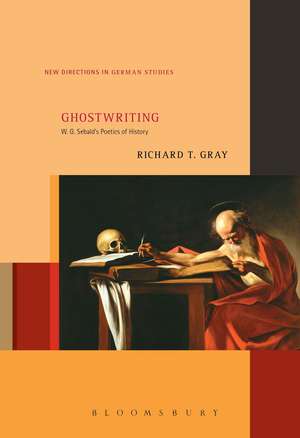
Ghostwriting: W. G. Sebald’s Poetics of History: New Directions in German Studies
Autor Dr. Richard T. Grayen Limba Engleză Paperback – 30 mai 2019
The title "Ghostwriting" signals the convergence in Sebald's works of a set of diverse historical questions, philosophical views, and literary practices. Many historical ghosts haunt Sebald's narratives on the level of story. Moreover, Sebald's narrator plays the role of a ghostwriter in the profound sense that his stories fictionally re-enact the histories of obscure, but once-living individuals whose lives they revitalize, and whose fates are tied up with the most virulent historical conjunctures of the modern world. This study thus seeks to comprehend the constitutive elements of Sebald's "poetics of history," his implementation of literary tools for effective historical memorializing.
Din seria New Directions in German Studies
- 14%
 Preț: 148.41 lei
 - 24%
 Preț: 211.29 lei
 - 23%
 Preț: 251.77 lei
 - 26%
 Preț: 241.59 lei
 -
 Preț: 109.15 lei
 - 25%
 Preț: 277.39 lei
 - 33%
 Preț: 613.84 lei
 - 16%
 Preț: 206.27 lei
 - 31%
 Preț: 212.98 lei
 -
 Preț: 250.42 lei
 - 24%
 Preț: 232.13 lei
 - 24%
 Preț: 242.55 lei
 - 24%
 Preț: 264.85 lei
 - 25%
 Preț: 240.44 lei
 - 16%
 Preț: 204.94 lei
 - 23%
 Preț: 235.90 lei
 - 14%
 Preț: 235.44 lei
 - 33%
 Preț: 616.33 lei
 - 24%
 Preț: 244.99 lei
 - 25%
 Preț: 248.75 lei
 - 23%
 Preț: 236.40 lei
 - 25%
 Preț: 276.77 lei
 - 19%
 Preț: 210.38 lei
 - 16%
 Preț: 275.60 lei
 - 37%
 Preț: 608.59 lei
 - 17%
 Preț: 207.84 lei
 -
 Preț: 297.74 lei
 -
 Preț: 197.10 lei
 - 38%
 Preț: 833.07 lei
 - 16%
 Preț: 278.18 lei
 - 25%
 Preț: 197.75 lei
 - 15%
 Preț: 213.48 lei
Preț: 253.50 lei
Preț vechi: 333.78 lei
-24%
Puncte Express: 380
Carte tipărită la comandă
Livrare economică 05-19 decembrie
Livrare prin curier în România Termenul estimat este afișat lângă disponibilitate.
Transport gratuit de la 400.00 lei Plată online sau ramburs, în funcție de opțiunile comenzii.
Retur gratuit în 14 zile Comandă securizată și suport în română.
Specificații
ISBN-13: 9781501352614
ISBN-10: 150135261X
Pagini: 464
Ilustrații: 36 b/w illustrations
Dimensiuni: 140 x 216 x 24 mm
Greutate: 0.54 kg
Editura: Bloomsbury Publishing
Colecția Bloomsbury Academic
Seria New Directions in German Studies
Locul publicării:New York, United States
ISBN-10: 150135261X
Pagini: 464
Ilustrații: 36 b/w illustrations
Dimensiuni: 140 x 216 x 24 mm
Greutate: 0.54 kg
Editura: Bloomsbury Publishing
Colecția Bloomsbury Academic
Seria New Directions in German Studies
Locul publicării:New York, United States
V-ar putea interesa
-
 Every Book Its ReaderNicholas A BasbanesPreț: 107.09 lei
 -
 Darkness VisibleWilliam Styron-20%Preț: 56.55 lei70.46 lei
 -
 Aspects of the NovelE. M. Forster-26%Preț: 57.92 lei78.50 lei
 -
 Bestsellers: A Very Short IntroductionJohn Sutherland-20%Preț: 56.92 lei71.00 lei
 -
 I Am Alive and You Are DeadEmmanuel CarrerePreț: 135.66 lei
 -
 Pride and PrejudiceJane AustenPreț: 304.13 lei
 -
 The Rise of the Gothic NovelMaggie KilgourPreț: 456.29 lei
 -
 Science FictionAdam RobertsPreț: 247.99 lei
 -
 The Routledge Companion to Science FictionMark Bould-15%Preț: 456.55 lei537.12 lei
 -
 Twilight and HistoryNancy R ReaginPreț: 120.69 lei
 -
 The Cambridge Companion to English NovelistsAdrian PoolePreț: 307.19 lei
 -
 Booze and the Private Eye: Alcohol in the Hard-Boiled NovelRita Elizabeth RippetoePreț: 225.09 lei
 -
 Preț: 87.09 lei
 -
 They Died in VainJim HuangPreț: 72.72 lei
 -
 Jonathan Franzen: The Comedy of RageProfessor Philip Weinstein-45%Preț: 90.07 lei163.16 lei
 -
 The Heirs of Anthony BoucherMarvin LachmanPreț: 80.46 lei
Cuprins
List of Abbreviations
List of Illustrations
Acknowledgments
Introduction: Sebald's Literary Séance
1. Wittgenstein's Ghost: Toward Understanding Sebald's Literary Turn
2. The Birth of the Prose Fictionalizer from the Spirit of Biographical Criticism: Schwindel. Gefühle
3. Sebald's Literary Refinement: "Dr. Henry Selwyn" and Its Textual Predecessor
4. Neither Here Nor There: Exile as Dis-Placement in "Dr. Henry Selwyn"
5. Sebald's Ectopia: Homelessness and Alienated Heritage in "Max Aurach"/"Max Ferber"
6. Fabulation and Metahistory: W. G. Sebald and the Problematic of Contemporary (German) Holocaust Fiction
7. Sebald's Segues: Performing Narrative Contingency in Die Ringe des Saturn
8. Writing at the Roche Limit: Order and Entropy in Die Ringe des Saturn
9. Narrating Environmental Catastrophe: Ecopsychology and Ecological Apocalypse in Sebald's Corsica Project
Bibliography
Index
List of Illustrations
Acknowledgments
Introduction: Sebald's Literary Séance
1. Wittgenstein's Ghost: Toward Understanding Sebald's Literary Turn
2. The Birth of the Prose Fictionalizer from the Spirit of Biographical Criticism: Schwindel. Gefühle
3. Sebald's Literary Refinement: "Dr. Henry Selwyn" and Its Textual Predecessor
4. Neither Here Nor There: Exile as Dis-Placement in "Dr. Henry Selwyn"
5. Sebald's Ectopia: Homelessness and Alienated Heritage in "Max Aurach"/"Max Ferber"
6. Fabulation and Metahistory: W. G. Sebald and the Problematic of Contemporary (German) Holocaust Fiction
7. Sebald's Segues: Performing Narrative Contingency in Die Ringe des Saturn
8. Writing at the Roche Limit: Order and Entropy in Die Ringe des Saturn
9. Narrating Environmental Catastrophe: Ecopsychology and Ecological Apocalypse in Sebald's Corsica Project
Bibliography
Index
Recenzii
A truly magisterial scholarly work on a writer who continues to inspire a small industry of academic labor. In his new 464-page book Gray has produced what may very well be the definitive text on Sebald for both languages and readerships.
Richard T. Gray is a remarkable reader of W. G. Sebald. Meticulous in his attention to detail as well as learned in understanding of the broader contexts, he teaches us new ways to think about this enigmatic writer.
Ghostwriting is well-written, informative, and wonderfully insightful. With a lucid and evocative style, Richard T. Gray presents exciting revelations about new archival materials: Sebald's marginalia from his library and his partially unpublished manuscript about pending ecological disaster in Corsica (and the world). This book poses the question that all Sebald readers have asked at some point: In what direction might Sebald's writing have gone if he had not died at age fifty-seven? Gray investigates whether Sebald might have returned to the eco-psychological style of the Corsica piece, as a ghostwriter for nature. Especially welcome is the wide-ranging learnedness, which Gray wears lightly, that makes Ghostwriting not just about Sebald but about modern Western literature and thought. This is an excellent, strong, authoritative book-the first to treat Sebald with the care that such a great writer deserves.
Richard T. Gray is a remarkable reader of W. G. Sebald. Meticulous in his attention to detail as well as learned in understanding of the broader contexts, he teaches us new ways to think about this enigmatic writer.
Ghostwriting is well-written, informative, and wonderfully insightful. With a lucid and evocative style, Richard T. Gray presents exciting revelations about new archival materials: Sebald's marginalia from his library and his partially unpublished manuscript about pending ecological disaster in Corsica (and the world). This book poses the question that all Sebald readers have asked at some point: In what direction might Sebald's writing have gone if he had not died at age fifty-seven? Gray investigates whether Sebald might have returned to the eco-psychological style of the Corsica piece, as a ghostwriter for nature. Especially welcome is the wide-ranging learnedness, which Gray wears lightly, that makes Ghostwriting not just about Sebald but about modern Western literature and thought. This is an excellent, strong, authoritative book-the first to treat Sebald with the care that such a great writer deserves.