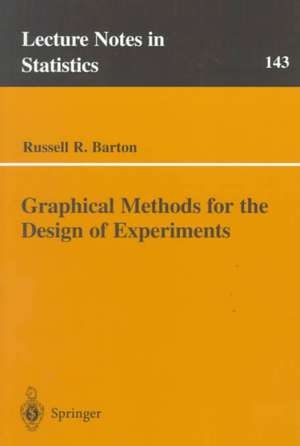
Graphical Methods for the Design of Experiments: Lecture Notes in Statistics, cartea 143
Autor Russell R. Bartonen Limba Engleză Paperback – 5 aug 1999
Din seria Lecture Notes in Statistics
-
 Preț: 477.59 lei
 - 18%
 Preț: 1236.28 lei
 - 18%
 Preț: 947.14 lei
 - 15%
 Preț: 643.38 lei
 - 18%
 Preț: 891.96 lei
 -
 Preț: 367.52 lei
 - 15%
 Preț: 608.90 lei
 - 15%
 Preț: 611.12 lei
 -
 Preț: 378.78 lei
 - 15%
 Preț: 635.22 lei
 - 15%
 Preț: 640.80 lei
 - 15%
 Preț: 673.53 lei
 - 15%
 Preț: 646.18 lei
 - 15%
 Preț: 617.80 lei
 - 15%
 Preț: 648.75 lei
 -
 Preț: 367.85 lei
 - 15%
 Preț: 611.74 lei
 - 15%
 Preț: 651.89 lei
 -
 Preț: 364.92 lei
 - 18%
 Preț: 848.72 lei
 - 15%
 Preț: 609.85 lei
 - 15%
 Preț: 623.70 lei
 -
 Preț: 364.56 lei
 - 18%
 Preț: 783.75 lei
 - 15%
 Preț: 616.45 lei
 - 18%
 Preț: 1059.82 lei
 - 15%
 Preț: 618.34 lei
 -
 Preț: 369.19 lei
 - 15%
 Preț: 613.36 lei
 - 18%
 Preț: 946.75 lei
 - 15%
 Preț: 654.41 lei
 - 15%
 Preț: 650.18 lei
 - 5%
 Preț: 721.02 lei
 - 15%
 Preț: 641.11 lei
 - 15%
 Preț: 607.49 lei
 - 5%
 Preț: 784.54 lei
 -
 Preț: 401.66 lei
 - 15%
 Preț: 617.39 lei
 - 18%
 Preț: 695.39 lei
 -
 Preț: 374.60 lei
 - 15%
 Preț: 639.64 lei
 - 18%
 Preț: 904.67 lei
 - 15%
 Preț: 613.15 lei
 - 15%
 Preț: 639.02 lei
 -
 Preț: 376.77 lei
 - 15%
 Preț: 646.40 lei
 -
 Preț: 367.04 lei
 - 15%
 Preț: 651.67 lei
 - 15%
 Preț: 612.99 lei
Preț: 665.98 lei
Preț vechi: 783.50 lei
-15%
Puncte Express: 999
Carte tipărită la comandă
Livrare economică 30 noiembrie-14 decembrie
Livrare prin curier în România Termenul estimat este afișat lângă disponibilitate.
Transport gratuit pentru acest produs Plată online sau ramburs, în funcție de opțiunile comenzii.
Retur gratuit în 14 zile Comandă securizată și suport în română.
Specificații
ISBN-13: 9780387947501
ISBN-10: 0387947507
Pagini: 196
Ilustrații: X, 196 p. 9 illus.
Dimensiuni: 155 x 235 x 11 mm
Greutate: 0.3 kg
Ediția:1999
Editura: Springer
Colecția Springer
Seria Lecture Notes in Statistics
Locul publicării:New York, NY, United States
ISBN-10: 0387947507
Pagini: 196
Ilustrații: X, 196 p. 9 illus.
Dimensiuni: 155 x 235 x 11 mm
Greutate: 0.3 kg
Ediția:1999
Editura: Springer
Colecția Springer
Seria Lecture Notes in Statistics
Locul publicării:New York, NY, United States
V-ar putea interesa
-
 SimulationSheldon M. Ross-32%Preț: 520.82 lei766.79 lei
 -
 -33%Preț: 786.42 lei1170.59 lei
 -
 Feynman-Kac FormulaePierre Del Moral-18%Preț: 1168.39 lei1424.86 lei
 -
 Nonparametric Functional Data AnalysisFrédéric Ferraty-18%Preț: 816.44 lei995.66 lei
 -
 Random Fields and GeometryR. J. Adler-18%Preț: 937.71 lei1143.54 lei
 -
 A Probabilistic Theory of Pattern RecognitionLuc Devroye-18%Preț: 830.41 lei1012.70 lei
 -
 Interpolation of Spatial DataMichael L. Stein-18%Preț: 922.58 lei1125.10 lei
 -
 Spatial Analysis Along NetworksAtsuyuki Okabe-9%Preț: 759.40 lei834.50 lei
 -
 Adaptive TestsO'Gorman-9%Preț: 941.44 lei1034.54 lei
 -
 Financial Mathematics: A Comprehensive TreatmentGiuseppe Campolieti-9%Preț: 838.61 lei921.54 lei
 -
 The Fokker-Planck EquationHannes Risken-20%Preț: 575.37 lei719.21 lei
Public țintă
ResearchCuprins
1 Introduction.- The role of experiment design in statistical methodology.- The five main steps in the design of an experiment.- Summary of topics.- The videodisk pressing example.- Study questions.- 2 Planning for a Designed Experiment.- Goal hierarchy plots.- Individual experiment goals and form of the statistical model.- Experiment goals: other aspects.- Key terms in experiment design.- Identifying and classifying variables.- Choosing a model: a priori main effect and interaction plots.- Summary.- Study questions.- 3 Design-Plots for Factorial and Fractional-Factorial Designs.- Factorial designs.- Graphical presentation of factorial designs.- Factorial designs and corresponding regression models.- Graphical projections and the notion of effect sparsity.- Confounding in fractional-factorial designs.- Geometric patterns of confounding relations.- Design-plots for other designs.- Study questions.- 4 Designing Experiments Graphically.- Constructing two-level fractional-factorial designs.- Designing fractional-factorial experiments with three or more levels.- Videodisk pressing example.- Graphical design of mixture experiments.- Graphical designs for blocking and nested effects.- Confounding graphs.- Experiment designs for robust design.- Designing pilot experiments.- Study questions.- 5 Assessing Experiment Designs.- A videodisk experiment design.- Numerical measures for design assessment.- Design assessment and `optimal’ designs.- Graphical methods for assessing confounding in regular 2k-pdesigns.- Prediction error plots.- Designs for a manufacturing simulation study.- Shaded-block matrix plots.- Parallel coordinate plots.- A model with dependent random perturbations.- Study questions.- 6 Presenting Results Graphically.- Traditional graphical displays of experimentalresults.- Response-scaled design-plots.- Constructing a response-scaled design-plot.- Interpreting response-scaled design-plots.- Response-scaled design-plots and robust design.- Model-free interpretation of experimental results.- Study questions.