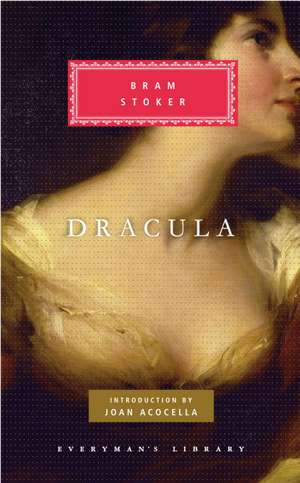
Dracula
Autor Bram Stokeren Limba Engleză Hardback – 4 mai 2010
Găsim în această lucrare fundamentală o arhitectură narativă de o complexitate remarcabilă: povestea nu este livrată de o voce atotștiutoare, ci se recompune fragmentat, din jurnale personale, scrisori, telegrame și înregistrări pe fonograf. Această structură epistolară, pe care o notăm cu un interes deosebit, transformă cititorul într-un detectiv care asamblează dovezile unei invazii supranaturale în inima Angliei victoriene. Pendulând între peisajul arhaic al Transilvaniei și modernitatea tehnologizată a Londrei din 1893, textul reușește să mențină o tensiune psihologică constantă, unde necunoscutul este documentat cu rigoare aproape științifică. Suntem de părere că stilul lui Bram Stoker are ceva din densitatea atmosferică și preocuparea pentru morbid a prozei lui Mary Shelley, fără să fie o imitație — Stoker înlocuiește angoasa metafizică cu o teroare viscerală, ancorată în detaliul biologic și geografic. Dacă în Dracula's Guest and Other Weird Tales autorul explorează limitele dintre vis și realitate prin povestiri scurte, în Dracula el își rafinează viziunea, oferind o lucrare de o anvergură mult mai mare, care funcționează simultan ca roman de aventură și critică socială. Organizarea volumului respectă succesiunea cronologică a evenimentelor, de la intrarea lui Jonathan Harker în castelul din Carpați până la confruntarea finală. Această ediție de la Random House este îmbogățită cu o introducere semnată de Carol Senf și note critice care plasează „monstrul” în contextul temerilor epocii sale: colonialismul, imigrația și noile convenții sexuale. Este, fără îndoială, momentul zero al literaturii cu vampiri, definind un mit care continuă să bântuie imaginația colectivă.
Preț: 160.33 lei
Carte disponibilă
Livrare economică 03-17 noiembrie
Specificații
ISBN-10: 0307593851
Pagini: 440
Dimensiuni: 136 x 210 x 34 mm
Greutate: 0.56 kg
Editura: Knopf Doubleday Publishing Group
V-ar putea interesa
-
 Murder on the Orient ExpressAgatha ChristiePreț: 64.49 lei
 -
 Pride and PrejudiceJane AustenPreț: 28.01 lei
 -
 American Gods. 10th Anniversary EditionNeil GaimanPreț: 73.12 lei
 -
 Brave New WorldAldous HuxleyPreț: 63.49 lei
 -
 The Day WatchSergei Lukyanenko-18%Preț: 59.48 lei72.67 lei
 -
 The Twilight WatchSergei Lukyanenko-25%Preț: 59.35 lei78.92 lei
 -
 The Handmaid's TaleMargaret Atwood-18%Preț: 59.42 lei72.48 lei
 -
 Sapiens: A Brief History of Human KindYuval Noah Harari-17%Preț: 80.04 lei95.89 lei
 -
 For Whom the Bell TollsErnest Hemingway-25%Preț: 54.49 lei72.78 lei
 -
 Animal FarmGeorge Orwell-29%Preț: 45.10 lei63.47 lei
 -
 The Tell-Tale HeartEdgar Allan Poe-39%Preț: 17.05 lei28.08 lei
 -
 A Modern DetectiveEdgar Allan Poe-37%Preț: 18.43 lei29.05 lei
 -
 Think and Grow RichNapoleon HillPreț: 55.22 lei
 -
 The Minds of Billy MilliganDaniel KeyesPreț: 55.78 lei
 -
 Elon MuskAshlee VancePreț: 71.47 lei
 -
 The Illustrated ManRay BradburyPreț: 66.24 lei
 -
 Fahrenheit 451Ray BradburyPreț: 66.10 lei
 -
 SkitterEzekiel BoonePreț: 78.11 lei
 -
 Homo Deus: A Brief History of TomorrowYuval Noah Harari-16%Preț: 80.34 lei96.07 lei
 -
 The Atlas of BeautyMihaela Noroc-20%Preț: 179.76 lei224.99 lei
 -
 FrankensteinMary ShelleyPreț: 30.38 lei
 -
 Great GatsbyF. Scott FitzgeraldPreț: 29.75 lei
 -
 -26%Preț: 58.20 lei79.00 lei
De ce să citești această carte
Recomandăm această ediție cititorilor care doresc să descopere textul original, dincolo de adaptările cinematografice. Veți câștiga o perspectivă profundă asupra modului în care societatea victoriană gestiona frica de „celălalt”. Este o lectură esențială pentru înțelegerea evoluției genului horror, oferind un amestec fascinant de tradiție gotică și tehnologie modernă, totul într-un format de buzunar accesibil.
Despre autor
Abraham „Bram” Stoker (1847–1912) a fost un autor irlandez a cărui notorietate literară a fost consolidată postum prin succesul fenomenal al romanului Dracula. În timpul vieții, Stoker a fost o figură centrală a lumii teatrale londoneze, ocupând funcția de manager al Teatrului Lyceum și fiind asistentul personal al celebrului actor Sir Henry Irving. Experiența sa în teatru și relațiile cu scriitori precum Arthur Conan Doyle sau Oscar Wilde i-au influențat stilul dramatic și atenția pentru scenografie. Deși a scris și alte lucrări de groază supranaturală, precum The Lair of the White Worm, Stoker rămâne arhitectul mitului vampirului modern.
Notă biografică
Joan Acocella is a cultural critic for The New Yorker. She is the author of several books, including Mark Morris and Willa Cather and The Politics of Criticism. She lives in New York.
Extras
By Joan Acocella
'Unclean, unclean!' Mina Harker screams, gathering her bloodied nightgown around her. In Chapter 21 of Bram Stoker's Dracula, Mina's friend John Seward, a psychiatrist in Purfleet, Essex, tells how he and a colleague, warned that Mina might be in danger, broke into her bedroom one night and found her kneeling on the edge of her bed. Bending over her was a tall figure, dressed in black.
His right hand gripped her by the back of the neck, forcing her face down on his bosom. Her white nightdress was smeared with blood, and a thin stream trickled down the man's bare breast which was shown by his torn-open dress. The attitude of the two had a terrible resemblance to a child forcing a kitten's nose into a saucer of milk to compel it to drink.
Mina's husband, Jonathan, lay on the bed, unconscious, a few inches from the scene of his wife's violation.
Later, between sobs, Mina relates what happened. She was in bed with Jonathan when a strange mist crept into the room. Soon, it congealed into the figure of a man — Count Dracula.
With a mocking smile, he placed one hand upon my shoulder and, holding me tight, bared my throat with the other, saying as he did so: 'First, a little refreshment to reward my exertions...' And oh, my God, my God, pity me! He placed his reeking lips upon my throat!
The Count took a long drink. Then he drew back, and spoke sweet words to Mina. 'Flesh of my flesh', he called her, 'my bountiful wine-press'. But now he wanted something else. He wanted her in his power from then on. A person who has had his — or, more often, her — blood sucked repeatedly by a vampire turns into a vampire too, but the conversion can be accomplished more quickly if the victim also sucks the vampire's blood. And so, Mina says,
he pulled open his shirt, and with his long sharp nails opened a vein in his breast. When the blood began to spurt out, he ... seized my neck and pressed my mouth to the wound, so that I must either suffocate or swallow some of the — Oh, my God!
The unspeakable happened — she sucked his blood, at his breast — at which point her friends stormed into the room. Dracula vanished, and, Seward relates, Mina uttered 'a scream so wild, so ear-piercing, so despairing ... that it will ring in my ears to my dying day'.
That scene, and Stoker's whole novel, is still ringing in our ears. Stoker did not invent vampires. If we define them, broadly, as the undead — spirits who rise, embodied, from their graves to torment the living — they have been part of human imagining since ancient times. Eventually, vampire superstition became concentrated in Eastern Europe. (It survives there today. In 2007, a Serbian named Miroslav Milosevic — no relation — drove a stake into the grave of Slobodan Milosevic.) It was presumably in Easter Europe that people worked out what became the standard methods for eliminating a vampire: you drive a wooden stake through his heart, or cut off his head, or burn him — or, to be on the safe side, all three. In the late seventeenth and early eighteenth centuries, there were outbreaks of vampire hysteria in Western Europe; numerous stakings were reported in Germany. By 1734, the word 'vampire' had entered the English language. In 1750 the first scholarly treatise on the subject appeared — the work of Dom Augustin Calmet, a French Benedictine monk who devoutly believed in these monsters.
In those days, vampires were grotesque creatures. Often, they were pictured as bloated and purple-faced (from drinking blood); they had long talons and wore dirty shrouds and smelled terrible — a description probably based on the appearance of corpses whose tombs had been opened by worried villagers. These early undead did not necessarily draw blood. Often, they just did regular mischief — stole firewood, scared horses. (Sometimes, they helped with the housework.) Their origins, too, were often quaint. Matthew Beresford, in his recent book From Demons to Dracula: The Creation of the Modern Vampire Myth, records a Serbian Gypsy belief that pumpkins, if kept for more than ten days, may cross over: 'The gathered pumpkins stir all by themselves and make a sound like "brrl, brrl, brrl!" and begin to shake themselves.' Then they become vampires. This is not yet the suave, opera-cloaked fellow of our modern mythology. That figure emerged in the early nineteenth century, a child of the Romantic movement.
In the summer of 1816, Lord Byron, fleeing marital difficulties, was holed up in a villa on Lake Geneva. With him was his personal physician, John Polidori, and nearby, in another house, his friend Persy Bysshe Shelley; Shelley's mistress, Mary Godwin; and Mary's stepsister Clair Clairmont, was angling for Byron's attention (with reason: she was pregnant by him). The weather that summer was cold and rainy. The friends spent hours in Byron's drawing room, talking. One night, they read on another ghost stories, which were very popular at the time, and Byron suggested that they all right ghost stories of their own. Shelley and Clairmont produced nothing. Byron began a story and then laid it aside. But the remaining members of the summer party went to their desks and created the most enduring figures of the modern horror genre. Mary Godwin, eighteen years old, began her novel Frankenstein (1818), and John Polidori, apparently following a sketch that Byron had written for his abandoned story, wrote The Vampyre: A Tale (1819). In Polidori's narrative, the undead villain is a proud, handsome aristocrat, fatal to women. (Some say that Polidori based the character on Byron.) He's interested only in virgins; he sucks their necks; they die; he lives. The modern vampire was born.
The public adored him. In England and France, Polidori's tale spawned popular plays, operas, and operettas. Vampire novels appeared, the most widely read being James Malcolm Rymer's Varney the Vampire, serialized between 1845 and 1847. Varney was a penny dreadful, and faithful to the genre. ('Shriek followed shriek....Her beautifully rounded limbs quivered with the agony of her soul....He drags her head to the bed's edge.') After Varney came Carmilla (1872), by Joseph Thomas Sheridan Le Fanu, an Irish ghost-story writer. Carmilla was the mother of vampire bodice-rippers. It also gave birth to the lesbian vampire story — in time, a plentiful subgenre. 'Her hot lips traveled along my cheek in kisses,' the female narrator writes, 'and she would whisper, almost in sobs, "You are mine, you shall be mine."' Varney and Carmilla were low-end hits, but vampires penetrated high literature as well. Baudelaire wrote a poem, and Théophile Gautier a prose poem, on the subject.
Then came Bram (Abraham) Stoker. Stoker was a civil servant who fell in love with theatre in his native Dublin. In 1878, he moved to London to become the business manager of the Lyceum Theatre, owned by his idol, the actor Henry Irving. On the side, Stoker wrote thrillers, one about a curse-wielding mummy, one about a giant homicidal worm, and so on. Several of these books are in print, but they probably wouldn't be if it were not for the fame — and the afterlife — of Stoker's fourth novel, Dracula (1897). Dracula was not an immediate success. Its star rose only later, once it was adapted for the stage and the movies. The first English Dracula play, by Hamilton Deane, opened in 1924 and was a sensation. The American production (1927), with a script revised by John. L. Balderston and with Bela Lugosi in the title role, was even more popular. Ladies were carried, fainting, from the theatre. Meanwhile, the films had begun appearing: notably, F. W. Murnau's silent Nosferatu (1922), which many critics still consider the greatest of Dracula movies, and then Tod Browning's Dracula (1931), the first vampire talkie, with Lugosi navigating among the spider webs and intoning the famous words 'I do not drink...wine.' (That line is not in the book. It was written for Browning's movie.) Lugosi stamped the image of Dracula forever, and it stamped him. Thereafter, this ambitious Hungarian actor had a hard time getting non-monstrous roles. He spent many years as a drug addict. He was buries in his Dracula cloak.
From that point to the present, there have been more than 140 Dracula movies. Roman Polanski, Andy Warhol, Werner Herzog, and Francis Ford Coppola all made films about the Count. There are subgenres of Dracula movies: comedy, pornography, blaxploitation, anime. After film, television, of course, took on vampires. Dark Shadows in the 1960s and Buffy the Vampire Slayer in the '90s were both big hits. Meanwhile, the undead have had a long life in fiction. The most important entrant in the late twentieth century was Anne Rice's Interview with the Vampire (1976), with its numerous sequels. Rice's heir was Stephenie Meyer, with her series of four Twilight novels, which, born in 2005, have sold an astonishing 85 million copies and generated a number of even more profitable movies. A runner-up was Charlaine Harris's collection of Sookie Stackhouse novels (Dead Until Dark and its sequels), about the passion of a Louisiana barmaid for a handsome revenant named Bill, and what she wore on each of their dates. This series, too, sold in the millions, and it spawned a television series called True Blood, with copious blood. In 2009 Dutton published Dracula: The Un-dead, co-authored by the fragrantly named Dacre Stoker (reportedly a great-grandnephew of Bram). It made the New York Times's extended best-seller list.
Outside the mass media, as well, Dracula has had a strong following. There is a Transylvanian Society of Dracula, based in Bucharest, with chapters in several other countries. If you travel to Romania there are several Dracula-country tours you can take. (The Count has been a gold mine for the post-Ceausescu tourist industry.) Even if you go only as far as Whitby, the English seaside resort where, in Stoker's book, Dracula begins his Western campaign, you can have the 'Dracula Experience', an excursion through the sites of his malefactions there. On a blurred borderline with the fan action is vampire scholarship. In the 1920s, the English historian Montague Summers, a Roman Catholic priest (or, some say, a man impersonating a priest), published The Vampire: His Kith and Kin and The Vampire in Europe, obsessively detailed books that at times seem aimed not so much to inform readers as to give them bad dreams. At one point, Summers quotes a nineteenth-century source on ho certain Australian tribes treat their sick with the blood of the healthy. The latter open a vein in their forearms and let the blood run into a bowl: 'It is generally taken in a raw state by the invalid, who lifts it to his mouth like jelly between his fingers and his thumb.' Like Calmet, Summers believed in the existence of vampires, and pitied people who didn't.
Later scholars, free of Christian faith, have bent the material to newer orthodoxies. In the mid-twentieth century, Freudian critics, addressing Stoker's novel, did what Freudians did at the time. More recently, postmodern critics, intent instead on politics — race, sex, and gender — have feasted at the table. Representative essays include Christopher Craft's '"Kiss Me with Thos Red Lips": Gender and Inversion in Bram Stoker's Dracula', Stephen D. Arata's 'The Occidental Tourist: Dracula and the Anxiety of Reverse Colonization', and Talia Schaffer's '"A Wilde Desire Took Me": The Homoerotic History of Dracula'. There is a Journal of Dracula Studies.
*
What is all this about? One could say that Dracula, like certain other works — Alice in Wonderland, the Sherlock Holmes stories — is a cult favorite. But why does it have a cult? Well, cults often gather around powerful works of popular art. Fans feel that they have to root for them. What, then, is the source of Dracula's power? A simple device, used in many notable works of art: the deployment of great and volatile forces within a very tight structure.
Descriere scurtă
Dracula is a classic of Gothic horror, an undying wellspring of modern mythology, and an irresistible entertainment.
Recenzii
From the Trade Paperback edition.
Descriere
Textul de pe ultima copertă
New to the second edition are essays that reflect cultural, queer, and postcolonial perspectives, plus an essay that combines several critical perspectives. The cultural documents section features new topics (the lesbian vampire, the new woman), and the updated editorial matter includes a selective bibliography of Dracula films of note.
Cuprins
INTRODUCTION
I. Jonathan Harker's Journal
II. Jonathan Harker's Journal
III. Jonathan Harker's Journal
IV. Jonathan Harker's Journal
V. Letter from Miss Mina Murray to Miss Lucy Westenra
VI. Mina Murray's Journal
VII. Cutting from The Dailygraph, 8 August
VIII. Mina Murray's Journal
IX. Letter, Mina Harker to Lucy Westenra
X. Letter, Dr Seward to Hon. Arthur Holmwood
XI. Lucy Westenra's Diary
XII. Dr Seward's Diary
XIII. Dr Seward's Diary
XIV. Mina Harker's Journal
XV. Dr Seward's Diary
XVI. Dr Seward's Diary
XVII. Dr Seward's Diary
XVIII. Dr Seward's Diary
XIX. Jonathan Harker's Journal
XX. Jonathan Harker's Journal
XXI. Dr Seward's Diary
XXII. Jonathan Harker's Journal
XXIII. Dr Seward's Diary
XXIV. Dr Seward's Phonograph Diary, spoken by Van Helsing
XXV. Dr Seward's Diary
XXVI. Dr Seward's Diary
XXVII. Mina Harker's Journal
LITERARY ALLUSIONS AND NOTES
CRITICAL EXCERPTS
SUGGESTIONS FOR FURTHER READING