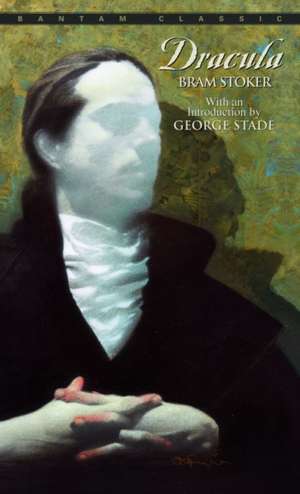
Dracula
Autor Bram Stokeren Limba Engleză Paperback – noi 1983
Găsim în această lucrare fundamentală o arhitectură narativă de o complexitate remarcabilă: povestea nu este livrată de o voce atotștiutoare, ci se recompune fragmentat, din jurnale personale, scrisori, telegrame și înregistrări pe fonograf. Această structură epistolară, pe care o notăm cu un interes deosebit, transformă cititorul într-un detectiv care asamblează dovezile unei invazii supranaturale în inima Angliei victoriene. Pendulând între peisajul arhaic al Transilvaniei și modernitatea tehnologizată a Londrei din 1893, textul reușește să mențină o tensiune psihologică constantă, unde necunoscutul este documentat cu rigoare aproape științifică. Suntem de părere că stilul lui Bram Stoker are ceva din densitatea atmosferică și preocuparea pentru morbid a prozei lui Mary Shelley, fără să fie o imitație — Stoker înlocuiește angoasa metafizică cu o teroare viscerală, ancorată în detaliul biologic și geografic. Dacă în Dracula's Guest and Other Weird Tales autorul explorează limitele dintre vis și realitate prin povestiri scurte, în Dracula el își rafinează viziunea, oferind o lucrare de o anvergură mult mai mare, care funcționează simultan ca roman de aventură și critică socială. Organizarea volumului respectă succesiunea cronologică a evenimentelor, de la intrarea lui Jonathan Harker în castelul din Carpați până la confruntarea finală. Această ediție de la Random House este îmbogățită cu o introducere semnată de Carol Senf și note critice care plasează „monstrul” în contextul temerilor epocii sale: colonialismul, imigrația și noile convenții sexuale. Este, fără îndoială, momentul zero al literaturii cu vampiri, definind un mit care continuă să bântuie imaginația colectivă.
Preț: 44.23 lei
Carte disponibilă
Livrare economică 04-18 noiembrie
Specificații
ISBN-10: 0553212710
Pagini: 448
Dimensiuni: 106 x 174 x 19 mm
Greutate: 0.21 kg
Editura: Random House
V-ar putea interesa
-
 Murder on the Orient ExpressAgatha ChristiePreț: 64.49 lei
 -
 Pride and PrejudiceJane AustenPreț: 28.01 lei
 -
 American Gods. 10th Anniversary EditionNeil GaimanPreț: 73.29 lei
 -
 Brave New WorldAldous HuxleyPreț: 63.49 lei
 -
 The Day WatchSergei Lukyanenko-16%Preț: 61.69 lei73.83 lei
 -
 The Twilight WatchSergei Lukyanenko-25%Preț: 59.35 lei78.92 lei
 -
 The Handmaid's TaleMargaret Atwood-18%Preț: 59.42 lei72.48 lei
 -
 Sapiens: A Brief History of Human KindYuval Noah Harari-17%Preț: 80.04 lei95.89 lei
 -
 For Whom the Bell TollsErnest Hemingway-25%Preț: 54.49 lei72.78 lei
 -
 Animal FarmGeorge Orwell-29%Preț: 45.10 lei63.47 lei
 -
 The Tell-Tale HeartEdgar Allan Poe-39%Preț: 17.05 lei28.08 lei
 -
 A Modern DetectiveEdgar Allan Poe-37%Preț: 18.43 lei29.05 lei
 -
 Think and Grow RichNapoleon HillPreț: 55.22 lei
 -
 The Minds of Billy MilliganDaniel KeyesPreț: 56.01 lei
 -
 Elon MuskAshlee VancePreț: 71.47 lei
 -
 The Illustrated ManRay BradburyPreț: 66.63 lei
 -
 Fahrenheit 451Ray BradburyPreț: 66.47 lei
 -
 SkitterEzekiel BoonePreț: 78.11 lei
 -
 Homo Deus: A Brief History of TomorrowYuval Noah Harari-16%Preț: 80.34 lei96.07 lei
 -
 The Atlas of BeautyMihaela Noroc-20%Preț: 179.76 lei224.99 lei
 -
 FrankensteinMary ShelleyPreț: 30.38 lei
 -
 Great GatsbyF. Scott FitzgeraldPreț: 29.75 lei
 -
 -26%Preț: 58.20 lei79.00 lei
De ce să citești această carte
Recomandăm această ediție cititorilor care doresc să descopere textul original, dincolo de adaptările cinematografice. Veți câștiga o perspectivă profundă asupra modului în care societatea victoriană gestiona frica de „celălalt”. Este o lectură esențială pentru înțelegerea evoluției genului horror, oferind un amestec fascinant de tradiție gotică și tehnologie modernă, totul într-un format de buzunar accesibil.
Despre autor
Abraham „Bram” Stoker (1847–1912) a fost un autor irlandez a cărui notorietate literară a fost consolidată postum prin succesul fenomenal al romanului Dracula. În timpul vieții, Stoker a fost o figură centrală a lumii teatrale londoneze, ocupând funcția de manager al Teatrului Lyceum și fiind asistentul personal al celebrului actor Sir Henry Irving. Experiența sa în teatru și relațiile cu scriitori precum Arthur Conan Doyle sau Oscar Wilde i-au influențat stilul dramatic și atenția pentru scenografie. Deși a scris și alte lucrări de groază supranaturală, precum The Lair of the White Worm, Stoker rămâne arhitectul mitului vampirului modern.
Recenzii
From the Trade Paperback edition.
Notă biografică
From the Hardcover edition.
Extras
Jonathan Harker’s Journal
(Kept in shorthand.)
3 May. Bistritz.1–Left Munich at 8:35 p. m., on 1st May, arriving at Vienna early next morning; should have arrived at 6:46, but train was an hour late. Buda-Pesth seems a wonderful place, from the glimpse which I got of it from the train and the little I could walk through the streets. I feared to go very far from the station, as we arrived late and would start as near the correct time as possible. The impression I had was that we were leaving the West and entering the East; the most western of splendid bridges over the Danube,2 which is here of noble width and depth, took us among the traditions of Turkish rule.
We left in pretty good time, and came after nightfall to Klausenburgh.3 Here I stopped for the night at the Hotel Royale. I had for dinner, or rather supper, a chicken done up some way with red pepper, which was very good but thirsty. (Mem., get recipe for Mina.) I asked the waiter, and he said it was called “paprika hendl,” and that, as it was a national dish, I should be able to get it anywhere along the Carpathians.4 I found my smattering of German very useful here; indeed, I don’t know how I should be able to get on without it.
Having had some time at my disposal when in London, I had visited the British Museum,5 and made search among the books and maps in the library regarding Transylvania: it had struck me that some foreknowledge of the country could hardly fail to have some importance in dealing with a nobleman of that country. I find that the district he named is in the extreme east of the country, just on the borders of three states, Transylvania, Moldavia and Bukovina,6 in the midst of the Carpathian mountains; one of the wildest and least known portions of Europe. I was not able to light on any map or work giving the exact locality of the Castle Dracula, as there are no maps of this country as yet to compare with our own Ordnance Survey maps;7 but I found that Bistritz, the post town named by Count Dracula, is a fairly well-known place. I shall enter here some of my notes, as they may refresh my memory when I talk over my travels with Mina.
In the population of Transylvania there are four distinct nationalities: Saxons in the South, and mixed with them the Wallachs, who are the descendants of the Dacians; Magyars in the West, and Szekelys8 in the East and North. I am going among the latter, who claim to be descended from Attila and the Huns. This may be so, for when the Magyars conquered the country in the eleventh century they found the Huns settled in it. I read that every known superstition in the world is gathered into the horseshoe of the Carpathians, as if it were the centre of some sort of imaginative whirlpool; if so my stay may be very interesting. (Mem., I must ask the Count all about them.)
I did not sleep well, though my bed was comfortable enough, for I had all sorts of queer dreams. There was a dog howling all night under my window, which may have had something to do with it; or it may have been the paprika, for I had to drink up all the water in my carafe, and was still thirsty. Towards morning I slept and was wakened by the continuous knocking at my door, so I guess I must have been sleeping soundly then. I had for breakfast more paprika, and a sort of porridge of maize flour which they said was “mamaliga,” and egg-plant stuffed with forcemeat, a very excellent dish, which they call “impletata.” (Mem., get recipe for this also.) I had to hurry breakfast, for the train started a little before eight, or rather it ought to have done so, for after rushing to the station at 7:30 I had to sit in the carriage for more than an hour before we began to move. It seems to me that the further east you go the more unpunctual are the trains. What ought they to be in China?
All day long we seemed to dawdle through a country which was full of beauty of every kind. Sometimes we saw little towns or castles on the top of steep hills such as we see in old missals; sometimes we ran by rivers and streams which seemed from the wide stony margin on each side of them to be subject to great floods. It takes a lot of water, and running strong, to sweep the outside edge of a river clear. At every station there were groups of people, sometimes crowds, and in all sorts of attire. Some of them were just like the peasants at home or those I saw coming through France and Germany, with short jackets and round hats and home-made trousers; but others were very picturesque. The women looked pretty, except when you got near them, but they were very clumsy about the waist. They had all full white sleeves of some kind or other, and the most of them had big belts with a lot of strips of something fluttering from them like the dresses in a ballet, but of course there were petticoats under them. The strangest figures we saw were the Slovaks, who were more barbarian than the rest, with their big cow-boy hats, great baggy dirty-white trousers, white linen shirts, and enormous heavy leather belts, nearly a foot wide, all studded over with brass nails. They wore high boots, with their trousers tucked into them, and had long black hair and heavy black moustaches. They are very picturesque, but do not look prepossessing. On the stage they would be set down at once as some old Oriental band of brigands. They are, however, I am told, very harmless and rather wanting in natural self-assertion.
It was on the dark side of twilight when we got to Bistritz, which is a very interesting old place. Being practically on the frontier–for the Borgo Pass leads from it into Bukovina–it has had a very stormy existence, and it certainly shows marks of it. Fifty years ago a series of great fires took place, which made terrible havoc on five separate occasions. At the very beginning of the seventeenth century it underwent a siege of three weeks and lost 13,000 people, the casualties of war proper being assisted by famine and disease.
Count Dracula had directed me to go to the Golden Krone Hotel, which I found, to my great delight, to be thoroughly old-fashioned, for of course I wanted to see all I could of the ways of the country. I was evidently expected, for when I got near the door I faced a cheery-looking elderly woman in the usual peasant dress–white undergarment with long double apron, front, and back, of coloured stuff fitting almost too tight for modesty. When I came close she bowed and said, “The Herr Englishman?” “Yes,” I said, “Jonathan Harker.” She smiled, and gave some message to an elderly man in white shirtsleeves, who had followed her to the door. He went, but immediately returned with a letter:–
“My Friend.–Welcome to the Carpathians. I am anxiously expecting you. Sleep well to-night. At three tomorrow the diligence9 will start for Bukovina; a place on it is kept for you. At the Borgo Pass my carriage will await you and will bring you to me. I trust that your journey from London has been a happy one, and that you will enjoy your stay in my beautiful land.
“Your friend,
“Dracula.”
From the Trade Paperback edition.
Descriere scurtă
Textul de pe ultima copertă
New to the second edition are essays that reflect cultural, queer, and postcolonial perspectives, plus an essay that combines several critical perspectives. The cultural documents section features new topics (the lesbian vampire, the new woman), and the updated editorial matter includes a selective bibliography of Dracula films of note.
Descriere
'it was butcher work...the horrid screeching as the stake drove home; the plunging of writhing form, and lips of bloody foam'Bram Stoker's 1897 Gothic shocker introduced Count Dracula to the world, an ancient creature bent on bringing his contagion to London, the very heart of the British Empire. Only a handful of men and women stand between Dracula and his long-cherished goal, but they are vulnerable and weak against the cunning and supernatural powers of the Count and his legions. As the horrifying story unfolds in the diaries and letters of young Jonathan Harker, Lucy, Mina, and Dr Seward, Dracula will be victorious unless his nemesis Professor Van Helsing can persuade them that monsters still lurk in the era of electric light.The most famous of all vampire stories, Dracula is a mirror of its age, its underlying themes of race, religion, science, superstition, and sexuality never far from the surface. A compelling read, rattling along at break-neck speed, it is a modern classic. This new edition includes Stoker's companion piece, 'Dracula's Guest'. ABOUT THE SERIES: For over 100 years Oxford World's Classics has made available the widest range of literature from around the globe. Each affordable volume reflects Oxford's commitment to scholarship, providing the most accurate text plus a wealth of other valuable features, including expert introductions by leading authorities, helpful notes to clarify the text, up-to-date bibliographies for further study, and much more.
Cuprins
INTRODUCTION
I. Jonathan Harker's Journal
II. Jonathan Harker's Journal
III. Jonathan Harker's Journal
IV. Jonathan Harker's Journal
V. Letter from Miss Mina Murray to Miss Lucy Westenra
VI. Mina Murray's Journal
VII. Cutting from The Dailygraph, 8 August
VIII. Mina Murray's Journal
IX. Letter, Mina Harker to Lucy Westenra
X. Letter, Dr Seward to Hon. Arthur Holmwood
XI. Lucy Westenra's Diary
XII. Dr Seward's Diary
XIII. Dr Seward's Diary
XIV. Mina Harker's Journal
XV. Dr Seward's Diary
XVI. Dr Seward's Diary
XVII. Dr Seward's Diary
XVIII. Dr Seward's Diary
XIX. Jonathan Harker's Journal
XX. Jonathan Harker's Journal
XXI. Dr Seward's Diary
XXII. Jonathan Harker's Journal
XXIII. Dr Seward's Diary
XXIV. Dr Seward's Phonograph Diary, spoken by Van Helsing
XXV. Dr Seward's Diary
XXVI. Dr Seward's Diary
XXVII. Mina Harker's Journal
LITERARY ALLUSIONS AND NOTES
CRITICAL EXCERPTS
SUGGESTIONS FOR FURTHER READING