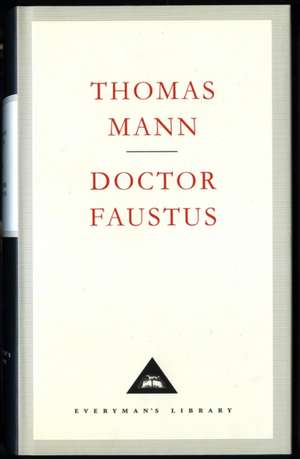
Doctor Faustus: Everyman's Library CLASSICS
Autor Thomas Mann Traducere de H.T. Lowe-Porteren Limba Engleză Hardback – 4 iun 1992
Din seria Everyman's Library CLASSICS
-
 Preț: 225.52 lei
 - 17%
 Preț: 95.58 lei
 - 18%
 Preț: 376.87 lei
 - 18%
 Preț: 87.40 lei
 - 16%
 Preț: 78.99 lei
 - 15%
 Preț: 92.96 lei
 - 20%
 Preț: 114.97 lei
 - 38%
 Preț: 65.15 lei
 - 18%
 Preț: 87.57 lei
 - 18%
 Preț: 70.22 lei
 - 18%
 Preț: 92.77 lei
 - 17%
 Preț: 88.69 lei
 - 26%
 Preț: 106.17 lei
 - 18%
 Preț: 98.71 lei
 - 15%
 Preț: 93.32 lei
 - 17%
 Preț: 100.10 lei
 - 15%
 Preț: 92.90 lei
 - 25%
 Preț: 95.02 lei
 - 17%
 Preț: 77.18 lei
 - 19%
 Preț: 83.86 lei
 - 29%
 Preț: 64.49 lei
 - 16%
 Preț: 116.11 lei
 - 17%
 Preț: 77.96 lei
 -
 Preț: 112.84 lei
 - 18%
 Preț: 62.98 lei
 - 18%
 Preț: 93.28 lei
 - 16%
 Preț: 115.23 lei
 - 18%
 Preț: 115.00 lei
 - 15%
 Preț: 75.27 lei
 - 17%
 Preț: 89.59 lei
 - 18%
 Preț: 74.57 lei
 - 17%
 Preț: 77.48 lei
 - 18%
 Preț: 86.67 lei
 - 18%
 Preț: 92.76 lei
 - 16%
 Preț: 92.12 lei
 - 18%
 Preț: 85.84 lei
 - 27%
 Preț: 78.04 lei
 - 18%
 Preț: 87.52 lei
 - 16%
 Preț: 78.59 lei
 - 15%
 Preț: 93.35 lei
 - 27%
 Preț: 105.03 lei
 - 19%
 Preț: 95.08 lei
 - 24%
 Preț: 107.71 lei
 - 16%
 Preț: 92.22 lei
 - 16%
 Preț: 91.65 lei
 - 17%
 Preț: 106.80 lei
 - 14%
 Preț: 88.71 lei
 - 18%
 Preț: 87.10 lei
 - 16%
 Preț: 78.92 lei
 - 17%
 Preț: 107.34 lei
Preț: 106.48 lei
Puncte Express: 160
Carte disponibilă
Livrare economică 09-23 mai
Livrare express 25 aprilie-01 mai pentru 37.25 lei
Specificații
ISBN-13: 9781857150803
ISBN-10: 1857150805
Pagini: 523
Dimensiuni: 211 x 230 x 35 mm
Greutate: 0.61 kg
Editura: EVERYMAN
Seria Everyman's Library CLASSICS
Locul publicării:United Kingdom
ISBN-10: 1857150805
Pagini: 523
Dimensiuni: 211 x 230 x 35 mm
Greutate: 0.61 kg
Editura: EVERYMAN
Seria Everyman's Library CLASSICS
Locul publicării:United Kingdom
V-ar putea interesa
-
 Sapiens: A Brief History of Human KindYuval Noah Harari-18%Preț: 74.85 lei91.34 lei
 -
 MephistoKlaus Mann-30%Preț: 54.97 lei79.07 lei
 -
 FaustJohann Wolfgang von Goethe-20%Preț: 54.48 lei68.39 lei
 -
 Faust: Part OneJ. W. von GoethePreț: 53.37 lei
 -
 The MagicianColm Tòibìn-26%Preț: 56.98 lei76.50 lei
 -
 Preț: 145.09 lei
 -
 The Birth of Tragedy and the Case of WagnerFriedrich NietzschePreț: 71.82 lei
 -
 Doctor FaustusChristopher MarlowePreț: 37.71 lei
 -
 The Picture of Dorian GrayOscar WildePreț: 33.39 lei
 -
 Dr. FaustusChristopher MarlowePreț: 25.41 lei
 -
 Death in VeniceThomas MannPreț: 23.87 lei
 -
 Death in Venice and Other StoriesThomas MannPreț: 40.57 lei
 -
 The Dehumanization of Art and Other Essays on Art, Culture, and LiteratureJosé Ortega Y. GassetPreț: 87.02 lei
 -
 The Magic MountainThomas Mann-17%Preț: 76.33 lei92.23 lei
 -
 -20%Preț: 195.56 lei244.82 lei
 -
 Death in VeniceThomas MannPreț: 43.16 lei
 -
 -31%Preț: 127.47 lei183.51 lei
 -
 Preț: 213.54 lei
 -
 Love and EnchantmentThomas MannPreț: 68.34 lei
 -
 FaustJohann Wolfgang von GoethePreț: 43.72 lei
 -
 Preț: 69.26 lei
 -
 The Maiden FaustConor FarringtonPreț: 26.21 lei
 -
 Preț: 283.95 lei
Descriere
Descriere de la o altă ediție sau format:
'Why must I feel that almost all--no, all--of the devices and conventions used by art are today only fit for parody?'Adrian Leverkühn is a composer who, at terrible personal cost, makes the breakthrough from traditional art to extreme modernism and success. Creative and brilliant, he will stop at nothing to achieve greatness. Thomas Mann wrote Doctor Faustus (1947) in American exile during and just after the Second World War. A prominent and long-standing defender of democracy, he sought to understand, in cultural and intellectual terms, how Germany had succumbed to Nazism. Mann structures his story through references to the German legend of Faust and his pact with the Devil. The life of the solitary composer, an ultimately tragic figure, is recounted by his friend and biographer, who represents a sadly ineffectual humanism, and whose social activities provide a panorama of middle-class German society in the early twentieth century. Ritchie Robertson's new English translation is accompanied by detailed annotations and an introduction illuminating the themes of the novel.ABOUT THE SERIES: For over 100 years Oxford World's Classics has made available the widest range of literature from around the globe. Each affordable volume reflects Oxford's commitment to scholarship, providing the most accurate text plus a wealth of other valuable features, including expert introductions by leading authorities, helpful notes to clarify the text, up-to-date bibliographies for further study, and much more.
'Why must I feel that almost all--no, all--of the devices and conventions used by art are today only fit for parody?'Adrian Leverkühn is a composer who, at terrible personal cost, makes the breakthrough from traditional art to extreme modernism and success. Creative and brilliant, he will stop at nothing to achieve greatness. Thomas Mann wrote Doctor Faustus (1947) in American exile during and just after the Second World War. A prominent and long-standing defender of democracy, he sought to understand, in cultural and intellectual terms, how Germany had succumbed to Nazism. Mann structures his story through references to the German legend of Faust and his pact with the Devil. The life of the solitary composer, an ultimately tragic figure, is recounted by his friend and biographer, who represents a sadly ineffectual humanism, and whose social activities provide a panorama of middle-class German society in the early twentieth century. Ritchie Robertson's new English translation is accompanied by detailed annotations and an introduction illuminating the themes of the novel.ABOUT THE SERIES: For over 100 years Oxford World's Classics has made available the widest range of literature from around the globe. Each affordable volume reflects Oxford's commitment to scholarship, providing the most accurate text plus a wealth of other valuable features, including expert introductions by leading authorities, helpful notes to clarify the text, up-to-date bibliographies for further study, and much more.
Notă biografică
Thomas Mann was born in 1875 in Lübeck, of a line of prosperous and influential merchants. Mann was educated under the discipline of North German schoolmasters before working for an insurance office aged nineteen. During this time he secretly wrote his first tale, Fallen, and shortly afterwards left the insurance office to study art and literature at the University in Munich. After a year in Rome he devoted himself exclusively to writing.
He was only twenty-five when Buddenbrooks, his first major novel, was published. Before it was burned by Hitler, it had sold over a million copies in Germany alone. His second great novel, The Magic Mountain, was published in 1924 and the first volume of his tetralogy Joseph and his Brothers in 1933. In 1929 he was awarded the Nobel Prize for literature. In 1933 Thomas Mann left Germany to live in Switzerland. Then, after several previous visits, in 1938 he settled in the United States where he wrote Doctor Faustus and The Holy Sinner. Among the honours he received in the USA was his appointment as a Fellow of the Library of Congress. He revisited his native country in 1949 and returned to Switzerland in 1952, where The Black Swan and Confessions of Felix Krull were written and where he died in 1955.
He was only twenty-five when Buddenbrooks, his first major novel, was published. Before it was burned by Hitler, it had sold over a million copies in Germany alone. His second great novel, The Magic Mountain, was published in 1924 and the first volume of his tetralogy Joseph and his Brothers in 1933. In 1929 he was awarded the Nobel Prize for literature. In 1933 Thomas Mann left Germany to live in Switzerland. Then, after several previous visits, in 1938 he settled in the United States where he wrote Doctor Faustus and The Holy Sinner. Among the honours he received in the USA was his appointment as a Fellow of the Library of Congress. He revisited his native country in 1949 and returned to Switzerland in 1952, where The Black Swan and Confessions of Felix Krull were written and where he died in 1955.
Textul de pe ultima copertă
This book is about Adrian Leverkuhn, a former theological student who has become a composer, who enters symbolically into a pact with the devil.