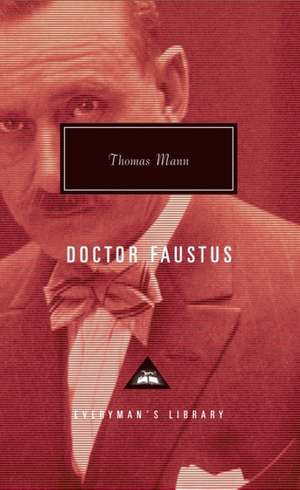
Doctor Faustus
Autor Thomas Mann Traducere de H T Lowe-Porteren Limba Engleză Hardback – 2 iun 1992
Thomas Mann wrote his last great novel, Doctor Faustus, during his exile from Nazi Germany. Although he already had a long string of masterpieces to his name, in retrospect this seems to be the novel he was born to write.
A modern reworking of the Faust legend in which a twentieth-century composer sells his soul to the devil for the artistic power he craves, the story brilliantly interweaves music, philosophy, theology, and politics. Adrian Leverkühn is a talented young composer who is willing to go to any lengths to reach greater heights of achievement. What he gets is twenty-four years of genius--years of increasingly extraordinary musical innovation intertwined with progressive and destructive madness. A scathing allegory of Germany's renunciation of its own humanity and its embrace of ambition and nihilism, Doctor Faustus is also a profound meditation on artistic genius. Obsessively exploring the evil into which his country had fallen, Mann succeeds as only he could have in charting the dimensions of that evil; his novel has both the pertinence of history and the universality of myth. Translated from the German by H. T. Lowe-PorterPreț: 181.78 lei
Puncte Express: 273
Carte disponibilă
Livrare economică 06-20 noiembrie
Livrare prin curier în România Termenul estimat este afișat lângă disponibilitate.
Transport gratuit de la 400.00 lei Plată online sau ramburs, în funcție de opțiunile comenzii.
Retur gratuit în 14 zile Comandă securizată și suport în română.
Specificații
ISBN-13: 9780679409960
ISBN-10: 0679409963
Pagini: 580
Dimensiuni: 135 x 212 x 34 mm
Greutate: 0.61 kg
Editura: Knopf Doubleday Publishing Group
ISBN-10: 0679409963
Pagini: 580
Dimensiuni: 135 x 212 x 34 mm
Greutate: 0.61 kg
Editura: Knopf Doubleday Publishing Group
V-ar putea interesa
-
 Sapiens: A Brief History of Human KindYuval Noah Harari-17%Preț: 80.04 lei95.89 lei
 -
 MephistoKlaus Mann-29%Preț: 58.79 lei82.98 lei
 -
 FaustJohann Wolfgang von Goethe-26%Preț: 58.26 lei78.73 lei
 -
 Faust: Part OneJ. W. von GoethePreț: 58.09 lei
 -
 The MagicianColm Tòibìn-24%Preț: 60.93 lei80.32 lei
 -
 Preț: 156.34 lei
 -
 The Birth of Tragedy and The Case of WagnerFriedrich NietzschePreț: 78.08 lei
 -
 Doctor FaustusChristopher MarlowePreț: 45.52 lei
 -
 The Picture of Dorian GrayOscar WildePreț: 35.93 lei
 -
 Doctor FaustusChristopher MarlowePreț: 32.07 lei
 -
 Death in VeniceThomas MannPreț: 25.09 lei
 -
 Death in Venice and Other StoriesThomas MannPreț: 51.89 lei
 -
 The Dehumanization of Art and Other Essays on Art, Culture, and LiteratureJosé Ortega Y. GassetPreț: 90.47 lei
 -
 The Magic MountainThomas Mann-16%Preț: 80.60 lei96.20 lei
 -
 Death in VeniceThomas MannPreț: 45.02 lei
 -
 -30%Preț: 135.26 lei192.32 lei
 -
 Love and EnchantmentThomas MannPreț: 71.75 lei
 -
 FaustJohann Wolfgang von GoethePreț: 45.89 lei
 -
 Preț: 62.80 lei
 -
 The Maiden FaustConor FarringtonPreț: 26.21 lei
 -
 Preț: 332.57 lei
Notă biografică
Thomas Mann was born in 1875 in Germany. He was only twenty-five when his first novel, Buddenbrooks, was published. In 1924 The Magic Mountain was published, and, five years later, Mann was awarded the Nobel Prize for Literature. Following the rise of the Nazis to power, he left Germany for good in 1933 to live in Switzerland and then in California, where he wrote Doctor Faustus (first published in the United States in 1948). Thomas Mann died in 1955.
Textul de pe ultima copertă
This book is about Adrian Leverkuhn, a former theological student who has become a composer, who enters symbolically into a pact with the devil.
Descriere
Descriere de la o altă ediție sau format:
'Why must I feel that almost all--no, all--of the devices and conventions used by art are today only fit for parody?'Adrian Leverkühn is a composer who, at terrible personal cost, makes the breakthrough from traditional art to extreme modernism and success. Creative and brilliant, he will stop at nothing to achieve greatness. Thomas Mann wrote Doctor Faustus (1947) in American exile during and just after the Second World War. A prominent and long-standing defender of democracy, he sought to understand, in cultural and intellectual terms, how Germany had succumbed to Nazism. Mann structures his story through references to the German legend of Faust and his pact with the Devil. The life of the solitary composer, an ultimately tragic figure, is recounted by his friend and biographer, who represents a sadly ineffectual humanism, and whose social activities provide a panorama of middle-class German society in the early twentieth century. Ritchie Robertson's new English translation is accompanied by detailed annotations and an introduction illuminating the themes of the novel.ABOUT THE SERIES: For over 100 years Oxford World's Classics has made available the widest range of literature from around the globe. Each affordable volume reflects Oxford's commitment to scholarship, providing the most accurate text plus a wealth of other valuable features, including expert introductions by leading authorities, helpful notes to clarify the text, up-to-date bibliographies for further study, and much more.
'Why must I feel that almost all--no, all--of the devices and conventions used by art are today only fit for parody?'Adrian Leverkühn is a composer who, at terrible personal cost, makes the breakthrough from traditional art to extreme modernism and success. Creative and brilliant, he will stop at nothing to achieve greatness. Thomas Mann wrote Doctor Faustus (1947) in American exile during and just after the Second World War. A prominent and long-standing defender of democracy, he sought to understand, in cultural and intellectual terms, how Germany had succumbed to Nazism. Mann structures his story through references to the German legend of Faust and his pact with the Devil. The life of the solitary composer, an ultimately tragic figure, is recounted by his friend and biographer, who represents a sadly ineffectual humanism, and whose social activities provide a panorama of middle-class German society in the early twentieth century. Ritchie Robertson's new English translation is accompanied by detailed annotations and an introduction illuminating the themes of the novel.ABOUT THE SERIES: For over 100 years Oxford World's Classics has made available the widest range of literature from around the globe. Each affordable volume reflects Oxford's commitment to scholarship, providing the most accurate text plus a wealth of other valuable features, including expert introductions by leading authorities, helpful notes to clarify the text, up-to-date bibliographies for further study, and much more.