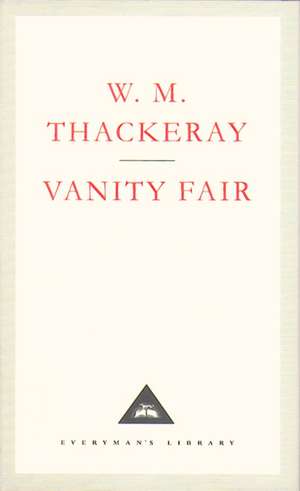
Vanity Fair: Everyman's Library CLASSICS
Autor William Makepeace Thackerayen Limba Engleză Hardback – 26 sep 1991
În inima Londrei de la începutul secolului al XIX-lea, acolo unde ambiția se ciocnește brutal de convențiile sociale, descoperim un univers care funcționează după regulile unui bâlci perpetuu. Alegerea acestui cadru temporal și spațial nu este întâmplătoare; într-o eră marcată de ascensiunea burgheziei și de ecourile bătăliei de la Waterloo, William Makepeace Thackeray construiește o scenă pe care își joacă rolurile marionete umane mânate de vanitate, lăcomie și dorința de parvenire. Subliniem aici dualitatea fascinantă a structurii: autorul se prezintă ca un maestru de ceremonii care trage cortina peste 67 de capitole, invitându-ne să observăm spectacolul lumii fără iluzii moralizatoare, dar cu o melancolie profundă. Ritmul narativ, de o ironie mușcătoare, amintește de observația socială din lucrările lui Charles Dickens, dar structura este mult mai panoramică și mai puțin sentimentală, concentrându-se pe mecanismele puterii și ale banilor. Spre deosebire de tonul picaresc din Barry Lyndon, o altă operă de referință a autorului, în Vanity Fair regăsim o maturitate a stilului care echilibrează perfect satira și compasiunea. Reținem contrastul magistral dintre Becky Sharp, eroina amorală și sclipitoare care refuză să accepte destinul umil de guvernantă, și Amelia Sedley, a cărei bunătate pasivă devine o vulnerabilitate în fața cinismului social. Această pendulare între 'high life' și mizerie morală transformă lectura într-o experiență contemplativă, un exercițiu de demascare a măștilor pe care le purtăm cu toții în marele bâlci al deșertăciunilor.
Din seria Everyman's Library CLASSICS
- 17%
 Preț: 92.65 lei
 - 15%
 Preț: 120.09 lei
 - 26%
 Preț: 97.97 lei
 - 18%
 Preț: 77.80 lei
 - 16%
 Preț: 92.91 lei
 - 19%
 Preț: 115.35 lei
 - 37%
 Preț: 123.08 lei
 - 17%
 Preț: 103.83 lei
 - 16%
 Preț: 123.71 lei
 - 14%
 Preț: 97.49 lei
 - 16%
 Preț: 122.66 lei
 - 17%
 Preț: 102.30 lei
 - 22%
 Preț: 96.89 lei
 - 18%
 Preț: 87.42 lei
 - 16%
 Preț: 82.25 lei
 - 16%
 Preț: 398.25 lei
 - 16%
 Preț: 105.41 lei
 - 19%
 Preț: 86.54 lei
 - 16%
 Preț: 82.03 lei
 - 17%
 Preț: 92.65 lei
 - 17%
 Preț: 120.09 lei
 - 17%
 Preț: 65.77 lei
 - 26%
 Preț: 146.72 lei
 - 14%
 Preț: 98.46 lei
 - 35%
 Preț: 79.73 lei
 - 14%
 Preț: 98.60 lei
 - 15%
 Preț: 122.31 lei
 - 17%
 Preț: 79.50 lei
 - 26%
 Preț: 110.90 lei
 - 20%
 Preț: 118.29 lei
 - 14%
 Preț: 78.04 lei
 - 24%
 Preț: 96.78 lei
 - 36%
 Preț: 70.07 lei
 - 17%
 Preț: 91.90 lei
 - 17%
 Preț: 79.74 lei
 - 22%
 Preț: 98.09 lei
 - 13%
 Preț: 100.01 lei
 - 37%
 Preț: 77.64 lei
 - 26%
 Preț: 81.52 lei
 - 15%
 Preț: 118.67 lei
 - 15%
 Preț: 95.65 lei
 - 17%
 Preț: 92.20 lei
 - 16%
 Preț: 99.84 lei
 - 14%
 Preț: 97.03 lei
 - 13%
 Preț: 92.65 lei
 - 29%
 Preț: 87.66 lei
 - 25%
 Preț: 84.63 lei
 - 15%
 Preț: 84.36 lei
 -
 Preț: 95.06 lei
Preț: 115.18 lei
Preț vechi: 149.26 lei
-23%
Carte disponibilă
Livrare economică 05-11 noiembrie
Livrare express 20-24 octombrie pentru 82.03 lei
Specificații
ISBN-10: 1857150120
Pagini: 800
Ilustrații: Illustrations
Dimensiuni: 139 x 211 x 42 mm
Greutate: 0.81 kg
Editura: EVERYMAN
Colecția Everyman's Library Classics
Seria Everyman's Library CLASSICS
Locul publicării:United Kingdom
V-ar putea interesa
-
 The Element Encyclopedia of WitchcraftJudika IllesPreț: 288.84 lei
 -
 Jane EyreCharlotte BrontëPreț: 28.01 lei
 -
 Wuthering HeightsEmily BrontëPreț: 28.01 lei
 -
 Tess of the D'UrbervillesThomas HardyPreț: 28.01 lei
 -
 The SelectionKiera Cass-NaN%Preț: 71.27 lei71.27 lei
 -
 The EliteKiera Cass-15%Preț: 61.48 lei72.34 lei
 -
 The OneKiera Cass-15%Preț: 55.53 lei65.33 lei
 -
 English CastlesCollins BooksPreț: 56.98 lei
 -
![The Encyclopedia of Birthdays [Revised edition]](https://i1.books-express.ro/bt/9780008393519/the-encyclopedia-of-birthdays-revised-edition.jpg) The Encyclopedia of Birthdays [Revised edition]Theresa CheungPreț: 138.35 lei
The Encyclopedia of Birthdays [Revised edition]Theresa CheungPreț: 138.35 lei -
 Morgan and Mikhail's Clinical Anesthesiology CasesJohn Butterworth-29%Preț: 517.23 lei729.39 lei
 -
 Tyger, TygerWilliam Blake-39%Preț: 17.30 lei28.43 lei
 -
 The Greek MythsRobert Graves-17%Preț: 104.92 lei125.70 lei
 -
 The Mysterious IslandJules VernePreț: 38.95 lei
 -
 Tales of HorrorEdgar Allan PoePreț: 44.70 lei
 -
 Bleak HouseCharles DickensPreț: 40.36 lei
 -
 Mayor of CasterbridgeThomas HardyPreț: 28.01 lei
 -
 Hard TimesCharles DickensPreț: 28.01 lei
 -
 MiddlemarchGeorge EliotPreț: 28.01 lei
De ce să citești această carte
Pentru cititorul care apreciază satira socială fină și personajele feminine complexe, care sfidează normele epocii. Vanity Fair oferă o perspectivă lucidă asupra ambiției umane, demonstrând că mecanismele parvenitismului și ale statutului social au rămas neschimbate de două secole. Câștigați o înțelegere profundă a societății britanice, livrată cu un umor negru și o inteligență critică rară.
Despre autor
William Makepeace Thackeray (1811–1863) a fost un romancier și ilustrator britanic de seamă, născut în Calcutta și educat în Anglia. Cariera sa literară a fost marcată de o activitate jurnalistică intensă la publicații precum Fraser's Magazine și Punch, unde și-a rafinat stilul satiric. Deși a cunoscut succesul cu The Luck of Barry Lyndon, publicarea Vanity Fair la vârsta de 37 de ani l-a propulsat definitiv în prima ligă a literaților victorieni. Experiențele sale personale, inclusiv pasiunea pentru jocurile de noroc și tragedia bolii soției sale, Isabella, au infuzat scrierile sale cu un amestec unic de realism crud și sensibilitate melancolică.
Descriere
Recenzii
Notă biografică
Thackeray's earliest literary success, The Yellowplush Correspondence, a group of satiric sketches written in the guise of a cockney footman's memoirs, was serialized in Fraser's Magazine beginning in 1837. Catherine (serialized 1839-40; published 1869), his first novel, parodied the crime stories popular in Victorian England. Under the name Michael Angelo Titmarsh, the most famous of his many pseudonyms, Thackeray turned out The Paris Sketch Book (1840) and The Irish Sketch-Book (1843), two popular volumes of travel writing. The Luck of Barry Lyndon (1844), which chronicles the adventures of an Irish knave in eighteenth-century England, marked his first serious attack on social pretension. In The Book of Snobs (1848), a collection of satiric portraits originally published in Punch magazine (1846-47), he lampooned the avarice and snobbery occasioned by the Industrial Revolution.
Vanity Fair, Thackeray's resplendent social satire exposing the greed and corruption raging in England during the turmoil of the Napoleonic wars, brought him immediate acclaim when it appeared in Punch beginning in 1847. "The more I read Thackeray's works," wrote Charlotte Bronte, "the more certain I am that he stands alone-alone in his sagacity, alone in his truth, alone in his feeling (his feeling, though he makes no noise about it, is about the most genuine that ever lived on a printed page), alone in his power, alone in his simplicity, alone in his self-control. Thackeray is a Titan. . . . I regard him as the first of modern masters."