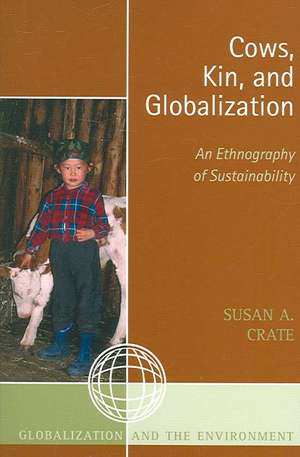
Cows, Kin, and Globalization: An Ethnography of Sustainability: Globalization and the Environment
Autor Susan Alexandra Crateen Limba Engleză Paperback – 19 oct 2006

Preț: 324.79 lei
Preț vechi: 402.19 lei
-19%
Puncte Express: 487
Carte tipărită la comandă
Livrare economică 20 noiembrie-04 decembrie
Livrare prin curier în România Termenul estimat este afișat lângă disponibilitate.
Transport gratuit de la 400.00 lei Plată online sau ramburs, în funcție de opțiunile comenzii.
Retur gratuit în 14 zile Comandă securizată și suport în română.
Specificații
ISBN-13: 9780759107403
ISBN-10: 0759107408
Pagini: 355
Dimensiuni: 160 x 229 x 24 mm
Greutate: 0.61 kg
Editura: Bloomsbury Publishing
Colecția AltaMira Press
Seria Globalization and the Environment
Locul publicării:New York, United States
ISBN-10: 0759107408
Pagini: 355
Dimensiuni: 160 x 229 x 24 mm
Greutate: 0.61 kg
Editura: Bloomsbury Publishing
Colecția AltaMira Press
Seria Globalization and the Environment
Locul publicării:New York, United States
V-ar putea interesa
-
 The Origin of Our SpeciesChris StringerPreț: 78.32 lei
 -
 Myths and Memories of the NationAnthony D. Smith-31%Preț: 544.22 lei791.74 lei
 -
 Lucy to Language: The Benchmark PapersR. I. M. Dunbar-31%Preț: 907.34 lei1313.14 lei
 -
 Teeth: A Very Short IntroductionPeter S. Ungar-18%Preț: 59.10 lei72.28 lei
 -
 The Sacred Landscape of the Inca: The Cusco Ceque SystemBrian S. BauerPreț: 267.68 lei
 -
 Human Population GeneticsJohn H. Relethford-23%Preț: 535.99 lei696.08 lei
 -
 Dental Functional MorphologyPeter W. LucasPreț: 463.51 lei
 -
 The Changing BodyRoderick FloudPreț: 291.73 lei
 -
 The Ethnography of CommunicationMuriel Saville-Troike-8%Preț: 432.38 lei469.97 lei
 -
 The Mirage of ChinaXin LiuPreț: 262.69 lei
 -
 A Brief History of DrugsAntonio EscohotadoPreț: 81.63 lei
 -
 Thin on the GroundSteven E Churchill-9%Preț: 945.92 lei1039.47 lei
 -
 A Companion to Forensic AnthropologyDennis DirkmaatPreț: 426.20 lei
 -
 -23%Preț: 757.54 lei983.83 lei
 -
 Catching Fire: How Cooking Made Us HumanRichard Wrangham-20%Preț: 74.76 lei92.94 lei
Cuprins
1 Foreword
2 Preface
3 Prologue
4 Chapter 1: At Home in Siberia
5 Chapter 2: Viliui Historical Ecology
6 Chapter 3: Cows-and-Kin: The Cultural Ecology of Post-Soviet Viliui Sakha Survival
7 Chapter 4: Having and Knowing Land
8 Chapter 5: An Environmental History of the Viliui
9 Chapter 6: Diamond Mining and Indigenous Rights in Comparative Context: The Case of Canadian Diamonds
10 Chapter 7: Investigating Viliui Sakha Sustainability
11 Chapter 8: Global Mining, Indigenous Peoples, and Sustainability
12 Epilogue
2 Preface
3 Prologue
4 Chapter 1: At Home in Siberia
5 Chapter 2: Viliui Historical Ecology
6 Chapter 3: Cows-and-Kin: The Cultural Ecology of Post-Soviet Viliui Sakha Survival
7 Chapter 4: Having and Knowing Land
8 Chapter 5: An Environmental History of the Viliui
9 Chapter 6: Diamond Mining and Indigenous Rights in Comparative Context: The Case of Canadian Diamonds
10 Chapter 7: Investigating Viliui Sakha Sustainability
11 Chapter 8: Global Mining, Indigenous Peoples, and Sustainability
12 Epilogue
Recenzii
Through this innovative multi-sited ethnography of complex local and global indigenous sustainability, we see how under diamond mining the Viliui Sakha were transformed from their pre-Soviet subsistence strategies into the Soviet working class then to a post-Soviet household production system founded upon having and knowing land. The Viliui Sakha reemerged as victors of sustainability. This is a perceptive ethnography of sustainability that passionately advances indigenous peoples' rights to socioecological equity, cultural survival, and political devolution.
Cows, Kin, and Globalization is three books in one: a vivid description of the Sakha people of Siberia, a comparative review of the impact of high-value mining on indigenous cultures, and a thoughtful exploration of the possibilities and perils of reconciling diamond mining and local populations. Because it brings these topics together, it is ideally suited for students and scholars in environmental studies, geography, and anthropology.
Through her eloquent description of the personal, daily choices of contemporary Viliui Sakha, Crate steers us toward the conclusion that 'truly sustainable development both enlarges the range of local people's choices to make development more democratic and participatory and incorporate(s) an in-depth knowledge of local ecosystems and cultures.' Hers is a cogent, necessary case study for anyone interested in issues of indigenous peoples, adaptaion, and sustainability seen through the lens of ethnographic inquiry.
This collection would be a welcome addition to a university library since many do not subscribe to the journals where Crate originally published her material. Crate's powerful personal connection to these Viliui Sakha communities allow her to understand local issues in great depth.
Excellent scholarship....Cows, Kin, and Globalization is a clearly written, easy-to-read monograph.... Could be productively used in undergraduate and graduate anthropology courses.
In this richly detailed work, Susan Crate offers a new take on an old form. Her ethnography of the Viliui Sakha captures the complex dimensions of daily life for one native people of contemporary Russia. This work, situated within a cultural, ecological, historical, and comparative framework, presents the 'how' and 'why' of human adaptation. In short, this is a multi-faceted jewel of a work.
It is delightful to see ethnography conducted in the former Soviet Union linked so closely to pressing concerns in broader anthropology and, indeed, in the social and natural sciences.
Excellent empirical data... well-documented
This ethnography provides a gripping account of historical movements and transformations in sub-Arctic practices of human ecology.
Cows, Kin, and Globalization is three books in one: a vivid description of the Sakha people of Siberia, a comparative review of the impact of high-value mining on indigenous cultures, and a thoughtful exploration of the possibilities and perils of reconciling diamond mining and local populations. Because it brings these topics together, it is ideally suited for students and scholars in environmental studies, geography, and anthropology.
Through her eloquent description of the personal, daily choices of contemporary Viliui Sakha, Crate steers us toward the conclusion that 'truly sustainable development both enlarges the range of local people's choices to make development more democratic and participatory and incorporate(s) an in-depth knowledge of local ecosystems and cultures.' Hers is a cogent, necessary case study for anyone interested in issues of indigenous peoples, adaptaion, and sustainability seen through the lens of ethnographic inquiry.
This collection would be a welcome addition to a university library since many do not subscribe to the journals where Crate originally published her material. Crate's powerful personal connection to these Viliui Sakha communities allow her to understand local issues in great depth.
Excellent scholarship....Cows, Kin, and Globalization is a clearly written, easy-to-read monograph.... Could be productively used in undergraduate and graduate anthropology courses.
In this richly detailed work, Susan Crate offers a new take on an old form. Her ethnography of the Viliui Sakha captures the complex dimensions of daily life for one native people of contemporary Russia. This work, situated within a cultural, ecological, historical, and comparative framework, presents the 'how' and 'why' of human adaptation. In short, this is a multi-faceted jewel of a work.
It is delightful to see ethnography conducted in the former Soviet Union linked so closely to pressing concerns in broader anthropology and, indeed, in the social and natural sciences.
Excellent empirical data... well-documented
This ethnography provides a gripping account of historical movements and transformations in sub-Arctic practices of human ecology.