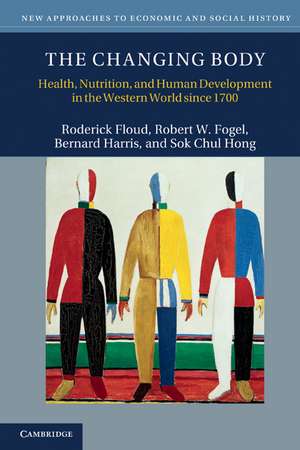
The Changing Body
Autor Roderick Floud, Robert W. Fogel, Bernard Harrisen Limba Engleză Paperback – 31 mar 2011
Subliniem un fapt surprinzător care stă la baza acestei cercetări monumentale: în ultimele trei secole, ființa umană a reușit nu doar să își dubleze speranța medie de viață, ci și să își mărească dimensiunea corporală cu peste 50%. În The Changing Body, descoperim o analiză riguroasă a modului în care sănătatea, nutriția și dezvoltarea umană în lumea occidentală au fost modelate de forțele economice începând cu anul 1700. Notăm cu interes tranziția de la simpla descriere istorică la utilizarea indicatorilor antropometrici — înălțimea și greutatea — ca măsuri precise ale standardului de viață. Autorii, printre care se numără și laureatul Nobel Robert W. Fogel, structurează volumul în șapte capitole esențiale care urmăresc evoluția tehnofiziologică. De la analiza variabilelor biologice și economice extrase din date fragmentare, până la examinarea specifică a experiențelor din Anglia, Țara Galilor, Europa continentală și Statele Unite, progresia textului oferă o înțelegere clară a modului în care mediul bolilor și dieta au influențat productivitatea muncii. Cititorul care a aplicat deja ideile din The Escape from Hunger and Premature Death, 1700–2100 va găsi aici o extindere necesară, care trece dincolo de combaterea malnutriției cronice, investigând dacă longevitatea sporită aduce beneficii economice sau impune poveri fiscale prin costurile ridicate ale sistemelor de pensii. Această lucrare reprezintă o evoluție firească față de The Cambridge Economic History of Modern Britain, unde Roderick Floud a pus bazele analizei cantitative. Dacă în lucrările anterioare accentul cădea pe distribuția veniturilor, aici focalizarea se mută pe corpul uman ca arhivă biologică a progresului economic. Stilul este unul academic, dar accesibil, susținut de 74 de tabele statistice care transformă biologia umană într-un instrument de prognoză pentru tendințele de sănătate din lumea în curs de dezvoltare.
Preț: 291.73 lei
Carte tipărită la comandă
Livrare economică 27 noiembrie-11 decembrie
Specificații
ISBN-10: 0521705614
Pagini: 458
Ilustrații: 86 b/w illus. 74 tables
Dimensiuni: 152 x 229 x 25 mm
Greutate: 0.66 kg
Editura: Cambridge University Press
Locul publicării:Cambridge, United Kingdom
V-ar putea interesa
-
 The Rational OptimistMatt RidleyPreț: 80.42 lei
 -
![Sapiens [Tenth Anniversary Edition]](https://i0.books-express.ro/bt/9780063422001/sapiens-tenth-anniversary-edition.jpg) Sapiens [Tenth Anniversary Edition]Yuval Noah HarariPreț: 183.68 lei
Sapiens [Tenth Anniversary Edition]Yuval Noah HarariPreț: 183.68 lei -
 The Species that Changed ItselfEdwin Gale-18%Preț: 76.55 lei93.83 lei
 -
 -8%Preț: 475.16 lei516.47 lei
 -
 -14%Preț: 129.19 lei150.84 lei
 -
 The Story of the Human BodyDaniel E LiebermanPreț: 119.65 lei
 -
 Seven DecadesMichael D. GurvenPreț: 236.29 lei
 -
 Centuries Of ChildhoodPhilippe AriesPreț: 122.91 lei
 -
 Aging in Society: Selected Reviews of Recent ResearchMatilda White Riley-9%Preț: 821.94 lei903.23 lei
 -
 Demographics UnravelledAmlan RoyPreț: 302.30 lei
 -
 Born: The Untold History of HumanityLucy Inglis-25%Preț: 82.26 lei109.47 lei
 -
 -26%Preț: 68.61 lei93.27 lei
 -
 Metamorphosis: A Natural and Human HistoryOren Harman-30%Preț: 133.14 lei191.14 lei
 -
 This Mortal CoilAndrew Doig-25%Preț: 59.41 lei79.72 lei
 -
 -21%Preț: 126.55 lei160.99 lei
 -
 -19%Preț: 87.10 lei107.49 lei
 -
 Healthy to 100Ken SternPreț: 122.51 lei
 -
 Peak HumanJohan Norberg-16%Preț: 99.56 lei118.59 lei
 -
 Food and UsSeamus HigginsPreț: 183.51 lei
 -
 The Shortest History of EconomicsAndrew LeighPreț: 72.12 lei
De ce să citești această carte
Recomandăm această carte profesioniștilor din economie, demografie și istorie socială care doresc să înțeleagă legătura cauzală dintre nutriție și creșterea economică pe termen lung. Veți câștiga o perspectivă unică asupra modului în care indicatorii fizici reflectă calitatea vieții mai fidel decât cifrele PIB-ului, oferind argumente solide despre impactul biotehnologiei asupra sustenabilității economice viitoare.
Despre autor
Roderick Floud este un istoric britanic de prestigiu, specialist în istorie economică modernă și pionier al istoriei antropometrice. A predat în instituții de renume din Marea Britanie și SUA și a fost recompensat cu titlul de cavaler pentru serviciile aduse învățământului superior. Este recunoscut pentru introducerea metodelor cantitative în studiul istoriei, fiind editorul coordonator al The Cambridge Economic History of Modern Britain. Expertiza sa îmbină analiza datelor statistice despre înălțime și greutate cu evoluția standardelor de viață, oferind o bază științifică solidă pentru înțelegerea dezvoltării umane în contextul industrializării.
Descriere scurtă
Cuprins
Recenzii
'This contribution to a topic that is rarely out of the news for long is by four distinguished scholars, each an expert in his field, and one of them, Robert Fogel, is a winner of the Nobel Prize for Economics. Volumes produced as cooperative ventures can sometimes appear disjointed, but this is not the case here. There is a pleasing unity in style and presentation.' The Times Higher Education Supplement
'It has long been widely believed that the upper class look down on the middle and lower classes. Now science has established that this is literally, as well as figuratively, so. Thirty years of research by leading economists, biologists, historians and demographers has confirmed the towering status of the high and mighty. The Changing Body … concludes that there is a clear link between height and earnings. Increases in both, over the past 300 years, are greater than over the three preceding millennia, demonstrating that the changes are too rapid to be evolutionary. And the secret lies in nutrition.' The Independent
'Rich, complex but surprisingly readable, The Changing Body is a paradigm-shifting contribution. A sub-discipline that began modestly by identifying height as a secondary indicator of wellbeing now provides a way to conceptualize economic, indeed human, progress.' Jane Humphries, Oxford University
'Roderick Floud and Robert Fogel pioneered the study of the links between nutrition, health, and individual productivity in the past. In this book they, and their two colleagues Bernard Harris and Sok Chul Hong, conduct a masterful survey of what has been achieved in this field in the past quarter century, providing persuasive and thought-provoking evidence whose importance has been greatly underrated.' Tony Wrigley, University of Cambridge
'The authors of The Changing Body demonstrate the value of anthropometric data and information on health and mortality to the understanding of long-term changes in the economic development of the US, England, France, and elsewhere in continental Europe. They provide important new insights into the causes and consequences of economic change in the modern world.' Stanley L. Engerman, John H. Munro Professor of Economics and Professor of History, University of Rochester
'For nearly three decades, the Nobel Prize-winning economist Robert W. Fogel and a small clutch of colleagues have assiduously researched what the size and shape of the human body say about economic and social changes throughout history, and vice versa. Their research has spawned not only a new branch of historical study but also a provocative theory that technology has sped human evolution in an unprecedented way during the past century.' New York Times
'… one of the most comprehensive reviews of mankind's development ever undertaken. Nobel Prize-winning US economist Robert Fogel and a team of colleagues spent three decades pulling together statistics to show how we have changed since 1700.' Daily Mail
'The statistical analysis involved is subtle, sophisticated … The anthropometric approach to history described in this book is impressive and skilful, and is likely to become routine in the study of future influences on human development.' Nature
'The Changing Body offers an authoritative summary of the field of technophysio evolution … [the authors] generate new insights into contemporary development processes.' Science
'Applies a scientific rigour that is rarely encountered in historical work … Historians do not understand science, and scientists do not get history. Fortunately the twain meet in this work which offers a treasure trove for future scholars.' The London Magazine
'… a must-read for anyone interested in the insights that anthropometric history has produced in recent decades.' International Review of Social History
'… The Changing Body is a very important book … well written and organised … an excellent book that I will reread again and again for insight and inspiration.' Journal of Continuity and Change