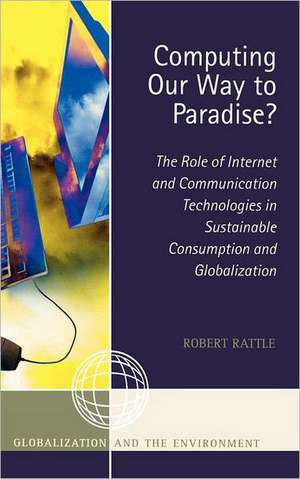
Computing Our Way to Paradise?: The Role of Internet and Communication Technologies in Sustainable Consumption and Globalization: Globalization and the Environment
Autor Robert Rattleen Limba Engleză Hardback – 16 ian 2010
Preț: 737.71 lei
Preț vechi: 1231.70 lei
-40%
Puncte Express: 1107
Carte tipărită la comandă
Livrare economică 01-15 decembrie
Livrare prin curier în România Termenul estimat este afișat lângă disponibilitate.
Transport gratuit pentru acest produs Plată online sau ramburs, în funcție de opțiunile comenzii.
Retur gratuit în 14 zile Comandă securizată și suport în română.
Specificații
ISBN-13: 9780759109483
ISBN-10: 0759109486
Pagini: 231
Dimensiuni: 154 x 232 x 18 mm
Greutate: 0.5 kg
Editura: Bloomsbury Publishing
Colecția AltaMira Press
Seria Globalization and the Environment
Locul publicării:New York, United States
ISBN-10: 0759109486
Pagini: 231
Dimensiuni: 154 x 232 x 18 mm
Greutate: 0.5 kg
Editura: Bloomsbury Publishing
Colecția AltaMira Press
Seria Globalization and the Environment
Locul publicării:New York, United States
V-ar putea interesa
-
 Social CapitalAoife BarryPreț: 104.44 lei
 -
 The World is FlatThomas L. Friedman-18%Preț: 101.96 lei123.79 lei
 -
 Sustainability: A Very Short IntroductionSaleem H. Ali-19%Preț: 57.46 lei71.30 lei
 -
 Preț: 202.50 lei
 -
 The Technological SocietyJacques EllulPreț: 91.29 lei
 -
 The Great ConvergenceRichard BaldwinPreț: 117.78 lei
 -
 Digital Degrowth: Technology in the Age of SurvivalMichael KwetPreț: 151.97 lei
 -
 Enduring Digital Damage: Rhetorical Reckonings for Planetary SurvivalDr. Dustin EdwardsPreț: 200.51 lei
 -
 -26%Preț: 68.27 lei92.57 lei
 -
 The Companion to Development StudiesVandana Desai-8%Preț: 543.23 lei590.48 lei
 -
 Digital DegrowthNeil SelwynPreț: 113.33 lei
 -
 Digital ExhaustionPaul LeonardiPreț: 123.50 lei
 -
 Inconspicuous Consumption: The Environmental Impact You Don't Know You HaveTatiana Schlossberg-26%Preț: 78.54 lei106.42 lei
 -
 International Communication: Continuity and ChangeDaya Kishan Thussu-24%Preț: 191.87 lei251.68 lei
 -
 Preț: 119.29 lei
 -
 Clearing the AirHannah RitchiePreț: 121.89 lei
 -
 EnshittificationCory DoctorowPreț: 170.65 lei
 -
 The Age of ExtractionTim WuPreț: 107.56 lei
 -
 The Dark CloudGuillaume PitronPreț: 112.92 lei
 -
 Perspectives on Global TransformationG. K. Rajanikant-20%Preț: 1463.47 lei1829.34 lei
Cuprins
Chapter 1 Foreword: Global Social Narcosis at the Speed of Light: How the Internet and Communications Technologies are gobbling resources, eradicating cultures, and destroying the planet, and what can be done to stop the runaway train
Chapter 2 Chapter 1. ICTs and Globalization: Asking Important Questions
Chapter 3 Chapter 2. The Poverty of Affluence: Sustainable Consumption and Global Environmental Change
Chapter 4 Chapter 3. Virtual Morality: Globalization, ICTs, and Sustainable Consumption
Chapter 5 Chapter 4. Lulled to Complacency: ICTs and Energy and Materials Consumption
Chapter 6 Chapter 5. The Efficiency Paradox: Intensity and Consumption
Chapter 7 Chapter 6. From Social Meanings to Global Conformity: ICTs and the Global Commons
Chapter 8 Chapter 7. Pathological Tendencies: The Health Link
Chapter 9 Chapter 8. Incantations and ICTs: A Global Ideological Pervasion
Chapter 10 Chapter 9. Redefining Reality, Transforming Values
Chapter 11 Chapter 10. Global Transformations: Serious Considerations and Promising Opportunities
Chapter 2 Chapter 1. ICTs and Globalization: Asking Important Questions
Chapter 3 Chapter 2. The Poverty of Affluence: Sustainable Consumption and Global Environmental Change
Chapter 4 Chapter 3. Virtual Morality: Globalization, ICTs, and Sustainable Consumption
Chapter 5 Chapter 4. Lulled to Complacency: ICTs and Energy and Materials Consumption
Chapter 6 Chapter 5. The Efficiency Paradox: Intensity and Consumption
Chapter 7 Chapter 6. From Social Meanings to Global Conformity: ICTs and the Global Commons
Chapter 8 Chapter 7. Pathological Tendencies: The Health Link
Chapter 9 Chapter 8. Incantations and ICTs: A Global Ideological Pervasion
Chapter 10 Chapter 9. Redefining Reality, Transforming Values
Chapter 11 Chapter 10. Global Transformations: Serious Considerations and Promising Opportunities
Recenzii
A timely, engaging read.... Highly recommended.
Computers, cell phones, and other novel information and communication technologies surround us, and will certainly shape our future. Can they help us move toward environmental sustainability, or will they make our impact on the environment worse? Computing Our Way to Paradise? offers the most comprehensive reply to those questions now available. It covers all the key issues, and, more importantly, it explores the big picture, the ways in which such technologies form part of our worldview, our capitalist economy, and our resource- and energy-intensive way of life. Computing Our Way to Paradise? reveals that only by understanding and acting on these fundamental matters can we fulfill the environmentally positive potential of our information and communication technologies.
This book amplifies the growing fissures emerging in our collective understanding of ICTs and how they can benefit sustainable consumption..This book is a timely and useful contribution to the debate on how we are to deal with unfolding social, economic, political and environmental chaos. It adds clarity to the unsustainable trends in consumer driven lifestyles, how ICTs drive them and how their extra-ordinary potential for a better future has yet to be fully harnessed.
Computers, cell phones, and other novel information and communication technologies surround us, and will certainly shape our future. Can they help us move toward environmental sustainability, or will they make our impact on the environment worse? Computing Our Way to Paradise? offers the most comprehensive reply to those questions now available. It covers all the key issues, and, more importantly, it explores the big picture, the ways in which such technologies form part of our worldview, our capitalist economy, and our resource- and energy-intensive way of life. Computing Our Way to Paradise? reveals that only by understanding and acting on these fundamental matters can we fulfill the environmentally positive potential of our information and communication technologies.
This book amplifies the growing fissures emerging in our collective understanding of ICTs and how they can benefit sustainable consumption..This book is a timely and useful contribution to the debate on how we are to deal with unfolding social, economic, political and environmental chaos. It adds clarity to the unsustainable trends in consumer driven lifestyles, how ICTs drive them and how their extra-ordinary potential for a better future has yet to be fully harnessed.