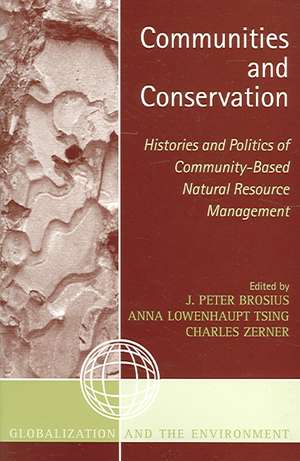
Communities and Conservation: Histories and Politics of Community-Based Natural Resource Management: Globalization and the Environment
Editat de Peter J. Brosius, Anna Lowenhaupt Tsing, Charles Zerner Contribuţii de Janis Alcorn, Grazia Borrini-Feyerabend, J Peter Brosius, Marcus Colchester, Walter Coward, Louise Fortmann, Augusto B. Gatmaytan, Emmy Hafild, Tania Li, Owen Lynch, Marshall Murphree, Rod Neumann, Peter Poole, Dianne Rocheleau, Richard Schroeder, Richard Chase Smith, Christopher Tarnowski, Roem Topatimasang, Anna Tsing, Ken Wilsonen Limba Engleză Paperback – 14 iul 2005
Destinat studenților din antropologie și geografie culturală, cercetătorilor în ecologie politică și practicienilor din domeniul politicilor de mediu, volumul Communities and Conservation oferă o analiză riguroasă a managementului resurselor naturale bazat pe comunitate (CBNRM). Participanții la acest demers academic câștigă o înțelegere profundă a modului în care conservarea biodiversității se intersectează inevitabil cu agenda justiției sociale și a drepturilor colective asupra pământului.
Considerăm că forța acestei lucrări rezidă în capacitatea sa de a documenta mișcarea de „countermapping” și strategiile juridice prin care comunitățile locale își revendică teritoriile. Ne-a atras atenția modul în care editorii Peter J. Brosius, Anna Lowenhaupt Tsing și Charles Zerner au structurat materialul, trecând de la mandatele instituționale la analize critice ale programelor emblematice. De exemplu, secțiunile dedicate programului CAMPFIRE din Africa oferă o perspectivă nuanțată asupra succeselor și compromisurilor strategice în context național.
Ca alternativă la Rights Resources and Rural Development pentru cursurile de dezvoltare rurală și conservare, această lucrare aduce avantajul unei perspective critice asupra globalizării, fiind integrată în seria Globalization and the Environment. În timp ce alte texte se concentrează pe eficiența economică, Communities and Conservation prioritizează dimensiunea politică și istorică a administrării resurselor. Structura progresivă, de la modele teoretice la studii de caz din Gambia sau Mozambic, permite cititorului să observe tensiunea constantă dintre obiectivele globale de mediu și realitățile locale de împuternicire sau coerciție.


Preț: 393.12 lei
Preț vechi: 557.15 lei
-29%
Carte tipărită la comandă
Livrare economică 08-22 decembrie
Specificații
ISBN-10: 0759105065
Pagini: 512
Dimensiuni: 168 x 227 x 32 mm
Greutate: 0.78 kg
Ediția:New.
Editura: Bloomsbury Publishing
Colecția AltaMira Press
Seria Globalization and the Environment
Locul publicării:New York, United States
V-ar putea interesa
-
 -15%Preț: 163.38 lei193.05 lei
 -
 Preț: 190.71 lei
 -
 Preț: 408.25 lei
 -
 Adaptive GovernanceRonald BrunnerPreț: 331.66 lei
 -
 Modernity and TechnologyThomas J. MisaPreț: 282.36 lei
 -
 Nature and Society: Anthropological PerspectivesPhilippe Descola-15%Preț: 425.17 lei500.20 lei
 -
 Navigating Social-Ecological SystemsFikret BerkesPreț: 464.80 lei
 -
 Biodiversity, Sustainability and Human CommunitiesTimothy O'RiordanPreț: 303.00 lei
 -
 Preț: 174.19 lei
 -
 Networks of PowerThomas Parker HughesPreț: 443.93 lei
 -
 Preț: 273.48 lei
 -
 -37%Preț: 207.47 lei329.56 lei
 -
 A History of Environmentalism: Local Struggles, Global HistoriesDr Marco Armiero-14%Preț: 236.99 lei274.38 lei
 -
 Law and Politics of the DanubeStephen GorovePreț: 370.05 lei
De ce să citești această carte
Recomandăm această carte oricărui specialist interesat de intersecția dintre ecologie și drepturile omului. Cititorul câștigă o viziune critică asupra modului în care comunitățile locale pot (sau nu) să gestioneze sustenabil resursele naturale în fața presiunilor globale. Este un instrument esențial pentru înțelegerea mecanismelor de putere din spatele politicilor de conservare, oferind argumente solide pentru advocacy și reformă instituțională în beneficiul populațiilor indigene.
Despre autor
Volumul este coordonat de trei figuri proeminente ale antropologiei mediului. Peter J. Brosius este profesor asociat la Universitatea din Georgia, specializat în impactul social al conservării. Anna Lowenhaupt Tsing, profesor la UC Santa Cruz, este recunoscută internațional pentru analizele sale privind „fricțiunile” globalizării. Charles Zerner ocupă catedra Barbara B. și Bertram J. Cohn la Sarah Lawrence College, fiind un expert recunoscut în studiul relației dintre cultură, tehnologie și mediu. Împreună, aceștia reunesc o echipă de contributori care au modelat practic domeniul managementului comunitar al resurselor.
Descriere
Cuprins
2 Part 1: Mobilizations and Models
3 A. Institutional Mandates
4 Chapter 1: Dances Around the Fire: Conservation Organizations and Community-Based Natural Resource Management
5 Chapter 2: Participatory Democracy in Natural Resource Management: A "Columbus' Egg"?
6 Chapter 3: Building Models of Community-Based Natural Resource Management: A Personal Narrative
7 B. Defining Community in National and Transnational Contexts
8 Chapter 4: Congruent Objectives, Competing Interests and Strategic Compromise: Concept and Process in the Evolution of Zimbabwe's CAMPFIRE Programme
9 Chapter 5: Of Diffusion and Context: The Bubbling Up of Community-BasedResource Management in Mozambique
10 Chapter 6: Model, Panacea, or Exception?: Contextualizing CAMPFIRE and Related Programs in Africa
11 Chapter 7: What We Need is a Community Bambi: The Perils and Possibilities of Powerful Symbols
12 C. Empowerment or Coercion?
13 Chapter 8: Community, Forestry and Conditionality in the Gambia
14 Chapter 9: Can David and Goliath Have a Happy Marriage: The Machiguenga People and the Camisea Gas Project in the Peruvian Amazon
15 Chapter 10: Social Movements, Community-Based Natural Resource Management, and the Struggle for Democracy: Experiences from Indonesia
16 Part 2: Stealing the Master's Tools: Mapping and Law in Community-Based Natural Resource Management
17 A. Mapping against Power
18 Chapter 11: Maps, Power and the Defense of Territory: The Upper Mazaruni Land Claim in Guyana
19 Chapter 12: The Ye'kuana Mapping Project
20 Chapter 13: Maps as Power-Tools: Locating "Communities" in Space or Situating People and Ecologies in Place?
21 Chapter 14: Mapping as Tool for Community Organizing Against Power: A Moluccas Experience
22 B. Legal Strategies for the Disenfranchised
23 Chapter 15: Concepts and Strategies for Promoting Legal Recognition of Community-Based Property Rights: Insights from the Philippines and Other Nations
24 Chapter 16: Engaging Simplifications: Community-Based Natural Resource Management, Market Processes, and State Agendas in Upland Southeast Asia
25 Chapter 17: Advocacy as Translation: Notes on the Philippine Experience
26 INDEX
27 ABOUT THE AUTHORS
Recenzii
Communities and Conservation is a solid effort to debate and document the historical development, political shape, and complexity of community-based natural resource management. It asks hard questions of all the actors involved in people and conservation issues. By challenging our understandings of social justice, cultural respect, and community, this book should be required reading for all conservation organizations, development institutions, and government agencies.
A unique and necessary volume. The editors perform a vital service in assembling this stellar cast from the scholarly, activist, and donor communities. The dialogue here is unprecedented and much-needed. This lively and engaging book is itself an example of the coalition-building the authors propose-a world-changing traffic of ideas and practices across geographical, political, and professional borders.
Communities and Conservation provides a bracing challenge to advocates of both conservation of biodiversity and the rights of local peoples. The terrain of conflict and cooperation between these two communities has not been well mapped, and self-promoting arguments of elision, laden with shibboleths, are too common. If either side is to succeed, let alone if the numerous areas of agreement are to be achieved, questions such as raised in this perceptive, important book must be understood and addressed.
The book speaks to a range of topics such as social movements, transnationalism, and environmentalism. For historians, anthropologists, sociologists, or political scientists interested in these issues, this book will be 'good to think with' due to its combination of rich case studies with nuanced theoretical insights. The origins and history of the transnational network explored here is not easily explained, and this book is as much an analysis and archive of its emergence, as it is about community-based natural resource management per se.
Community is what Raymond Williams called a 'keyword', a sort of semantic building block whose meanings are bound up with the problems the word is being used to address. Communities and Conservation explores both the historical and institutional semantics of community and how community has become a building block-what they call a charismatic program-for the making of contemporary conservation and resource management. Residing within its institutional perimeters are subtle forms of rule, identity, discipline, and power, and also, as the authors show, the potential to challenge conventional models of governance and sustainable development. An indispensable collection for any understanding of the intersections of social justice and advocacy in the realm of natural resource management.
This collection consists of well-written and powerful chapters, which will serve as references for students, researchers and practitioners in years to come.