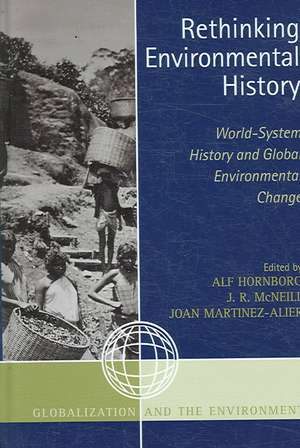
Rethinking Environmental History: World-System History and Global Environmental Change: Globalization and the Environment
Editat de Alf Hornborg, J. R. McNeill, Joan Martinez-Alier Contribuţii de Stephen G. Bunker, William H. Fisher, Rafael A. Gassón, Stefan Giljum, N Thomas Håkansson, Josiah Heyman, J Donald Hughes, Andrew K. Jorgenson, Robert B. Marks, Jason W. Moore, Roldan Muradian, Janken Myrdal, James Rice, Joseph A. Tainter, Immanuel Wallerstein, Helga Weisz, Mats Widgren, Richard Wilk, Michael Williamsen Limba Engleză Hardback – 18 ian 2007
Structura și metodologia acestui volum colectiv sunt fundamentate pe o ambiție transdisciplinară: fuziunea dintre istoria sistemelor-lume și schimbările de mediu la scară globală. Volumul este organizat pentru a ghida cititorul printr-o progresie cronologică și tematică riguroasă, începând cu impactul ecologic al economiei romane și continuând cu transformările din China pe parcursul a două milenii sau rolul defrișărilor în integrarea sistemelor moderne. Putem afirma că lucrarea reușește să demonstreze cum procesele economice nu sunt fenomene izolate, ci forțe care modelează direct biosfera.
Recomandăm această lectură pentru modul în care reușește să contextualizeze criza climatică actuală nu ca pe un eveniment recent, ci ca pe rezultatul unor procese extractive începute acum sute de ani. Menționăm, de pildă, analiza despre argint și originile lumii moderne (1450-1640), care oferă o perspectivă critică asupra modului în care fluxurile de capital au fost întotdeauna legate de fluxuri de resurse naturale. Acoperă aceeași arie tematică precum Ecology and the World-System, dar cu o abordare mai profund ancorată în studii de caz istorice specifice și arheologie peisagistică.
În contextul operei editorului Alf Hornborg, acest titlu consolidează tezele dezvoltate în The Power of the Machine sau Global Magic, unde acesta argumentează că tehnologia și acumularea de capital sunt mecanisme de distribuție inegală a sarcinilor de mediu. Prezența unor autori precum Immanuel Wallerstein asigură o rigoare teoretică ce transformă acest volum dintr-o simplă culegere de eseuri într-un instrument metodologic esențial pentru studenții și cercetătorii din domeniile ecologiei politice și istoriei globale.

Preț: 789.37 lei
Preț vechi: 1190.55 lei
-34%
Carte tipărită la comandă
Livrare economică 18 noiembrie-02 decembrie
Specificații
ISBN-10: 0759110271
Pagini: 408
Ilustrații: Illustrations, maps
Dimensiuni: 152 x 232 x 28 mm
Greutate: 0.77 kg
Editura: Bloomsbury Publishing
Colecția AltaMira Press
Seria Globalization and the Environment
Locul publicării:New York, United States
V-ar putea interesa
-
 -16%Preț: 159.55 lei189.68 lei
 -
 Preț: 190.71 lei
 -
 Preț: 406.19 lei
 -
 Adaptive GovernanceRonald BrunnerPreț: 307.61 lei
 -
 Modernity and TechnologyThomas J. MisaPreț: 282.36 lei
 -
 Nature and Society: Anthropological PerspectivesPhilippe Descola-15%Preț: 425.17 lei500.20 lei
 -
 Navigating Social-Ecological SystemsFikret BerkesPreț: 464.80 lei
 -
 Biodiversity, Sustainability and Human CommunitiesTimothy O'RiordanPreț: 303.00 lei
 -
 Preț: 173.93 lei
 -
 Networks of PowerThomas Parker HughesPreț: 443.93 lei
 -
 Preț: 265.53 lei
 -
 -37%Preț: 207.47 lei329.56 lei
 -
 A History of Environmentalism: Local Struggles, Global HistoriesDr Marco Armiero-14%Preț: 236.99 lei274.38 lei
 -
 Law and Politics of the DanubeStephen GorovePreț: 370.05 lei
De ce să citești această carte
Această carte este esențială pentru cei care doresc să înțeleagă rădăcinile istorice ale globalizării prin prisma degradării mediului. Cititorul câștigă o viziune integrată asupra modului în care imperiile și piețele globale au exploatat ecosistemele de-a lungul istoriei. Este o recomandare certă pentru studenții la geografie, istorie și științe politice care caută o alternativă la analizele pur economice ale dezvoltării globale.
Despre autor
Volumul beneficiază de expertiza a trei editori de marcă. Alf Hornborg este antropolog și profesor de ecologie umană la Universitatea din Lund, cunoscut pentru analizele sale critice asupra tehnologiei și valorii. J. R. McNeill este un istoric de renume la Georgetown University, specializat în istorie de mediu, în timp ce Joan Martinez-Alier, de la Universitatea Autonomă din Barcelona, este unul dintre fondatorii economiei ecologice și ai mișcării de justiție de mediu. Împreună, aceștia coordonează o echipă interdisciplinară ce reunește perspective din sociologie, istorie și geografie.
Descriere
Cuprins
Part I The Environment in World-System History: Tracing Social Processes in Nature
1. Environmental Impacts of the Roman Economy and Social Structure: Augustus to Diocletian
2. "People Said Extinction Was Not Possible": Two Thousand Years of Environmental Change in South China
3. Precolonial Landesque Capital: A Global Perspective
4. Food, War, and Crisis: The Seventeenth-Century Swedish Empire
5. The Role of Deforestation in Earth and World-System Integration
6. Silver, Ecology, and the Origins of the Modern World, 1450-1640
7. Trade, "Trinkets," and Environmental Change at the Edge of World-Systems: Political Ecology and the East African Ivory Trade
8. Steps to an Environmental History of the Western Llanos of Venezuela: A World-System Perspective
9. The Extractive Economy: An Early Phase of the Globalization of Diet, and Its Environmental Consequences
10.Yellow Jack and Geopolitics: Environment, Epidemics, and the Struggles for Empire in the American Tropics, 1640-1830
Part II Ecology and Unequal Exchange: Unraveling Environmental Injustice in the Modern World
11. Marxism, Social Metabolism, and International Trade
12. Natural Values and the Physical Inevitability of Uneven Development under Capitalism
13. Footprints in the Cotton Fields: The Industrial Revolution as Time-Space Appropriation and Environmental Load Displacement
14. Uneven Ecological Exchange and Consumption-Based Environmental Impacts: A Cross-National Investigation
15. Combining Social Metabolism and Input-Output Analyses to Account for Ecologically Unequal Trade
16. Physical Trade Flows of Pollution-Intensive Products: Historical Trends in Europe and the World
17. Environmental Issues at the U.S.-Mexico Border and the Unequal Territorialization of Value
18. Surrogate Money, Technology, and the Expansion of Savanna Soybeans in Brazil
19. Scale and Dependency in World-Systems: Local Societies in Convergent Evolution
20. The Ecology and the Economy: What is Rational?
Recenzii
This book offers new perspectives on global environmental problems at a time when many of these issues are discussed and taught in a historical and political-economic vacuum. It is coherent in theme, interdisciplinary in scope, historically innovative, and geographically far-reaching. A 'world-system' perspective provides a thread for a multifaceted view of distributive aspects of our interlinked economic and environmental histories. Rethinking Environmental History offers carefully crafted studies and provocative essays by some of the most respected scholars (and best writers!) on the topic. This volume brings much-needed depth to the scholarship of globalization and environment, and inauguates a new phase of inquiry in political ecology, environmental history, and environmental sciences in general.
Environmental history is new, exciting, and protean-a veritable stem cell of scholarly inquiry. To sample it while its insights are fresh and provoke new views of even your own origins, read Rethinking Environmental History.
This is the best overview we have of political ecology, which tries to link environmental change to political economy and social injustice. Through a set of richly layered and well-argued chapters, the authors demonstrate how empires and powerful nation-states have long enriched themselves and protected their own environments by extracting wealth from faraway places. These authors restore both ecology and economy to the center of environmental history. All historians and environmental policy makers should read their contributotions carefully and incorporate their ecological perspective into our understanding of the past.
We like to think that we are free agents and that everything is possible. Yet technological development today is highly uneven, just as it was throughout the past. All development is subject to various ecological constraints. How actors deal with these constraints and who ends up bearing their burden are often more complex processes than they may seem from local perspectives. The chapters in Hornborg, McNeill, and Martinez-Alier help illustrate these multifaceted problems in a number of fascinating and globally conscious ways.