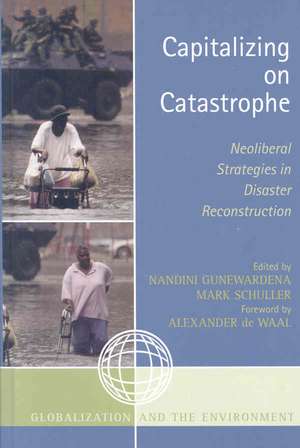
Capitalizing on Catastrophe: Neoliberal Strategies in Disaster Reconstruction: Globalization and the Environment
Editat de Nandini Gunewardena, Mark Schuller Cuvânt înainte de Alexander De Waal Contribuţii de Sara E. Alexander, Gregory Button, Bettina Damiani, Antonio Donini, Elizabeth Guillette, Wahneema Lubiano, Anthony Oliver-Smith, Adolph Reed Jr, Anna Belinda Sandoval Girón, Susan Stonichen Limba Engleză Hardback – 25 feb 2008

Preț: 792.28 lei
Preț vechi: 1115.06 lei
-29%
Puncte Express: 1188
Carte disponibilă
Livrare economică 16-30 noiembrie
Livrare prin curier în România Termenul estimat este afișat lângă disponibilitate.
Transport gratuit pentru acest produs Plată online sau ramburs, în funcție de opțiunile comenzii.
Retur gratuit în 14 zile Comandă securizată și suport în română.
Specificații
ISBN-13: 9780759111028
ISBN-10: 0759111022
Pagini: 288
Ilustrații: Illustrations
Dimensiuni: 158 x 230 x 24 mm
Greutate: 0.58 kg
Ediția:New.
Editura: Bloomsbury Publishing
Colecția AltaMira Press
Seria Globalization and the Environment
Locul publicării:New York, United States
ISBN-10: 0759111022
Pagini: 288
Ilustrații: Illustrations
Dimensiuni: 158 x 230 x 24 mm
Greutate: 0.58 kg
Ediția:New.
Editura: Bloomsbury Publishing
Colecția AltaMira Press
Seria Globalization and the Environment
Locul publicării:New York, United States
Cuprins
Part 1 Part I. Framing the Capitalization of Catastrophes
Chapter 2 Chapter 1. Human Security versus Neoliberal Approaches to Disaster Recovery
Chapter 3 Chapter 2. Deconstructing the Disaster after the Disaster: Conceptualizing Disaster Capitalism
Chapter 4 Chapter 3. Through a Glass, Darkly: Humanitarianism and Empire
Part 5 Part II. Tourism as Reconstruction
Chapter 6 Chapter 4. International Tourism and Disaster Capitalism: The Case of Hurricane Mitch in Honduras
Chapter 7 Chapter 5. Peddling Paradise, Rebuilding Serendib: The 100-Meter Refugees versus the Tourism Industry in Post-tsunami Sri Lanka
Chapter 8 Chapter 6. The Resilience of Vulnerable Households: Adjusting to Neoliberal Capitalism in the Aftermath of Hurricane Iris
Part 9 Part III. Exposing Katrina: Class, Race, and Displacement
Chapter 10 Chapter 7. Race, Class, and the Politics of Death: Critical Responses to Hurricane Katrina
Chapter 11 Chapter 8. Disaster, Displacement and Employment: Distortion of Labor Markets During Post-Katrina Reconstruction
Chapter 12 Chapter 9. Class Inequality, Liberal Bad Faith, and Neoliberalism: the True Disaster of Katrina
Part 13 Part IV. Prolonging Recovery: Bypassing Accountability and Transparency
Chapter 14 Chapter 10. Capitalization of Post-9/11 Recovery
Chapter 15 Chapter 11. The Foul Odor of Capital: The Union Carbide Disaster in Bhopal, India
Part 16 Part V. Dividends of Conflict: Reconstruction as Reform
Chapter 17 Chapter 12. "Haiti is Finished!" Haiti's End of History Meets the Ends of Capitalism
Chapter 18 Chapter 13. After the Storm: The Aftermath of Guatemala's Post-Civil War
Part 19 Part VI. Conclusion: Envisioning Alternatives: Seven Pragmatic Proposals to Advance Human Security in Disaster Assistance and Recovery
Chapter 2 Chapter 1. Human Security versus Neoliberal Approaches to Disaster Recovery
Chapter 3 Chapter 2. Deconstructing the Disaster after the Disaster: Conceptualizing Disaster Capitalism
Chapter 4 Chapter 3. Through a Glass, Darkly: Humanitarianism and Empire
Part 5 Part II. Tourism as Reconstruction
Chapter 6 Chapter 4. International Tourism and Disaster Capitalism: The Case of Hurricane Mitch in Honduras
Chapter 7 Chapter 5. Peddling Paradise, Rebuilding Serendib: The 100-Meter Refugees versus the Tourism Industry in Post-tsunami Sri Lanka
Chapter 8 Chapter 6. The Resilience of Vulnerable Households: Adjusting to Neoliberal Capitalism in the Aftermath of Hurricane Iris
Part 9 Part III. Exposing Katrina: Class, Race, and Displacement
Chapter 10 Chapter 7. Race, Class, and the Politics of Death: Critical Responses to Hurricane Katrina
Chapter 11 Chapter 8. Disaster, Displacement and Employment: Distortion of Labor Markets During Post-Katrina Reconstruction
Chapter 12 Chapter 9. Class Inequality, Liberal Bad Faith, and Neoliberalism: the True Disaster of Katrina
Part 13 Part IV. Prolonging Recovery: Bypassing Accountability and Transparency
Chapter 14 Chapter 10. Capitalization of Post-9/11 Recovery
Chapter 15 Chapter 11. The Foul Odor of Capital: The Union Carbide Disaster in Bhopal, India
Part 16 Part V. Dividends of Conflict: Reconstruction as Reform
Chapter 17 Chapter 12. "Haiti is Finished!" Haiti's End of History Meets the Ends of Capitalism
Chapter 18 Chapter 13. After the Storm: The Aftermath of Guatemala's Post-Civil War
Part 19 Part VI. Conclusion: Envisioning Alternatives: Seven Pragmatic Proposals to Advance Human Security in Disaster Assistance and Recovery
Recenzii
Capitalizing on Catastrophe critically examines the motivations and agendas that fuel the political will to act in the name of humanitarian assistance to the large-scale crises and human tragedies of our times. Using diverse examples of disaster from around the world, the authors tease apart the complex continuum of causality, response, and consequence-asking the basic questions of who pays, who profits, and to what effect. In so doing, they put a human face to disaster response, and that face is not a pretty one. Nandini Gunewardena and Mark Schuller have pulled together an incredibly strong collection of case studies, framed in a sharp and clear analysis with pragmatic suggestions for change. In a world of escalating chaos and misery, this collection offers the reader a useful tool to assess recent experiences. More importantly, Capitalizing on Catastrophe offers pragmatic strategies to emphasize human needs in humanitarian response.
This is a stunning book that builds on, and extends, previous research on disaster, social vulnerability, and reconstruction. The contributors discuss social vulnerability and neoliberalism, disaster capitalism, humanitarian issues, and cultural data sets from around the world. The book provides a rich combination of ethnography and theory.
Moralized discourse served as a protective bubble that provided immunity from rigorous analysis. That bubble has burst, but only on the top floor of the ivory tower. The overwhelming majority of media coverage and academic writing remains entrapped in an untheorized consensus that relief and rehabilitation are good things beyond rebuke. Capitalizing on Catastrophe is an important exercise in scholarship. It brings the phenomenon of neo-liberal disaster capitalism into sharp focus, defining the field in a theoretical and comparative manner and exploring some important case studies. This book is also an essential exercise in framing an emergent public policy issue.
The book's strengths lie in the breadth of its case studies and its impressive balance between fine ethnographic detail and consistency of argument in which neither is sacrificed. Owing to its accessible writing and analytically coherent selection of research, Capitalizing on Catastrophe will be of great interest to students, scholars, and general readers concerned about the insidious machinations at work in the global field of disaster capitalism. It is both shocking and convincing.
Valuable suggestions on emergency situations take on a new light and potential importance. The volume draws strength from the variety of case studies and broad experience of the contributing authors, many of whom spent years in the discussed communities, interviewing stakeholders and compiling data.
This is a stunning book that builds on, and extends, previous research on disaster, social vulnerability, and reconstruction. The contributors discuss social vulnerability and neoliberalism, disaster capitalism, humanitarian issues, and cultural data sets from around the world. The book provides a rich combination of ethnography and theory.
Moralized discourse served as a protective bubble that provided immunity from rigorous analysis. That bubble has burst, but only on the top floor of the ivory tower. The overwhelming majority of media coverage and academic writing remains entrapped in an untheorized consensus that relief and rehabilitation are good things beyond rebuke. Capitalizing on Catastrophe is an important exercise in scholarship. It brings the phenomenon of neo-liberal disaster capitalism into sharp focus, defining the field in a theoretical and comparative manner and exploring some important case studies. This book is also an essential exercise in framing an emergent public policy issue.
The book's strengths lie in the breadth of its case studies and its impressive balance between fine ethnographic detail and consistency of argument in which neither is sacrificed. Owing to its accessible writing and analytically coherent selection of research, Capitalizing on Catastrophe will be of great interest to students, scholars, and general readers concerned about the insidious machinations at work in the global field of disaster capitalism. It is both shocking and convincing.
Valuable suggestions on emergency situations take on a new light and potential importance. The volume draws strength from the variety of case studies and broad experience of the contributing authors, many of whom spent years in the discussed communities, interviewing stakeholders and compiling data.