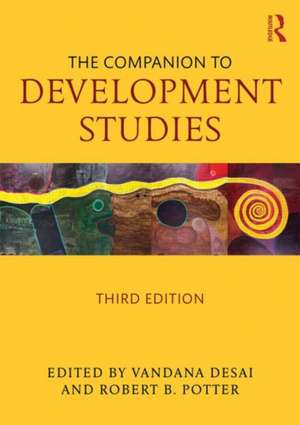
The Companion to Development Studies
Editat de Vandana Desai, Rob Potteren Limba Engleză Paperback – 10 mar 2014
Relevanța acestei lucrări pentru examenele de specialitate și acreditările în domeniul relațiilor internaționale sau sociologiei este incontestabilă, fiind un text de referință în bibliografiile universitare globale. The Companion to Development Studies, aflat la a treia ediție, reprezintă o resursă enciclopedică ce reușește să sintetizeze complexitatea studiilor de dezvoltare prin contribuțiile a peste o sută de experți. Notăm cu interes modul în care editorii Vandana Desai și Rob Potter au structurat volumul în zece părți distincte, oferind o progresie logică de la bazele teoretice și istorice către provocări contemporane presante. Putem afirma că această ediție este marcată de o actualizare masivă, aducând în discuție 45 de perspective noi asupra unor subiecte precum securitatea alimentară, hydropolitica și impactul tehnologiei digitale. Alternativă la Theories and Practices of Development de Katie Willis pentru cursurile de geografie umană și politici de dezvoltare, acest volum are avantajul unei acoperiri mult mai vaste a studiilor de caz, de la economiile BRICs până la fragilitatea statelor în contextul conflictelor etnice. În contextul operei editorului, volumul completează abordările metodologice din Doing Development Research și analizele structurale din The Handbook of Displacement, făcând trecerea de la tehnica cercetării la aplicarea politicilor în teren. Reținem organizarea riguroasă a cuprinsului, care ghidează cititorul prin labirintul globalizării, urbanizării și economiei politice, oferind totodată resurse suplimentare și referințe web esențiale pentru aprofundare.
Preț: 526.88 lei
Preț vechi: 572.70 lei
-8%
Carte disponibilă
Livrare economică 16-30 mai
Livrare express 05-09 mai pentru 56.08 lei
Specificații
ISBN-10: 1444167243
Pagini: 626
Ilustrații: 49 black & white illustrations, 19 black & white tables, 3 black & white halftones, 46 black & white line drawings
Dimensiuni: 174 x 246 x 38 mm
Greutate: 1.07 kg
Ediția:Revizuită
Editura: Taylor & Francis
Colecția Routledge
Locul publicării:Oxford, United Kingdom
V-ar putea interesa
-
 Economics: A Very Short IntroductionPartha Dasgupta-21%Preț: 53.98 lei68.10 lei
 -
 -24%Preț: 563.08 lei744.32 lei
 -
 The Companion to Development StudiesEmil DaunceyPreț: 345.44 lei
 -
 The Routledge Handbook of Global DevelopmentKearrin SimsPreț: 413.70 lei
 -
 Preț: 353.99 lei
 -
 GlobalizationGeorge RitzerPreț: 306.29 lei
 -
 Theories and Practices of DevelopmentKatie WillisPreț: 338.29 lei
 -
 -8%Preț: 434.02 lei471.76 lei
 -
 PoliticsAndrew Heywood-20%Preț: 289.04 lei361.16 lei
 -
 The Development Dictionary: A Guide to Knowledge as PowerWolfgang Sachs-21%Preț: 154.27 lei194.12 lei
 -
 -23%Preț: 173.62 lei224.26 lei
 -
 -18%Preț: 150.46 lei183.63 lei
 -
 Introduction to International and Global Studies, Third EditionShawn C SmallmanPreț: 330.23 lei
 -
 Preț: 134.48 lei
 -
 -25%Preț: 508.66 lei675.59 lei
 -
 Developing Countries: Political, Economic & Social IssuesArthur Ramazzotti-30%Preț: 1221.79 lei1751.71 lei
 -
 The Women, Gender and Development ReaderValentine Moghadam-24%Preț: 187.51 lei246.45 lei
 -
 World Development: A Core TextbookBarry Baker-28%Preț: 94.54 lei130.49 lei
 -
 Preț: 411.41 lei
De ce să citești această carte
Această carte este esențială pentru studenții și profesioniștii din domeniul științelor politice, economiei și geografiei care doresc o înțelegere autoritară a dinamicii globale. Cititorul câștigă acces la o bibliotecă întreagă de expertiză într-un singur volum, beneficiind de analize actualizate despre schimbările climatice și crizele financiare, oferind un avantaj competitiv în pregătirea academică și profesională.
Despre autor
Vandana Desai este o figură proeminentă în cercetarea interdisciplinară, activitatea sa concentrându-se pe intersecția dintre guvernanța urbană, gen și politicile de dezvoltare. Cu o experiență vastă în colaborarea cu ONG-uri internaționale precum WaterAid și Practical Action, ea aduce o perspectivă pragmatică asupra relațiilor dintre donatorii din Nord și beneficiarii din Sud. Cercetările sale vizează în mod special infrastructura urbană și locuințele pentru persoanele cu venituri mici, integrând teorii din sociologie și geografie pentru a influența procesele de elaborare a politicilor internaționale, aspecte reflectate în rigoarea editorială a acestui ghid.
Descriere scurtă
This third edition has been extensively updated and contains 45 new contributions from leading authorities, dealing with pressing contemporary issues such as race and development, ethics and development, BRICs and development, global financial crisis, the knowledge based economy and digital divide, food security, GM crops, comparative urbanism, cities and crime, energy, water hydropolitics, climate change, disability, fragile states, global war on terror, ethnic conflict, legal rights to development, ecosystems services for development, just to name a few. Existing chapters have been thoroughly revised to include cutting-edge developments, and to present updated further reading and websites.
The Companion to Development Studies presents concise overviews providing a gateway to further reading and a flexible resource for teaching and learning. It has established a role as essential reading for all students of development studies, as well as those in cognate areas of geography, international relations, politics, sociology, anthropology and economics.