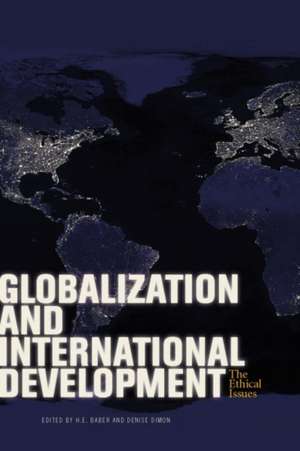
Globalization and International Development: The Ethical Issues
Editat de H.E. Baber, Denise Dimonen Limba Engleză Paperback – 19 aug 2013
Preț: 520.40 lei
Preț vechi: 699.22 lei
-26%
Puncte Express: 781
Carte disponibilă
Livrare economică 29 octombrie-12 noiembrie
Livrare express 14-20 octombrie pentru 101.47 lei
Livrare prin curier în România Termenul estimat este afișat lângă disponibilitate.
Transport gratuit pentru acest produs Plată online sau ramburs, în funcție de opțiunile comenzii.
Retur gratuit în 14 zile Comandă securizată și suport în română.
Specificații
ISBN-13: 9781554810123
ISBN-10: 1554810124
Pagini: 672
Dimensiuni: 178 x 229 x 27 mm
Greutate: 0.84 kg
Editura: BROADVIEW PR
Colecția Broadview Press
Locul publicării:Peterborough, Canada
ISBN-10: 1554810124
Pagini: 672
Dimensiuni: 178 x 229 x 27 mm
Greutate: 0.84 kg
Editura: BROADVIEW PR
Colecția Broadview Press
Locul publicării:Peterborough, Canada
V-ar putea interesa
-
 Being Good: A Short Introduction to EthicsSimon Blackburn-21%Preț: 66.47 lei83.73 lei
 -
 Can God Be Trusted?: Faith and the Challenge of EvilJohn G. Stackhouse-16%Preț: 214.63 lei257.01 lei
 -
 Respect, Pluralism, and Justice: Kantian PerspectivesThomas E. Hill-19%Preț: 360.45 lei445.82 lei
 -
 Reasons and PersonsDerek Parfit-15%Preț: 201.64 lei237.81 lei
 -
 Pluralism, Justice, and EqualityDavid Miller-28%Preț: 412.53 lei575.62 lei
 -
 Freedom and ReasonR. M. Hare-18%Preț: 359.91 lei439.03 lei
 -
 -21%Preț: 524.60 lei667.99 lei
 -
 Moral FictionalismMark Eli Kalderon-13%Preț: 358.95 lei413.22 lei
 -
 Moral WritingsH. A. Prichard-21%Preț: 406.70 lei516.28 lei
 -
 War and Self-DefenseDavid Rodin-20%Preț: 349.84 lei434.85 lei
 -
 Principled Ethics: Generalism as a Regulative IdealSean McKeever-19%Preț: 322.43 lei398.85 lei
 -
 Civilian Immunity in WarIgor Primoratz-19%Preț: 445.85 lei550.44 lei
 -
 -28%Preț: 391.64 lei547.11 lei
 -
 Ancient Wisdom, Modern World: Ethics for the New MillenniumHis Holiness The Dalai Lama-28%Preț: 65.55 lei90.95 lei
 -
 -18%Preț: 2540.91 lei3098.68 lei
 -
 The Genealogy of MoralsFriedrich Nietzsche-20%Preț: 33.64 lei42.17 lei
 -
 A Year to LiveStephen LevinePreț: 86.14 lei
Recenzii
This new anthology offers a wide selection of readings addressing the contemporary moral issues that arise from the division between the Global North and South—“the problem of the color-line” that W.E.B. Du Bois identified at the beginning of the twentieth century and which, on a scale that Du Bois could not have foreseen, is the problem of the twenty-first. The book is interdisciplinary in scope. In addition to standard topical essays in ethical theory by philosophers such as Anthony Appiah, Martha Nussbaum, and Peter Singer, it contains essays from economists such as Amartya Sen, Joseph Stiglitz, and Thomas DeGregori, as well as current empirical data from the World Bank, IMF, United Nations, and other sources.
“Globalization and International Development is a superb anthology. Unlike other such collections, it brings together a diversity of philosophical, economic, and anthropological materials, conveniently providing all that one might need for an undergraduate course on global economic justice. The readings are carefully selected, accessible, and certain to stimulate productive classroom discussion. In short, an ideal textbook!” — Frank Lovett, Washington University in St. Louis
“Baber and Dimon provide a comprehensive set of readings from a range of disciplines. The book’s organization allows students to work through the positions presented, to see globalization and development beyond narrow disciplinary boundaries, and to challenge their own normative ideas about the issues raised.” — Lisa Glidden, SUNY Oswego
“Globalization and International Development is an inspiring and carefully selected anthology of readings for topical-focused courses on international ethics and global justice. The readings explore crucial aspects of the global North–South divide, and voices are represented from both sides. Students are offered a wealth of empirical material, and the readings strike a good balance between articles written by philosophers and those written by social scientists.” — Harry van der Linden, Butler University
“Globalization and International Development is a superb anthology. Unlike other such collections, it brings together a diversity of philosophical, economic, and anthropological materials, conveniently providing all that one might need for an undergraduate course on global economic justice. The readings are carefully selected, accessible, and certain to stimulate productive classroom discussion. In short, an ideal textbook!” — Frank Lovett, Washington University in St. Louis
“Baber and Dimon provide a comprehensive set of readings from a range of disciplines. The book’s organization allows students to work through the positions presented, to see globalization and development beyond narrow disciplinary boundaries, and to challenge their own normative ideas about the issues raised.” — Lisa Glidden, SUNY Oswego
“Globalization and International Development is an inspiring and carefully selected anthology of readings for topical-focused courses on international ethics and global justice. The readings explore crucial aspects of the global North–South divide, and voices are represented from both sides. Students are offered a wealth of empirical material, and the readings strike a good balance between articles written by philosophers and those written by social scientists.” — Harry van der Linden, Butler University
Cuprins
Introduction
I Ethical Theory
Introduction
Introduction
Introduction
Introduction
Introduction
Introduction
Introduction
Introduction
Introduction
I Ethical Theory
Introduction
- John Stuart Mill, “Utilitarianism” (selections from Utilitarianism)
- John Rawls, “An Egalitarian Theory of Justice” (selections from A Theory of Justice)
- Robert Nozick, “The Entitlement Theory” (selections from Anarchy, State and Utopia)
- Peter Singer, “The Right to Be Rich or Poor”
- Michael J. Sandel, “The Procedural Republic and the Unencumbered Self”
- Amartya Sen, “Equality of What?”
Recommended Reading
Introduction
- Abhijit V. Banerjee and Esther Duflo, “The Economic Lives of the Poor”
- Rebecca Mead, “Dressing for Lula”
- Peter Singer, “The Drowning Child and the Expanding Circle”
- Daron Acemoglu and James Robinson, “Toward a Theory of World Inequality” (selections from Why Nations Fail)
- UN Millennium Project, “Investing in Development: A Practical Plan to Achieve the Millennium Development Goals”
- William Easterly, “A Modest Proposal”
- Paul Collier, “Poverty Reduction in Africa”
Recommended Reading
Introduction
- IMF Staff, “Globalization: Threat or Opportunity” (selections)
- Joseph E. Stiglitz, “Do What We Did, Not What We Say”
- Kevin Watkins, “Making Globalization Work for the Poor” (with a responseby David Dollar and Aart Kraay)
- Matthew Zwolinski, “Sweatshops, Choice, and Exploitation” (selections)
- Benjamin R. Barber, “Jihad vs. McWorld”
Recommended Reading
Introduction
- J.L. Holzgrefe, “The Humanitarian Intervention Debate”
- John Stuart Mill, “A Few Words on Non-Intervention”
- Dinesh D’Souza, “Two Cheers for Colonialism”
- Rudyard Kipling, “Lispeth”
- Clifford Bob, “Merchants of Morality”
- Muhammad Yunus, “The Grameen Bank”
- Aneel Karnani, “Employment, Not Microcredit, Is the Solution”
Recommended Reading
Introduction
- Frantz Fanon, “Concerning Violence” (selections from The Wretched of the Earth)
- David Luban, “Just War and Human Rights”
- Deepak Lal, “In Defense of Empires” (selections)
- Soran Reader, “Making Pacifism Plausible”
- Thomas Nagel, “War and Massacre”
Recommended Reading
Introduction
- United Nations Environmental Programme, Global Environment Outlook 4 (selections)
- Garrett Hardin, “Living on a Lifeboat”
- Peter Singer, “One Atmosphere” (selection from One World: The Ethicsof Globalization)
- Vandana Shiva, “An Open Letter to Oxfam”
- Thomas R. DeGregori, “Shiva the Destroyer?”
Recommended Reading
Introduction
- World Bank, Engendering Development (selections)
- Susan Moller Okin, “Is Multiculturalism Bad for Women?”
- Martha Nussbaum, “Adaptive Preference and Women’s Options” (selections from Women and Human Development)
- H.E. Baber, “Adaptive Preference”
Recommended Reading
Introduction
- United Nations, Universal Declaration of Human Rights
- Carolyn Fluehr-Lobban, “Anthropologists, Cultural Relativism, and Universal Rights”
- James Rachels, “The Challenge of Cultural Relativism” (selection from The Elements of Moral Philosophy)
- Carol J. Williams, “The Price of Freedom, in Blood”
Recommended Reading
Introduction
- David Goodhart, “Too Diverse?”
- Robert D. Putnam, “E Pluribus Unum: Diversity and Community in the Twenty-first Century”
- Alexis Rawlinson, “The Political Manipulation of Ethnicity in Africa”
- Amartya Sen, “The Uses and Abuses of Multiculturalism: Chili and Liberty”
- K. Anthony Appiah, “Race, Culture, Identity: Misunderstood Connections”(selections from Color Conscious: The Political Morality of Race)
Recommended Reading