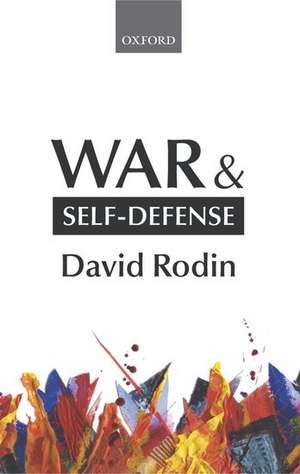
War and Self-Defense
Autor David Rodinen Limba Engleză Paperback – 25 noi 2004
Considerăm acest volum o resursă fundamentală pentru nivelul de licență avansată și master în filozofie politică, etică sau drept internațional. În War and Self-Defense, David Rodin întreprinde o analiză riguroasă a celei mai frecvente justificări pentru conflictul armat: autoapărarea. Observăm cum autorul demontează sistematic analogia tradițională dintre individ și stat, argumentând că dreptul unei națiuni de a recurge la forță nu poate fi derivat simplist din dreptul moral al individului de a se proteja.
Apreciem rigoarea cu care Rodin chestionează fundamentele teoriei Războiului Just, propunând în schimb o regândire a modului în care înțelegem suveranitatea și responsabilitatea morală în arena internațională. Stilul este precis și analitic, specific tradiției oxoniene, evitând retorica inflamată în favoarea unei construcții logice dense. Cartea reprezintă o alternativă conceptuală la The Ethics of War and Peace de Helen Frowe pentru cursurile de etică aplicată; în timp ce Frowe oferă o introducere accesibilă în teoria contemporană, Rodin avansează o critică structurală profundă care forțează cititorul să reevalueze validitatea juridică a multor elemente din dreptul internațional actual.
Această lucrare ocupă un loc central în opera autorului, precedând și fundamentând temele explorate în The Individualization of War și Just and Unjust Warriors. Dacă în lucrările ulterioare Rodin se concentrează pe responsabilitatea combatanților, aici el stabilește cadrul teoretic necesar pentru a înțelege de ce justificările colective ale războiului sunt adesea precare din punct de vedere moral.
Preț: 321.15 lei
Preț vechi: 372.83 lei
-14%
Carte tipărită la comandă
Livrare economică 05-16 iunie
Specificații
ISBN-10: 0199275416
Pagini: 230
Dimensiuni: 138 x 215 x 13 mm
Greutate: 0.29 kg
Editura: OUP OXFORD
Colecția OUP Oxford
Locul publicării:Oxford, United Kingdom
V-ar putea interesa
-
 Preț: 305.14 lei
 -
 Natural Law Theory: Contemporary EssaysRobert P. George-24%Preț: 381.62 lei502.01 lei
 -
 Ethics and Practical ReasonGarrett Cullity-14%Preț: 369.80 lei429.53 lei
 -
 The Evidential Force of Religious ExperienceCaroline Franks Davis-24%Preț: 365.69 lei482.41 lei
 -
 Essays on Ethics and MethodHenry Sidgwick-30%Preț: 347.63 lei498.76 lei
 -
 Sorting Out EthicsR. M. Hare-15%Preț: 342.46 lei402.43 lei
 -
 Ethical Intuitionism: Re-evaluationsPhilip Stratton-Lake-14%Preț: 336.84 lei391.83 lei
 -
 -18%Preț: 354.26 lei430.37 lei
 -
 -18%Preț: 461.33 lei564.90 lei
 -
 -12%Preț: 367.49 lei417.79 lei
 -
 Whose Justice? Which Rationality?Alasdair MacintyrePreț: 274.09 lei
 -
 Reclaiming Goodness – Education and the Spiritual QuestHanan A. Alexander-23%Preț: 565.92 lei734.96 lei
 -
 Living Philosophy: An Introduction to Moral ThoughtRay BillingtonPreț: 399.59 lei
 -
 Arguing about MetaethicsAndrew FisherPreț: 447.30 lei
 -
 Ethical Dimensions of Marxist ThoughtCornel WestPreț: 168.46 lei
De ce să citești această carte
Recomandăm această carte studenților și specialiștilor care doresc să înțeleagă limitele etice ale utilizării forței în politica globală. Veți câștiga o perspectivă critică asupra conceptului de autoapărare națională, dincolo de clișeele juridice. Este o lectură esențială pentru a înțelege de ce multe dintre argumentele morale folosite în conflictele moderne sunt, sub lupa analizei filosofice, fundamentate pe analogii incomplete.
Despre autor
David Rodin este un expert recunoscut la nivel mondial în etica războiului, deținând poziții de cercetare la University of Oxford și Australian National University. Activitatea sa academică este dublată de o vastă experiență practică, activând ca pedagog și consultant pentru organizații precum NATO, UNESCO și armata britanică. Lucrarea de față a fost distinsă cu prestigiosul premiu APA Sharp, confirmând impactul său asupra filozofiei juridice și morale contemporane. Prin scrierile sale, Rodin a devenit una dintre figurile centrale ale „revizionismului” în teoria războiului just.
Descriere
Recenzii
Rodin's discussion of war and of self-defence seeks to drive a wedge between the two ideas. The first part of the book presents a robust account of the moral justification for killing in self-defence. The second part argues, convincingly in my view, that waging war cannot be morally justified as a form of self-defence.
his critique of the rights-based theory of war as self-defence should be required reading for anyone concerned with questions about the morality of war. And in the current state of the world, that ought to mean everyone.
Nothing could be more timely . . . than a careful reconsideration of the relation between war and the self-defense of citizens. David Rodin's War and Self-Defense is everything such a book should be: a careful and learned exploration of the topic that resolves some long-standing issues while raising new questions and advancing new proposals for how to think about war. "A dispiriting level of confusion is often evident in both popular and philosophical-legal thought on the justice of war," he remarks midway through his study (p. 126). Rodin's is just the sort of work we need to address this problem. It will be a starting point for discussion of these topics in the future.
illuminating and provocative
In War and Self-Defense David Rodin uncovers many flaws of current thinking about war. Rodin correctly points out that the justification of national self-defense goes beyond the justification of individual self-defense. He accurately rejects the standard notion of moral symmetry--the accepted view that both just and unjust warriors can permissibly kill enemies as long as they observe the laws of war. Rodin vindicates the right view: if a war is unjust, each and every injury caused by the unjust warrior is a criminal act. There are no morally justified killings by those who fight unjust wars. Further, Rodin rightly rejects various holistic theories of self-defense. Last but not least, he correctly denounces . . . the idea that tyrannical governments are worth defending against interventions aimed at deposing them because they are protected by the principle of sovereignty.