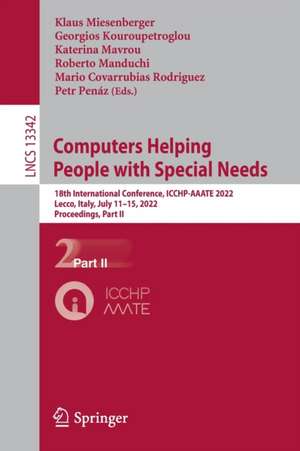
Computers Helping People with Special Needs: 18th International Conference, ICCHP-AAATE 2022, Lecco, Italy, July 11–15, 2022, Proceedings, Part II: Lecture Notes in Computer Science, cartea 13342
Editat de Klaus Miesenberger, Georgios Kouroupetroglou, Katerina Mavrou, Roberto Manduchi, Mario Covarrubias Rodriguez, Petr Penázen Limba Engleză Paperback – 20 iun 2022
The 112 papers presented were carefully reviewed and selected from 285 submissions. Included also are 18 introductions. The papers are organized in the following topical sections:
Part I: Art Karshmer Lectures in Access to Mathematics, Science and Engineering; Digital Solutions for Inclusive Mobility: solutions and accessible maps for indoor and outdoor mobility; implementation and innovation in the area of independent mobility through digital technologies; haptic and digital access to art and artefacts; accessibility of co-located meetings; interactions for text input and alternative pointing; cognitive disabilities and accessibility; augmentative and alternative communication (AAC): emerging trends, opportunities and innovations; language accessibility for the deaf and hard-of-hearing.Part II: Digital accessibility: readability and understandability; serious and fun games; internet of things: services and applications for people with disabilities and elderly persons; technologies for inclusion and participation at work and everyday activities; robotic and virtual reality technologies for children with disabilities and older adults; development, evaluation and assessment of assistive technologies; ICT to support inclusive education – universal learning design (ULD); design for assistive technologies and rehabilitation; assistive technologies and inclusion for older people.
11 Chapters are available open access under a Creative Commons Attribution 4.0 International License via link.springer.com.
Din seria Lecture Notes in Computer Science
- 20%
 Preț: 558.53 lei
 - 20%
 Preț: 571.88 lei
 - 20%
 Preț: 675.83 lei
 - 20%
 Preț: 1020.28 lei
 - 20%
 Preț: 851.78 lei
 - 20%
 Preț: 560.93 lei
 - 20%
 Preț: 633.70 lei
 - 20%
 Preț: 731.82 lei
 - 20%
 Preț: 1359.66 lei
 - 20%
 Preț: 620.33 lei
 - 20%
 Preț: 733.68 lei
 - 18%
 Preț: 945.44 lei
 - 15%
 Preț: 558.12 lei
 - 20%
 Preț: 793.92 lei
 - 20%
 Preț: 560.93 lei
 - 20%
 Preț: 748.63 lei
 - 20%
 Preț: 562.49 lei
 - 20%
 Preț: 1246.46 lei
 - 20%
 Preț: 449.81 lei
 - 20%
 Preț: 606.22 lei
 - 20%
 Preț: 620.33 lei
 - 20%
 Preț: 562.49 lei
 - 20%
 Preț: 560.93 lei
 - 20%
 Preț: 313.10 lei
 - 20%
 Preț: 828.44 lei
 - 20%
 Preț: 560.93 lei
 - 20%
 Preț: 314.86 lei
 - 20%
 Preț: 1033.45 lei
 - 20%
 Preț: 563.29 lei
 - 20%
 Preț: 733.68 lei
 - 20%
 Preț: 1137.10 lei
 - 20%
 Preț: 735.28 lei
 - 20%
 Preț: 1079.23 lei
 - 20%
 Preț: 584.42 lei
 - 20%
 Preț: 854.16 lei
 - 15%
 Preț: 672.87 lei
 - 20%
 Preț: 1032.47 lei
 - 20%
 Preț: 617.17 lei
 - 20%
 Preț: 1022.15 lei
 - 20%
 Preț: 984.64 lei
 - 20%
 Preț: 556.96 lei
 - 20%
 Preț: 402.28 lei
 - 20%
 Preț: 316.28 lei
 - 20%
 Preț: 663.69 lei
 - 20%
 Preț: 320.24 lei
 - 20%
 Preț: 343.12 lei
 - 20%
 Preț: 313.87 lei
Preț: 493.88 lei
Preț vechi: 617.36 lei
-20%
Puncte Express: 741
Carte tipărită la comandă
Livrare economică 08-22 decembrie
Livrare prin curier în România Termenul estimat este afișat lângă disponibilitate.
Transport gratuit pentru acest produs Plată online sau ramburs, în funcție de opțiunile comenzii.
Retur gratuit în 14 zile Comandă securizată și suport în română.
Specificații
ISBN-13: 9783031086441
ISBN-10: 3031086449
Pagini: 547
Ilustrații: XXVII, 547 p. 144 illus., 119 illus. in color.
Dimensiuni: 155 x 235 mm
Greutate: 0.8 kg
Ediția:1st ed. 2022
Editura: Springer International Publishing
Colecția Springer
Seria Lecture Notes in Computer Science
Locul publicării:Cham, Switzerland
ISBN-10: 3031086449
Pagini: 547
Ilustrații: XXVII, 547 p. 144 illus., 119 illus. in color.
Dimensiuni: 155 x 235 mm
Greutate: 0.8 kg
Ediția:1st ed. 2022
Editura: Springer International Publishing
Colecția Springer
Seria Lecture Notes in Computer Science
Locul publicării:Cham, Switzerland
Cuprins
Digital Accessibility: Readability and Understandability.- Digital Accessibility: Readability and Understandability.- Overlay Tools as a Support for Accessible Websites - Possibilities and Limitations.- Digital Authentication and Dyslexia: A Survey of the Problems and Needs of Dyslexia People.- Rethinking Alt Text to Improve its Effectiveness.- Password Challenges for Older People in China and the United Kingdom.- Digital Authentication for Visually Disabled People: Initial Results of an Online Survey.- Layered Audio Descriptions for Videos.- Serious and Fun Games.- Serious and Fun Games - Introduction to the Special Thematic Session.- Accessibility Improvement of Leisure Sports “M¨olkky” for Visually Impaired Players Using AI Vision.- GoalBaural-II: An Acoustic Virtual Reality Training Application for Goalball Players to Recognize Various Game Conditions.- Comparison of Guidelines for the Accessible Design of Augmented Reality Applications.- Internet of Things: Services and Applications for People with Disabilities and Elderly Persons.- Internet of Things – Services and Applications for People with Disabilities and Elderly Persons - Introduction to the Special Thematic Session.- Home Automation System Controlled through Brain Activity.- BUZZBAND: A Vibrating Wristband for Hearing-Impaired Elderly People.- Hands-free Interaction Methods for Smart Home Control with Google Glass.- Ontenna: Design and Social Implementation of Auditory Information Transmission Devices Using Tactile and Visual Senses.- Usability Study of Tactile and Voice Interaction Modes by People with Disabilities for Home Automation Controls.- Universal Access Panel: A Novel Approach for Accessible Smart Homes and IoT.- Technologies for Inclusion and Participation at Work and in Everyday Activities.- Technologies for Inclusion and Participation at Work and in Everyday Activities - Introduction to the Special Thematic Session.- A Review on Technological Solutions Supporting People with Dementia in the Activity of Dressing.- Testing an Augmented Reality Learning App for People with Learning Difficulties in Vocational Training in Home Economics – Central Results of the Project LernBAR (Learning based on Augmented Reality).- Working from Home in the COVID-19 Pandemic - Which Technological and Social Factors Influence the Working Conditions and Job Satisfaction of People with Disabilities.- Remote Working: A Way to Foster Greater Inclusion and Accessibility.- Robotic and Virtual Reality Technologies for Children with Disabilities and Older Adults.- Robotic and Virtual Reality Technologies for Children with Disabilities and Older Adults - Introduction to the Special Thematic Session.- Creating a Robot-Supported Education Solution for Children with Autism Spectrum Disorder.- A Wizaed of Oz Interface with Qtrobot for Facilitating the Handwriting Learning in Children with Dysgraphia and its Usability Evaluation.- POWERUP: A 3D-printed Exoskeleton and Serius Games for the Rehabilitation of Children with Motor Disabiilities.- Visual Impairment Sensitization: Co-designing a Virtual Reality Tool with Sensitization Instructors.- Assessing Professional Caregivers’ Intention to Use and Relatives’ Support of Use for a Mobile Service Robot in Group Therapy for Institutionalized People with Dementia – a Standardized Assessment Using an Adapted Version of UTAUT.- Development, Evaluation and Assessment of Assistive Technologies.- Development, Evaluation and Assessment of Assistive Technologies - Introduction to the Special Thematic Session.- A Model to Represent Knowledge about Assistive Products.- Buddy – a Personal Companion to Match People with Cognitive Disabilities and AT.- Towards an Inclusive Co-design Toolkit: Perceptions and Experiences of Co-design Stakeholders.- Evaluating a Visual Mobile Banking App for Users with Low Subjective Numeracy.- How to Ensure Continuity of AT Assessment Services for Frail People in Times of Pandemics: an Italian Experience.- Communication Styles as Challenges for Participatory Design Process Facilitators Working with Young People with Additional Needs in a Residential Care Setting - A Conversation Analysis.- ICT to Support Inclusive Education – Universal Learning Design (ULD).- ICT to Support Inclusive Education - Universal Learning Design (ULD) - Introduction to the Special Thematic Session.- Simulating the Answering Process of Dyslexic Students for Audio Versions of the Common Test for University Admissions.- Gauging Awareness of Accessibility in Open Educational Resources.- Usability of an Accessible Learning Platform - Lessons Learned.- Assessment Requirements of Disabled Students in Higher Education.- Video Screen Commentary System Supporting Online Learning of Visually Impaired Students.- Inclusive Education Going Digital: The Education of ,,Digital Scouts”.- Design for Assistive Technologies and Rehabilitation.- A Multidisciplinary Approach for the Designing and Realization of Customized High Performance Prostheses by Continuous Fiber Additive Manufacturing.- Mechanical Arm for Soft Exoskeleton Testing.- Hybrid Manufacturing of Upper-Limb Prosthesis Sockets with Improved Material Properties.- Sensor-based Task Ergonomics Feedback for a Passive Low-Back Exoskeleton.- Implementation and Evaluation of a Control System for a Hand Exoskeleton on Mobile Devices.- Design and Administration of a Questionnaire for the User-centered Design of a Novel Upper-limb Assistive Device for Brachial Plexus Injury and Post-stroke Patients.- Multimodal Wearable System for Motor Rehabilitation: Usability and Acceptability.- Training with a Mobile FES-cycling System: A Case Study with a Spinal Cord Injured Pilot to Investigate Performances Optimization.- Towards an Ontology-based Decision Support System to Support Car-reconfiguration for Novice Wheelchair Users.- A Model-based Framework for the Selection of Mechatronic Components of Wearable Robots: Preliminary Design of an Active Ankle-foot Prosthesis.- Pointing Gestures for Human-robot Interaction in Service Robotics: A Feasibility Study.- Assessment of the Usability of an Innovative Assistive Swimsuit.- Design of a Car Simulator to Assess Driving Capabilities in People with Disability.- Mixed Reality as Assistive Technology: Guidelines Based on an Assessment of Residual Functional Vision in Persons with Low Vision.- Characterization of the Response of Fiber Bragg Grating Sensors Embedded in a 3D Printed Continuous Fiberglass Reinforced Composite for Biomedical Applications.- Assistive Technologies and Inclusion for Older People.- Assistive Technologies and Inclusion for Older People - Introduction to the Special Thematic Session.- Ageism and Sexism amongst Young Technicians and Older People in China.- Ageism in Design: Accessibility without User Experience.- Addressing Privacy Concerns in Depth Sensors.- Assessing the Outcome of Mobility Assistive Technology (OMAT) in Daily Living: Preliminary Results in an Italian Sample.
Textul de pe ultima copertă
11 Chapters are available open access under a Creative Commons Attribution 4.0 International License via link.springer.com.