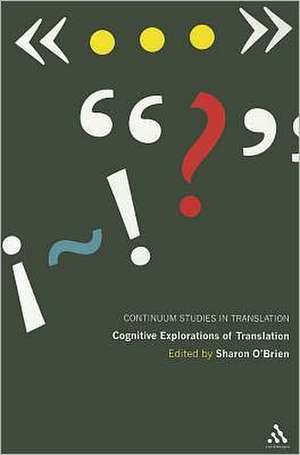
Cognitive Explorations of Translation: Continuum Studies in Translation
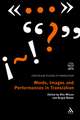
Editat de Dr Sharon O'Brienen Limba Engleză Paperback – 17 feb 2011
Central themes include modelling translation competence, construction and reformulation of text meaning, translators' behaviour during translation and what methodologies can best be utilized to investigate these topics. Techniques covered include eye-tracking, Think-Aloud protocols, keyboard logging and EEG (Electroencephalogram).
This book will be of interest to researchers and postgraduates in translation studies and cognitive linguistics as well as practicing translators.
Preț: 309.33 lei
Preț vechi: 387.41 lei
-20%
Puncte Express: 464
Carte disponibilă
Livrare economică 16-30 mai
Specificații
ISBN-13: 9781441172686
ISBN-10: 1441172688
Pagini: 256
Dimensiuni: 154 x 234 x 18 mm
Greutate: 0.47 kg
Ediția:New.
Editura: Bloomsbury Publishing
Colecția Continuum
Seria Continuum Studies in Translation
Locul publicării:London, United Kingdom
ISBN-10: 1441172688
Pagini: 256
Dimensiuni: 154 x 234 x 18 mm
Greutate: 0.47 kg
Ediția:New.
Editura: Bloomsbury Publishing
Colecția Continuum
Seria Continuum Studies in Translation
Locul publicării:London, United Kingdom
V-ar putea interesa
-
 Still Lost in TranslationCharlie CrokerPreț: 87.83 lei
 -
 The Interpreting Studies ReaderFranz Pochhacker-15%Preț: 474.54 lei558.27 lei
 -
 On TranslationPaul RicoeurPreț: 221.33 lei
 -
 Preț: 333.62 lei
 -
 -8%Preț: 407.84 lei443.30 lei
 -
 -15%Preț: 453.46 lei533.48 lei
 -
 Preț: 392.83 lei
 -
 Mouse or Rat?: Translation as NegotiationProf Umberto Eco-29%Preț: 63.05 lei88.20 lei
 -
 -24%Preț: 915.68 lei1204.85 lei
 -
 Quality In Professional Translation: Assessment and ImprovementDr Joanna Drugan-11%Preț: 355.95 lei399.96 lei
 -
 -24%Preț: 227.52 lei300.07 lei
 -
 The Pragmatic Translator: An Integral Theory of TranslationDr Massimiliano Morini-24%Preț: 265.46 lei350.58 lei
Cuprins
Introduction, Sharon O'Brien
1. Back to basics: designing a study to determine the validity and reliability of verbal report data on translation processes, Riitta Jääskelainen
2. Results of the validation of the PACTE translation competence model: Translation project and dynamic translation index, PACTE Group
3. Exploring translation competence acquisition: criteria of analysis put to the test, Susanne Göpferich, Gerrit Bayer-Hohenwarter, Friederike Prassl and Johann Stadlober
4. Development of translation competence in novices: a corpus design and key logging analysis, Heloísa Pezza Cintrão
5. Uncertainty management, metacognitive bundling in problem solving, and translation quality, Erik Angelone and Gregory M. Shreve
6. EEG, EYE and Key: three simultaneous streams of data for investigating the cognitive mechanisms of translation, Christian Michel Lachaud
7. Translation directionality and the revised hierarchical model: an eye-tracking study, Vincent Chieh-Ying Chang
8. Towards an investigation of reading modalities in/for translation: an exploratory study using eye tracking data, Fabio Alves, Adriana Pagano and Igor da Silva
9. Cognitive effort in metaphor translation: an eye-tracking study, Annette Sjørup
10. Distribution of attention between source text and target text during translation, Kristian T.H. Jensen
Glossary of Terms
Index
1. Back to basics: designing a study to determine the validity and reliability of verbal report data on translation processes, Riitta Jääskelainen
2. Results of the validation of the PACTE translation competence model: Translation project and dynamic translation index, PACTE Group
3. Exploring translation competence acquisition: criteria of analysis put to the test, Susanne Göpferich, Gerrit Bayer-Hohenwarter, Friederike Prassl and Johann Stadlober
4. Development of translation competence in novices: a corpus design and key logging analysis, Heloísa Pezza Cintrão
5. Uncertainty management, metacognitive bundling in problem solving, and translation quality, Erik Angelone and Gregory M. Shreve
6. EEG, EYE and Key: three simultaneous streams of data for investigating the cognitive mechanisms of translation, Christian Michel Lachaud
7. Translation directionality and the revised hierarchical model: an eye-tracking study, Vincent Chieh-Ying Chang
8. Towards an investigation of reading modalities in/for translation: an exploratory study using eye tracking data, Fabio Alves, Adriana Pagano and Igor da Silva
9. Cognitive effort in metaphor translation: an eye-tracking study, Annette Sjørup
10. Distribution of attention between source text and target text during translation, Kristian T.H. Jensen
Glossary of Terms
Index
Recenzii
Trainers of translators tend to know what a good translation is. This knowledge results from their teaching experience and their knowledge of the professional market, but not always from empirical research. The contributors to this volume help to change that state of affairs: they make use of various methods (think aloud protocols, keylogging, eyetracking and cued retrospection) and their results are of great interest to those in practical and theoretical translation studies.
This collective volume reflects recent trends in cognitive translation process research. Some articles deal primarily with theoretical and methodological issues; others show applications of introspective methods and software like keystroke-logging, screen recording, eye-tracking, pupillometrics and EEG. Several exploratory studies using various method combinations are reported and discussed. Aspects considered include translation competence development, uncertainty management, the cognitive load under different reading modalities or when translating from and into L1, eye-tracking of metaphor translation, distribution of attention between source text and target text, and limits on cognitive processing. In some of the studies, the cognitive effort involved in translating is investigated in groups with different degrees of expertise; processes of students or novice translators are compared with the processes of professional translators - with the primary aim of improving translation competence acquisition.
This collective volume reflects recent trends in cognitive translation process research. Some articles deal primarily with theoretical and methodological issues; others show applications of introspective methods and software like keystroke-logging, screen recording, eye-tracking, pupillometrics and EEG. Several exploratory studies using various method combinations are reported and discussed. Aspects considered include translation competence development, uncertainty management, the cognitive load under different reading modalities or when translating from and into L1, eye-tracking of metaphor translation, distribution of attention between source text and target text, and limits on cognitive processing. In some of the studies, the cognitive effort involved in translating is investigated in groups with different degrees of expertise; processes of students or novice translators are compared with the processes of professional translators - with the primary aim of improving translation competence acquisition.