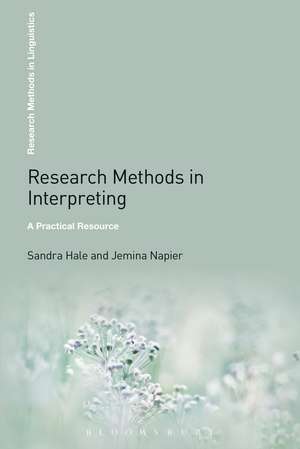
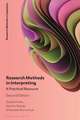
Research Methods in Interpreting: A Practical Resource: Research Methods in Linguistics
Autor Sandra Hale, Dr Jemina Napieren Limba Engleză Paperback – 5 dec 2013
A groundbreaking guide to research methods in interpreting, full of questions and examples.

Preț: 243.18 lei
Preț vechi: 314.62 lei
-23%
Puncte Express: 365
Carte disponibilă
Livrare economică 06-20 noiembrie
Livrare express 22-28 octombrie pentru 109.67 lei
Livrare prin curier în România Termenul estimat este afișat lângă disponibilitate.
Transport gratuit de la 400.00 lei Plată online sau ramburs, în funcție de opțiunile comenzii.
Retur gratuit în 14 zile Comandă securizată și suport în română.
Specificații
ISBN-13: 9781441168511
ISBN-10: 1441168516
Pagini: 288
Dimensiuni: 156 x 234 x 16 mm
Greutate: 0.45 kg
Editura: Bloomsbury Publishing
Colecția Bloomsbury Academic
Seria Research Methods in Linguistics
Locul publicării:London, United Kingdom
ISBN-10: 1441168516
Pagini: 288
Dimensiuni: 156 x 234 x 16 mm
Greutate: 0.45 kg
Editura: Bloomsbury Publishing
Colecția Bloomsbury Academic
Seria Research Methods in Linguistics
Locul publicării:London, United Kingdom
V-ar putea interesa
-
 -32%Preț: 545.13 lei807.01 lei
 -
 Preț: 435.30 lei
 -
 -30%Preț: 412.08 lei586.46 lei
 -
 Preț: 382.00 leiRecomandat
 -
 Preț: 423.39 lei
 -
 -25%Preț: 198.48 lei265.18 lei
 -
 -6%Preț: 346.70 lei370.61 lei
 -
 The Routledge Handbook of InterpretingHolly Mikkelson-8%Preț: 471.83 lei512.85 lei
 -
 Preț: 423.09 lei
 -
 Research Methods in LinguisticsDr. Lia Litosseliti-16%Preț: 213.58 lei252.95 lei
 -
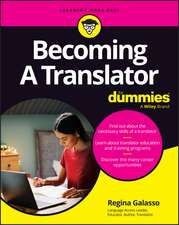 Becoming A Translator For DummiesRegina GalassoPreț: 112.69 lei
 -
 Research MethodsBob Matthews-13%Preț: 492.88 lei566.53 lei
 -
 -27%Preț: 87.48 lei120.66 lei
 -
 Research Methods in Clinical Linguistics and PhoneticsNicole MüllerPreț: 388.56 lei
 -
 Preț: 365.78 lei
 -
 Research Methods in Applied Linguistics: A Practical ResourceBrian Paltridge-22%Preț: 268.26 lei342.09 lei
 -
 Interpreting InterviewsMats AlvessonPreț: 416.12 lei
 -
 Collaborative Methods: Participatory Data Analysis in Feminist ResearchKaylan C. SchwarzPreț: 236.20 lei
 -
 Research Methods in InformationAlison Jane Pickard-19%Preț: 558.33 lei689.30 lei
 -
 Translating MigrationAngela Treiber-15%Preț: 449.12 lei528.37 lei
Cuprins
Chapter 1: What is research and why do we do it?
Chapter 2: Critical reading and writing
Chapter 3: Questionnaires in Interpreting research
Chapter 4: Ethnographic research on interpreting
Chapter 5: Discourse analysis in Interpreting research
Chapter 6: Experimental methods in interpreting research
Chapter 7: Research on interpreting education and assessment
Chapter 8: Conducting and disseminating interpreting research
References
Index
Chapter 2: Critical reading and writing
Chapter 3: Questionnaires in Interpreting research
Chapter 4: Ethnographic research on interpreting
Chapter 5: Discourse analysis in Interpreting research
Chapter 6: Experimental methods in interpreting research
Chapter 7: Research on interpreting education and assessment
Chapter 8: Conducting and disseminating interpreting research
References
Index
Recenzii
As a practitioner, researcher and educator in the field of interpreting for over two decades, I would recommend this book as an outstanding resource to anyone involved in interpreting or linguistics research.
This book is a blessing both for students making their first tentative steps into the world of research and also for more experienced academic staff who may be supervising dissertations and theses for the first time. It is a clearly written, step by step guide designed to demystify the often arcane field of linguistics research. Whilst aimed primarily at students and practitioners of Interpreting Studies, it could also be an excellent resource for students of other disciplines.
Hale and Napier's practical guide to research methods in interpreting provides a good and comprehensive overview of some of the more traditional and well-established empirical records in the field.
In a field so reliant on empirical studies using a range of methodological approaches, this timely book offers much-needed and eminently user-oriented guidance. Hale and Napier excel in combining a well-founded presentation of key concepts and techniques in empirical research with illustrative hands-on instruction. Rich in up-to-date sources and relevant examples, this volume is an invaluable asset to novice researchers and to the interpreting studies community at large.
This is a wonderful addition to the field of interpretation, offering structure and insight into the research methodologies that are available to researchers working with spoken and signed language interpreting. It also demystifies the research process by providing examples that are not only relevant, but that lead the reader to further sources of inspiration and knowledge. Napier and Hale have produced an excellent resource for emerging researchers, and our communities of practice will be the better for having this text.
Hale and Napier bring their expertise to co-author an outstanding pragmatic contribution to the Interpreting research field. The book provides insightful guidelines for Interpreting PhD candidates embarking on the research journey, as well as for Interpreting educators and students who could equally benefit from this articulate, insightful and methodically presented book.
[T]he first textbook which seeks to cover the needs of beginners, holistically and systematically.
This book is a blessing both for students making their first tentative steps into the world of research and also for more experienced academic staff who may be supervising dissertations and theses for the first time. It is a clearly written, step by step guide designed to demystify the often arcane field of linguistics research. Whilst aimed primarily at students and practitioners of Interpreting Studies, it could also be an excellent resource for students of other disciplines.
Hale and Napier's practical guide to research methods in interpreting provides a good and comprehensive overview of some of the more traditional and well-established empirical records in the field.
In a field so reliant on empirical studies using a range of methodological approaches, this timely book offers much-needed and eminently user-oriented guidance. Hale and Napier excel in combining a well-founded presentation of key concepts and techniques in empirical research with illustrative hands-on instruction. Rich in up-to-date sources and relevant examples, this volume is an invaluable asset to novice researchers and to the interpreting studies community at large.
This is a wonderful addition to the field of interpretation, offering structure and insight into the research methodologies that are available to researchers working with spoken and signed language interpreting. It also demystifies the research process by providing examples that are not only relevant, but that lead the reader to further sources of inspiration and knowledge. Napier and Hale have produced an excellent resource for emerging researchers, and our communities of practice will be the better for having this text.
Hale and Napier bring their expertise to co-author an outstanding pragmatic contribution to the Interpreting research field. The book provides insightful guidelines for Interpreting PhD candidates embarking on the research journey, as well as for Interpreting educators and students who could equally benefit from this articulate, insightful and methodically presented book.
[T]he first textbook which seeks to cover the needs of beginners, holistically and systematically.
Notă biografică
Sandra Hale is Professor of Interpreting & Translation and Chair of the Research Committee at the School of International Studies at the University of New South Wales, Australia.